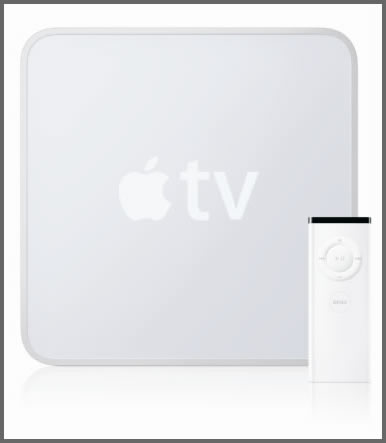
 After weeks of speculation and one official delay by Apple last month, Apple has now announced that they are shipping the Apple TV unit from today.
From its name, you’ll guess that it’s an Apple unit to be connected directly to a TV, giving the chance to listen and watch content via the iTunes software. The WSJ, who have had it for the last 10 days, is reporting that the unit can only be used with Widescreen TVs, as there isn’t support for 4:3 screens – a surprising limitation. They also report another limitation – the screen can only be connected to the Apple TV via HDMI cables or component jacks.
To get the most out of it, the diminutive Apple TV (it’s only 8 inches square) cannot be used as a stand-alone unit, but must be used in conjunction with either a Mac running OSX, or a PC running XP – both of which need to be running iTunes 7.1 or later. The direct to Internet connectivity is currently very limited, only giving access to film trailers and the like.
(We wonder if the lack of support for Windows Vista is a deliberate move).
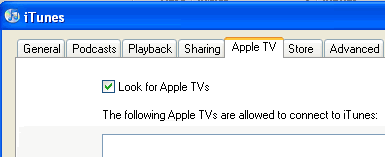
Related to that, we recently noticed when we installed iTunes on our latest PC, that it already has support for Apple TV built in to it in the Preference settings (see image).
Getting around the different forms of content is done by the Apple Remote, so a keyboard/mouse combination is not required.
The content gets to the Apple TV via cabled-Ethernet, or WiFi, running at the yet-to-be-ratified 802.11n, which has a theoretical maximum speed of 540 Mbps.
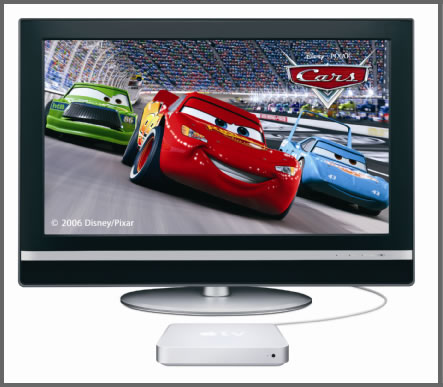 The unit has a 40Gb hard drive that Apple says can “store up to 50 hours of video, 9,000 songs, 25,000 photos or a combination of each and is capable of delivering high-definition 720p output.”
It’s with some amazement that we’re seeing official Apple comments about a product coming from someone apart from The Steve, to that end Philip Schiller, Apple’s senior vice president of Worldwide Product Marketing enthused that “Apple TV is like a DVD player for the Internet age—providing an easy and fun way to play all your favourite iTunes content from your PC or Mac on your widescreen TV.”
Apple tell us that it’s shipping from today, priced at £199 in the UK and $299 in the US.
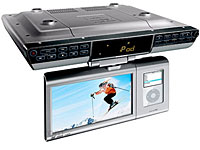 Designed to be fitted under a kitchen cabinet, the Philips DCD778 sports a flip down 8.5-inch widescreen LCD display with an iPod docking bay (compatible with fourth- and fifth-generation iPods, the iPod mini, and iPod nano).
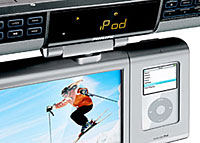 For a bit of Jonathan Ross while you create your Master Chef-challenging creations, there’s a digital AM/FM tuner onboard as well as a cooking timer and clock, and wireless remote.
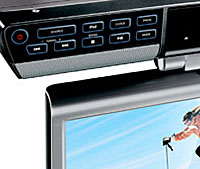 The Philips DCD778 Docking Entertainment System is expected to start shipping in the US next week for around $400, although there’s no news on a UK release.
 Despite a
  HDForAll are a pressure group made up of TV manufacturers, retailers and public service broadcasters including DSGI, Samsung, Sony and Toshiba and BBC, ITV, Channel 4 and Five. They’re keen to remind people that there’s only a limited amount of time left to contact Ofcom to make their views known on auctioning off spectrum to the highest bidder. Background on this and how to respond are available on
  The upload speed will also be upped to 768Kbs, not exactly setting the uploading world alight, but better than a poke in the eye with a stick, non?
 It’s quite an interesting approach that’s worthy of a little attention, especially as this will form the basis for the approach for the rest of the UK.
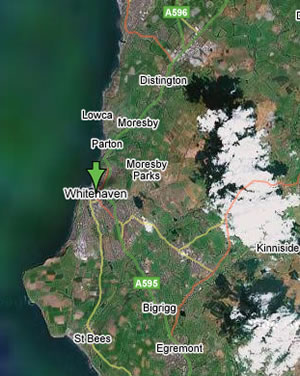 Back in June last year, we heard that
 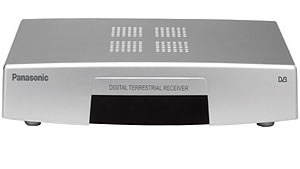 The quarterly report snappily titled, Communications Market: Digital Television Progress Report, covering the fourth quarter of 2006 (October-December), shows the figures are up from 39% in the same period the previous year, and also from 44.7% in the Q3 2006.
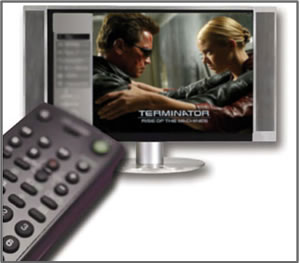 Research house iSupply are predicting that IPTV will be boosting the reveneue generated by the premium video services market from its current level of less than $200Bn to a whopping $277Bn by 2010.
 That aside, iSupply see the battle royal between two big, hairy beasts – the current pay-TV world of direct-to-home satellite and digital and analogue cable TV services – and the telcos who will be pushing quad-play.
 The frost started back in November last year when Virgin’s Richard Branson complained about Sky buying a £940m holding in the UK broadcaster, ITV. Branson jumped up and down and generally said how unfair it was.
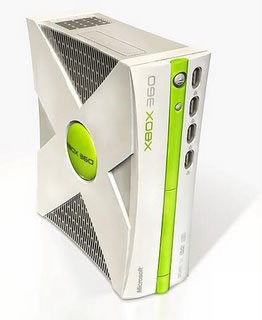 It’s had an outing at CES in January this year and was well received.