As if having someone hand you their mobile and insist that you’d be bored to death looking at their collection of blurry, “here’s me drunk with my mates” videos wasn’t bad enough, it looks like things are set to get a lot worse.
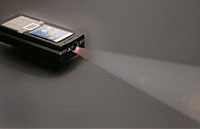 At the CTIA Wireless 2007 show in Orlando, Florida, tech firm Texas Instruments has been giving public demonstrations of its digital light processing (DLP) ‘pico’ projector – a teensy weensy movie projector that’s small enough to wedge into a mobile phone.
“How does it all work?” we hear you ask. And the answer is, “with clever stuff that we don’t quite understand.”
We can tell you, however, that the mini-projector sports three lasers, a LP chip and a power supply, with the whole caboodle measuring just 38mm, making it technically possible to fit in all the gubbins inside a normal sized phone.
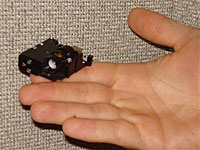 Using the phone projector (“phonejector?” “prophonetor”?”), the mobile phone will eventually be able to beam DVD-quality video on to a screen or a wall, making it a workable portable video player or TV.
However, the prototype is currently only capable of displaying an image about the size of an A4 sheet of paper (8.5×11-inches) at a rather humble HVGA (640×240) resolution in “ambient light conditions” (i.e. it’s not very bright).
We understand that for some of you, the prospect of filling giant walls with the handheld highlights of the office party may prove a compelling attraction, but we’re afraid that you’re going to having to wait: TI has not announced when it will actually start producing projectors for the mobile phone market.
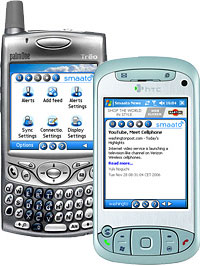 Smaato News is a RSS reader for smartphones that lets users read RSS feeds of their favourite Websites and blogs and get other information on the move.
 Although the application is free, the program is supported by adverts which appear on the top section of the screen (“if you see something interesting, don’t hesitate to click,” implores their manual, rather optimistically).
 Microsoft’s Corporate VP Bill Veghte was clearly a chuffed fella, “We are encouraged to see such a positive consumer response to Windows Vista right out of the gate,” he purred in an official statement released on Monday.
 The figures seem to stack up well against the 17 million copies of Windows XP sold in the two months following its release in 2001, but the PC market has increased exponentially since then: according to IDC, total worldwide PC shipments hit 136 million units in 2001, a figure dwarfed by last year’s 227 million total sales.
 Although Windows marketing director Bill Mannion acknowledged that the upgrade program had nudged the sales figures in an upward direction, he played down the numbers saying that upgraders didn’t make up the “core component of the 20 million.”
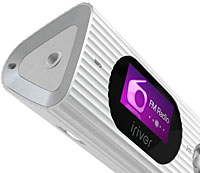 A tiny 1-inch 128 x 64, 65k colour CSTN LCD display gives status feedback and if the promo pics are anything to go by, it’s a mighty fine looking little screen too.
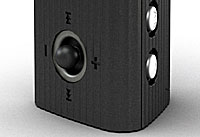
 The unit also packs in a handy FM tuner and voice recorder, with functions controlled by a wee joystick.
 FM Radio Yes
 Sitting on the tube, opposite such an ad, I figured that there were only two possible companies which could be accused of controlling 80% of information on the Web; it could plausibly refer to either Internet Explorer’s market share (and would therefore be an advert for Firefox) or Google’s market share. Since I knew Mozilla wasn’t planning any advert like this, I assumed that it was a competitor to Google, and concluded it was probably Ask (since neither Yahoo or Microsoft would manage to think outside the box to such an extent). However, I dismissed that idea instantly as it seemed so unlikely that a well respected company would attempt such a pathetic campaign, and that therefore it must be some new search engine with far too much venture capital. By that point I had lost interest, and began examining the ventilation panel.
 GodTube, you won’t be surprised to hear, shows videos that praise god. It’s yet to launched, with the expected out-of-beta date being 1 May.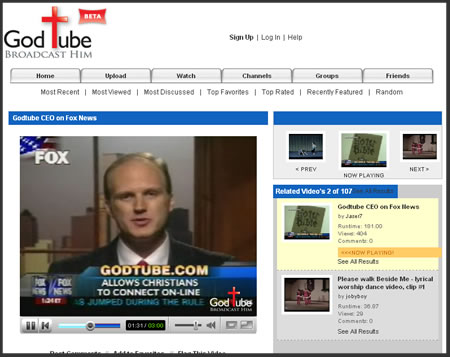
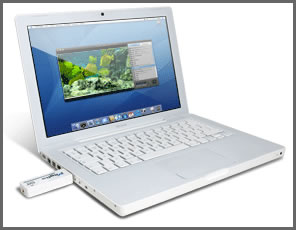 Miglia have not only signed a deal with software suppliers Equinux, but have a package available already with the software, called The Tube. They’re calling the hardware and software bundle the TVMini Express.
 Equinux are confident with the swift reaction of the software, as they tell us it was written “from the ground up” in Cocoa, Apple’s object-oriented application environment designed specifically for developing Mac OS X-only native applications. ie it wasn’t written for Windows and ported over to the Mac.
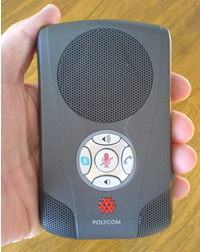 We mourned the lack of Mac and Linux support. Given that all Polycom needed to do was write a driver or two to get it running, we were disappointed that there was no movement on this