 With Sony and Toshiba still enjoying a schoolyard scrap over which of their rival formats should become the standard format for next-generation DVDs, Samsung have announced a nifty compromise that plays both formats.
With the ghost of Betamax still casting long shadows over weary consumers, Samsung have decided to soothe buyer indecision by offering a player that supports both Sony’s Blu-Ray Disc and Toshiba’s HD DVD standards.
In an interview in the Financial Times Deutschland, Samsung’s consumer electronics big cheese, Choi Gee-Sung, announced that the machine will launch sometime next year.
“We would welcome a unified standard but if this doesn’t come, which looks likely, we’ll bring a unified solution to market,” he said.
“It won’t be simple but you’ll see our solution in the coming year. Consumers will be too confused otherwise,” he added.
The bun fight between the two next-gen DVD camps has been dragging on for what feels like an eternity, with initial hopes of an agreement in April 2005 falling apart by August.
See: Unified DVD Format Trouble Confirmed
All this faffing about with different formats is sure to hold back punters who don’t fancy being lumbered with this year’s Sinclair C5, but pundits are hopeful that dual-play machines could prove the key to breaking the deadlock.
 Although both Blu-Ray and HD DVD use groovy blue laser light to dramatically increase the storage capacity of a DVD-sized optical disc, they work in completely different ways.
The two formats employ different capacities, optical specifications and file structures, so Samsung’s new dual-format player will have to supplement its red laser (for current CDs/DVDs) with at least two other read heads for the blue-laser discs.
All that extra electronic wizardry suggests that their combo player is not going to be cheap, potentially putting off consumers wooed by the prospect of future-proof compatibility.
All of which adds to the industry pressure for stubborn Sony and tenacious Toshiba to sort out their differences in double quick time.
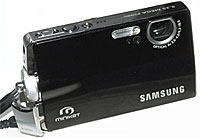 Samsung have unveiled their sleek, credit-card sized Miniket VP-MS15 digital camera at the Berlin IFA show.
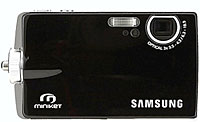 Connecting the Miniket via USB 2.0 also lets it be used as a Webcam or a ‘portable hard drive’.
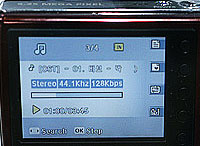 Samsung have also released two identical-looking smaller brothers to the MS15; the VP-MS11, with 128MB of onboard memory. and the VP-MS10 with 64MB.
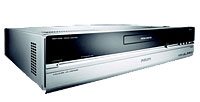 Philips has announced the Showline MCP 9350i, a media PC powered by Microsoft’s Windows XP Media Center Edition 2005 platform.
 There are two integrated tuners onboard letting sofa-reclining types watch one channel while recording another on the 250 GB hard drive or to CD or DVD.
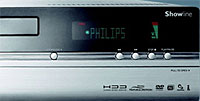 Philips’ Digital Natural Motion technology is employed to improve video quality and reduce stutter, with built in support for the UPnP protocol to allowing the unit to act as a media server for products in Philips’ Streamium range of media viewers.
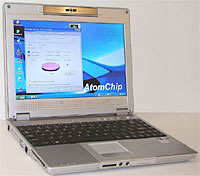 UPDATE – Thanks for the number of people who have written to us about this one, lead by Matt Lacey.
 The 6.8GHz behemoth is powered by AtomChip’s Quantum II processor (or four 1.7GHz Intel Pentium M processors) with a terabyte of Quantum-Optical non-volatile RAM (NvIOpSRAM-SODIMM 200-pin) onboard.
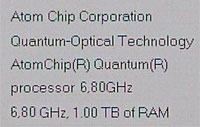 Despite the nation-threatening amount of power on hand, Atom Chip are claiming an impressive battery life of approximately 8 hours for the AtomChip II processor and 3 hours for the 4 x Intel Pentium M processor version.
 Skype has slapped hands and manfully patted backs with German network operator E-Plus as the VoIP giant secures their first 3G partnership.
 The busy-bee Skypesters are said to be already hatching up schemes with a number of major handset and headset manufacturers – including Motorola – to develop a broader range of offer Skype-ready devices
 Skype currently claims more than 2.8 million Skype users in Germany.
 In a damning blow to the UK government’s love affair with identity cards, a British criminologist has warned that the new technology could actually increase, rather than solve, the problem of identity theft and fraud.
 “Studying the way that individuals disclose sensitive information would be far more valuable in preventing identity fraud than the evolution of technologically advanced but ultimately fallible measures to prevent misuse of personal information after it has been obtained,” she added.
 Prototype cellphones capable of transmitting data faster than a startled squirrel on speed have been demonstrated by NTT DoCoMo in Japan, according to the New Scientist.
 During the tests, another smartypants wireless networking trick was employed to send data via various routes across a network to further increase data capacity.
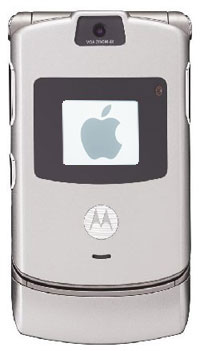 Pop stars are falling over themselves to fill their pockets with corporate cash as the Apple/Motorola iTunes phone promotion machine switches into overdrive.
 The Brand Republic article goes on to say that, “The ads may debut from next week, at the same time the Motorola phone with iPod personal music system is launched.”
 For the first time since its UK launch May 2004, the online music store Napster has dished the dirt on its usage and membership figures for the UK.
 This represents an amazing turnaround for Napster who famously started life as the brainchild of an 18-year-old college dropout named Shawn Fanning in 1999.
 Napster folded in September 2002, but the brand was revived as a legal P2P service by the owners of the Napster name Roxio in 2003, quickly growing to become a major competitor for market leader iTunes.
 After having made the UK wait nearly 9 months since the launch of the
  Those UK’ers who couldn’t wait for the much-desired, multi-media device to arrive had an avenue closed to them after Sony successfully took legal action against grey-importers of Japanese and US equipment.