 Sony is gearing up to launch a rival to popular online virtual world Second Life later this year. Playstation Home is a massively-multiplayer online game (MMO) in which a user adopts an avatar (a digital character which represents them) which they are then free to move around a virtual world, interacting with other avatars. In their Developer FAQs (PDF), Sony describes the project:
Home™ is a real-time 3D, networked community that serves as a meeting place for PLAYSTATION3 (PS3) users from around the world, where they can interact, communicate, join online games, shop, share content and even build and show off their own personal spaces.
It looks like Home may well be going beyond Second Life in a few areas. Gaming is the most obvious, perhaps unsurprisingly given the link to the Playstation. Users will be able to play various different arcade games around the virtual world through their avatars. So I might decide to go for a virtual drink in a virtual pub with my virtual friends, and I would then be able to have a virtual game of pinball on a virtual pinball machine. You get the idea.
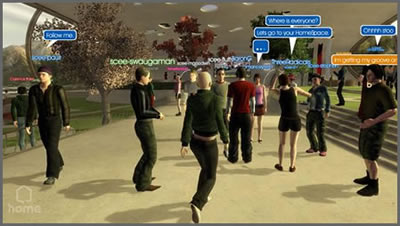
Probably more interesting is the ability to meetup with someone in Home, and then play a Playstation game with them over the Internet. Whilst the playing over the Internet idea is far from new, it is a unique way to approach it. It adds a social dimension to game play (along with the included voice chat) which could possibly make Internet gameplay far more addictive.
Sony are also taking user generated content seriously; as a user of Home I will be given, for free, an apartment, which I can then hang my own pictures up in and customise to my heart’s content, presumably buying various virtual items from Sony to add to my dream virtual home.
UGC is absolutely crucial for such games; it creates a feeling of ownership over the game for every individual user, making it far more sticky.

Commerce is not being overlooked. Sony state in their FAQs that:
Home prioritises community and entertainment over ecommerce. That said, we believe that there will be ample opportunities for businesses and individuals alike to generate significant revenues from the Home platform.
This is similar to the approach taken by Second Life and other MMO games, and it makes a lot of sense. Sony, and others who set up business in Home, will be able to make vast sums of money selling things which do not really exist and which cost little or no money to develop. In the modern world of games consoles being sold at a vast loss, manufacturers are looking at every possible avenue to create additional revenue streams.
Second Life has been hyped enormously, with pop concerts and press conferences from real bands and companies happening exclusively within Second Life. Despite this, I have always held Second Life in the greatest disdain; I spent about 15 minutes playing it some time ago and was struck by the pointlessness of it all. Whilst there are many, many people who are fans of such games, I have rightly or wrongly assumed that they are either people without a social life, who are fascinated in the technology or who are only able to create meaningful friendships through such a program.
I do not, however, treat Playstation Home with the same disdain. It seems that Home has a purpose, namely gaming, which should give the whole virtual world meaning. If I were able to afford a Playstation 3, I think I might well enjoy a quick stroll around Home to find someone to play against, and then actually playing the game with them. In Second Life all that is possible is the stroll, and I think that if virtual worlds are to live up to the hype, they have to offer more than a stroll.
[Engadget was a useful source]
Huw Leslie is editor of UK-based Web 2.0 and software blog Gizbuzz. He is the co-founder of the Oratos Media technology blog network, and his personal blog is For Crying Out Loud!
 Although some may already feel that walking around Brixton is akin to taking a stroll around another planet, we began to think we might have been transported to a parallel universe when we spotted bright garish yellow billboards appearing all around town exclaiming, “THEY WANT YOUR POD!”
 In smaller text underneath the screaming headline, “BEWARE” the sign goes on, “Street robbers are targeting persons using mp3 music players in this street!”
 Although the sign doesn’t actually tell you what to do to prevent being ‘jacked’ (
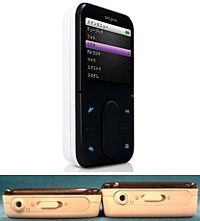 Fresh outta hi-tech Fat Farm, the new Zen Vision M and W models have managed to reduce their bulk by 15% on previous versions while wedging in a bigger hard disk.
 The rather desirable little fella weighs in at a light as heck 170g (and that includes the battery) and comes with a 2.5 inch colour screen.
 Vision W
 When?
When? Until then, Miglia has been bundling Elgato’s TVEye software with their digital TV DVB-T/Freeview/TNT tuners.
 BT is under a legal obligation to provide phone boxes up and down the length of the UK, which they claim numbers 63,795. BT say that 40,500 of these phone boxes are unprofitable.
 Last week Microsoft went on a PR offensive to promote the new format, despite them having
  In the interview with German weekly magazine Focus, published today, she poses the following question, “”Do you think it’s fine that a CD plays in all CD players but that an iTunes song only plays in an iPod?” It’s followed by a couple of words that are going to make uncomfortable reading for Apple, “I don’t. Something has to change.”
 Three Quarters Of Consumers Naffed Off With Mobile Web
 Mercer joined Apple in 1987 and was the lead designer of Version 7 of the Macintosh finder before founding a software tools firm called Pixo which was involved in designing the first version of the iPod user interface.
 Voice-recognition software, Apple’s most advanced to date, can recite a speech highlighting the features of the device while injecting several clever digs at competitors.
 After growing tired of endless beer-fuelled, late night rummages around the house for a mountain of easily-lost remote controls, we thought we’d check out an all-in-one controller.

 The Kameleon only managed to find one set of codes that immediately worked on our devices; there was nothing for our 3 year old AV Yamaha amp and it neither had codes for our new Humax PVR nor wanted to learn any either (the learning process involved us continually bashing a single button, but the remote kept quitting before it found anything for the PVR).
 By this time we were beginning to harbour thoughts about how far we could throw the streamlined remote, but thought we’d drop One For All a line for help instead.
 Moreover, we were reminded of the shortcomings of ‘virtual’ buttons versus real hardware buttons – groovy glowing buttons emerging from the darkness of a black remote may look the stuff of Spock, but ‘real’ buttons remain easier to use and more responsive to the touch (something that those dreaming of an iPhone might want to consider).
 This just feels wrong on just about every level we can think of, but in an attempt to reach out to Da Yoot, the US Army have created a slick and highly polished MySpace recruitment site.
 A warning next to the psychopathic-looking Sgt Star warns, “The information you enter is to be used only for recruiting Soldiers into the U.S. Army and the Army Reserve.”
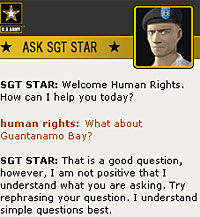 We apologised: “OK. Sorry. We want to go to Iraq and bomb some soft Johnny Foreigners back into the Stone Age in the name of peace.”
 Clearly a sizeable wad of defence budget has been thrown at the slick game, which purports to offer realistic battlefield scenes (although we couldn’t find any options to rain friendly fire on Brit troops and then try and cover up the investigation afterwards.)
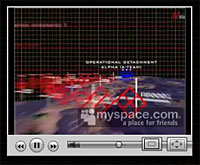 Of course, there’s sound business reasoning behind the US Army shoving its shiny size nines onto a social networking site like MySpace, with the site able to interact with the community, make friends and receive comments and – possibly – make the Army look vaguely cool and enticing.