The European Commission has dished out formal charges to Apple and ‘unnamed major record companies’, accusing them of restricting music sales in Europe.
 The EU alleges that agreements between Apple and the record companies are guilty of breaking European Union rules that prohibit restrictive business practices. It’s far from the first time that the EU and other Northern European Countries has got wound up about Apple and iTunes.
“Consumers can only buy music from the iTunes online stores in their country of residence and are therefore restricted in their choice of where to buy music, and consequently what music is available and at what price,” said Jonathan Todd, European Commission spokesman.
 “The statement of objections alleges that distribution agreements between Apple and major record companies contain territorial sales restrictions,” he added.
Promptly shifting the blame on to the record companies, Apple insisted that they’d tried to operate a single pan-European iTunes store accessible to peeps from any member state but were foiled by music labels and publishers imposing legal limits on the download rights.
The Commission first got involved back in 2005 after the UK consumer group Which? pointed out that iTunes purchasers in France and Germany were paying far less than us poor chumps in the UK (67 pence against 79 pence).
 Apple and the record companies now have two months to defend themselves in writing or take part in an oral hearing which usually happens around a month after a written reply has been received.
This latest development is unrelated to yesterday’s deal between Apple and EMI.
 The report found that half of all UK adults live in broadband-connected households, up 11% from 12 months ago and a hefty seven times increase from 2002.
 Although just under half of users had no idea how fast they were connecting to the Internet, the report put the average headline connection speed at 3.8Mbps (up from 1.6Mbps in 2005).
 It wasn’t the
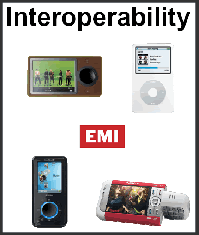
 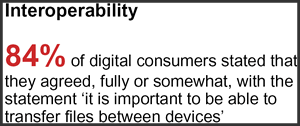 “We are going to give iTunes customers a choice — the current versions of our songs for the same 99 cent price, or new DRM-free versions of the same songs with even higher audio quality and the security of interoperability for just 30 cents more,” said Steve Jobs, Apple’s CEO.
 Keen not to miss out on the quote-fest, Eric Nicoli, CEO of EMI Group, piped up: “EMI and iTunes are once again teaming up to move the digital music industry forward by giving music fans higher quality audio that is virtually indistinguishable from the original recordings, with no usage restrictions on the music they love from their favourite artists.”
 If you travel around the UK a lot and find the homogenisation of High Streets into identical rows of bland coffeeshop multinationals a deeply depressing experience, you may find
  Delocating the world
 With Starbucks promising to open a new branch
 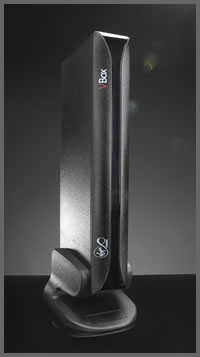 Virgin Media has ramped up the availability of its quadplay (broadband, phone, mobile and TV) services beyond its cable franchise network with today’s announcement of a new digital TV service.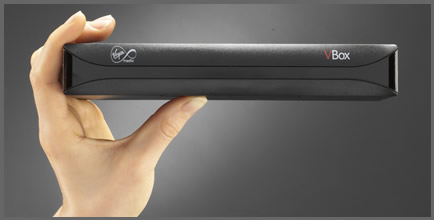
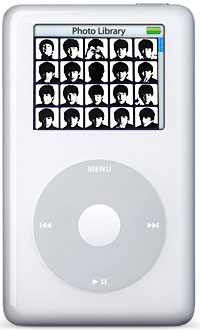 Yesterday, record company giants EMI Group PLC announced that it planned to unveil “an exciting new digital offering” with Steve Jobs and the gang at Apple, leading pundits to conclude that The Beatles’ music catalogue is finally about to be made available through Apple’s iTunes online music store.
 The Beatles have famously refused to sign up to iTunes and other online music services for years, and many expect the download charts to be instantly filled up with the Fab Four’s songs as soon as their catalogue becomes available.
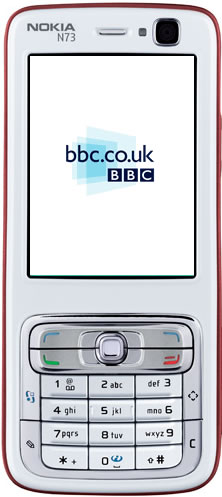 Three UK operators will be taking part, Orange, Vodafone and 3 giving subscribers to the trial the ability to watch BBC One, BBC News 24 and BBC Three streamed on their mobiles. Beyond some sports programmes and programmes where they don’t have the necessary rights.
 The idea behind the .xxx p0rn domain extension (or Top Level Domain TLD, in domain -ese) has been floating around for a
 Although digital cameras make it easy to quickly snap product shots, the built in flash often creates unflattering shadows and reflections, so Lastolite are hoping that people will be prepared to shell out for their economy-priced ePhotomaker kit.A much smaller and less complex affair than the three hundred quid
  Also lurking in the bag is a sheet of blue ‘gel’ (to compensate for the yellow hue of the average light bulb) and two crocodile clips for attaching it to a desk lamp.
 Conclusion
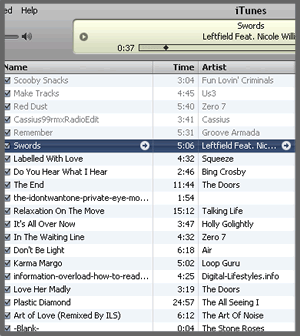 Today they’ve announced it’s for real. The new Complete My Album will give iTunes users 79p credit per track for each track on an album that they decide to purchase, if they’ve bought the tracks individually first.