 According to a study by IDC, instant messaging in the business world is going bonkers and looks set to continue its huge growth, but experts are warning of security risks.
Their research found that the worldwide enterprise instant messaging market (which includes instant messaging server products as well as enterprise instant messaging security, compliance, and management products) leapt 37% in terms of year-over-year revenue in 2004, and is expected to skyrocket from $315 million in 2005 to $736 million in 2009.
“With more than 28 million business users worldwide using enterprise instant messaging products to send nearly 1 billion messages each day in 2005, and many more crossover corporate consumers who use consumer instant messaging networks in the workplace, these products are clearly reaching more mainstream users,” said Robert P. Mahowald, program director for IDC’s Collaborative Computing research.
“Especially in compliance-driven sectors like Wall Street, financial services, and government, instant messaging is a critical differentiator. In the next few years, IDC expects instant messaging – once the plaything of teenagers – to continue to grow into its role as a substantial business collaboration application,” he added
 The growth in the enterprise segment is being fuelled by domestic users of IM tools like MSN Messenger bringing their online chatting habits into the work place and using the service as a business collaboration tool.
The report identified financial services and the public sector as the keenest to take up enterprise IM, with business IM monitoring and archiving tools able to keep a watchful eye on yapping employees.
According to a recent Gartner poll, instant messaging is now used in 70% of all companies, but figures from the Yankee Group reveal that only 15-20% of those companies operate IM administration, leaving 50% of office IM use unmonitored.
This wouldn’t appear to be the brightest idea as a new IMLogic study reveals that an increasing number of virus authors are starting to focus on IM clients as virus spreading agents.
 IMLogic says that the attacks on the IM clients have reached record values – up 14 times on last year – with the complexity of the attacks also increasing.
The company’s IM monitoring service showed that MSN Messenger suffered the highest attack rate at 62% of the reported cases, with AOL’s AIM client coming at second with 31% of the attacks and Yahoo third with 7% of the attacks targeting their client.
IMLogic’s research found that the majority of the attacks were worm-based (87%) with 12% of the attacks aimed at spreading a virus.
 BT will roll out IPTV in ‘late summer 2006’, according to Andrew Burke, CEO, BT Entertainment, (pictured right) speaking at the Enhanced TV Show in London today.
 Elena Branet, Senior Marketing Manager at Microsoft TV, (pictured left) said IPTV would allow viewers to use picture in picture channel surfing, see caller ID on their TV sets, or watch TV while messaging a virtual community of friends and family. She said that basic IPTV would be possible with a minimum connection speed of just 1.5 MB.
 Also at the show, David Bainbridge, MD of Yes, Yoo Media, (pictured right) said trials of a new product, ‘Broadband TV’ would start on ntl in October. Not to be confused with IPTV, this is a solution to help content creators repurpose content across platforms – working with cable TV, IPTV and 3.
 It’s funny, laugh!
 Ew… That’s not nice!
 Flogging a dead horse… Literally
 From deep within the Microsoft base, Bill Gates has pulled a few levers and dispatched a corporate grabbing tentacle in the direction of Teleo, a privately held provider of VoIP software and services.
 The San Francisco-based outfit Teleo was founded just two years ago and got as far offering a beta PC to PC or standard phone Skype-like VoIP service with click-to-call dialing through Microsoft Outlook and Internet Explorer before Gates grabbed the product.
 Terms of the deal haven’t been disclosed, but Microsoft have said that members of the Teleo executive team will continue to work closely with MSN, while some Teleo product developers are expected to shuffle across and join MSN.
 It’s Tin For Win95
 Browse the Web on PSP
 The Register is running a
  Upgrades To Flight Mode
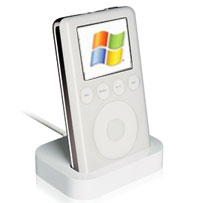 Apple may be forced to shell out royalties to Microsoft for every single iPod it sells after it emerged that Microsoft was first to file a crucial patent on technology used in its iPod.
 The application doesn’t identify the iPod by name (usual for such petitions), describing a “portable, pocket-sized multimedia asset player” capable of managing MP3 music files including “a song title, a song artist, a song album, a song length”
 Microsoft has launched the first public beta of its Virtual Earth, an online mapping application overlaying satellite images with local searches and maps.
 Virtual Earth will also have the capability to visually point out locations for ATMs, restaurants, and petrol stations – something that the rival Google Maps service has been able to do since incorporating satellite imagery in April this year.
 Mac users, however, will have to wait until autumn for a version that runs on their machines.
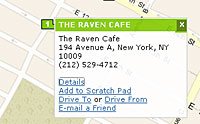 Wags on the Internet are claiming that Microsoft has virtually wiped Apple off the face of the Web, noting that Apple’s Silicon Valley headquarters – which can be seen in their full glory on Google Maps – appears as nothing more than a deserted parking lot in Virtual Earth.
 Microsoft Wants To Own Emoticons
 Sony Whips Out A White PSP
 Google Grabs 47% Of All Searches Online
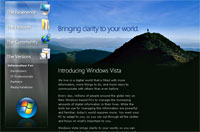 After a morning of fishwife-hot rumours, it’s been officially announced that the next version of Microsoft Windows – previously code-named Longhorn – will be known as Microsoft Vista.
 Possibly because of a fear of failing to release the product in the year bearing its name, Microsoft has once again shied away from its earlier practice of releasing dated operating systems (Windows95, Windows98 etc).
 The ability to disconnect from the world has taken a further blow as Vodafone and Microsoft announce a global tied up to offer MSN Messenger IM to Vodafone’s mobile phone customers. People sitting at their MSN Instant Messaging (IM) client on their computers will be able to carry out chats with their Vodafone carrying chums.
 Putting on his best tech-savvy face, Peter Bamford, Chief Marketing Officer for Vodafone glowed, “IM is a growing part of the increasingly important mobile messaging market. By bringing our collective customers together, we’ll deliver more options for staying in touch when messaging. Our agreement will grow IM and SMS, meaning additional revenue for Vodafone.”
 While we didn’t get to any exact figures, we were able to find out the service will be charged on the basis of each message sent. This will cause current IM users to radically change the way they use IM. No more will they be quickly replying with short witticisms, but will need to become more Bard-like in their compositions – if they don’t want to end up with huge bills at the end of the month.