All of you budding code-aholics take note, Google is hosting ten Google Developer Days in their various offices around the world on 31 May.
They’re going to have workshops, keynotes and breakout discussions on Google’s APIs and developer tools.
Google have been running a few of these already with much smaller capacity. A few have happened in Silicon Valley and a couple in London that we’re aware of, but this is on a much bigger scale.
 The program is being headed up by code-fan pin-up girl Marissa Mayer, who’s Google’s Vice President of Search Products and User Experience. She was one of the first 20 people to join Google (just imagine her stock options!) and the first female engineer hired by them.
They’re rolling out some of their top talent to get the code-kids hot under the collar. Get ready for this …
Guido Van Rossum, Google software engineer and creator of the Python programming language (Beijing); Chris DiBona, Google open source programs manager (London); Mark Stahl, Google data APIs tech lead (Madrid); Bruce Johnson and Joel Webber, co-creators of the Google Web Toolkit (Mountain View); Bret Taylor, group product manager for Google developer products (Mountain View); Lars Rasmussen, Google Maps senior engineer (Sydney); and Greg Stein, Google engineering manager and chairman of the Apache Software Foundation (Tokyo).
The subjects they’ll be covering also sound pretty enticing. Here’s a cross section, “Developing with Geo: Google Maps, Google Earth and SketchUp,” “Tools for Better Web Development: The Google Web Toolkit, Open Source and Other Developer Initiatives” and “Mashups and More: AJAX, Google Gadgets and the Google Data APIs.”
What does Google get out of this?
Google’s going to be lashing all of their cash, time and resources on this, so what’s driving them?
 Well, people become more familiar with how to write programs to use their applications via the published API’s, which means the potential for extra advertising income for Google.
That’s all well a good but more importantly, Google get to spot the hottest programming talent around the world and can in turn try to persuade that talent to join the Google gang. Meaning Google ends up with the best programmers, not their competition.
Smart, eh?
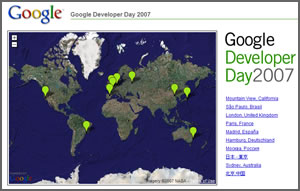
Locations
- Mountain View, California
- São Paulo, Brasil
- London, United Kingdom
- Paris, France
- Madrid, España
- Hamburg, Deutschland
- Москва, Россия (That’s Russia to you)
- Tokyo – Japan
- Sydney, Australia
- Beijing,China
Those who can’t make it don’t need to be left out, Google will offer live streaming webcasts from its Mountain View office and provide a YouTube™ channel with videos of Google Developer Day sessions around the world.
 In the same way that UK frequencies are being freed up by analogue TV going digital, a big chunk of valuable frequency will also be coming up for grabs in the US too. The big difference is that the US one is coming up a lot sooner, with the US government having mandated that their analogue switch off occurs on 19 Feb 2009.
 The 700-megahertz frequency is highly favoured as it has a significant capacity, good range and can easily penetrate buildings and other structures.
 Previously released as a featherweight 2.1 pounds laptop sporting a 40/80GB hard drive and 12.1 inch display, Sony have just cranked up the VAIO’s desirability rating to wanton craving with the news of a 32GB Solid State Disk option.
 Without a hard drove rattling away inside, the standard battery life has been extended by half an hour, giving a very generous 6.5 hours in total. Users investing in the longlife ‘L’ battery can enjoy a battery life that will leave even the Duracell bunny in need of a fag and lie down, with Sony claiming a whopping 12.5 hours of use.
 Linux may be associated with sunlight-avoiding, beardy computer ‘enthusiasts’ pottering in sheds, but the popularity of its mobile phone version is predicted to soar.
 ABI also predicts that handsets incorporating the open source Linux as a real-time operating system (RTOS) replacement will also grow massively, leaping up from a base of just about zero today to 76 million units in 2012.
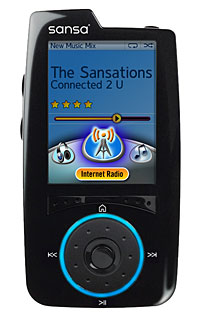 After connecting the Sansa Connect media player to the Internet via Wi-Fi, users will be able to listen to LAUNCHcast Internet radio, rummage through Flickr photos and check out what Yahoo Messenger friends and nearby Sansa Connect owners are grooving to.
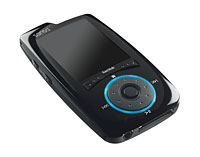 “We see this as a very strong partnership with Yahoo,” purred top SanDisk marketing bod Eric Bone, adding that he saw his company progressing from “fast-follower mode to a technical-leadership mode” in a market still dominated by the ubiquitous iPod.
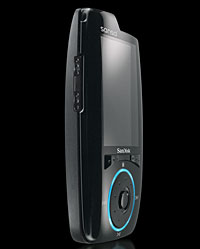 As well as wirelessly connecting to Yahoo’s Music service, the Connect supports MP3s and DRM WMAs provided by other services like Rhapsody, but you’ll have to get out Ye Olde cable to transfer the music from your desktop.
 Yesterday, Apple announced that it had shifted its 100 millionth iPod, making it the fastest selling music player in the history of the known universe and quite possibly beyond.
 Never one to knowingly underhype his own products, Jobs continued; “iPod has helped millions of people around the world rekindle their passion for music, and we’re thrilled to be a part of that.”
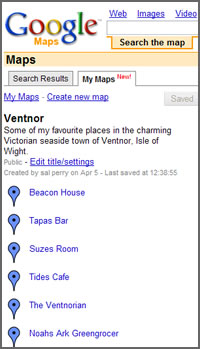 Google Maps has wowed people ever since it moved to the Web from the standalone Google Earth application, letting anyone with a Web browser take a look at both the maps and satellite images of anywhere in the world.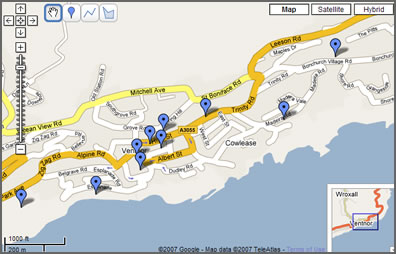

 Early pre-UK-release signs weren’t promising, nor were they looking any better when the UK PS3 was selling for £100 under their release price, a couple of days beforehand.
 25 years! Staggering how old the industry is now isn’t it?

 Our Sister site, Ventnor-Blog, has been