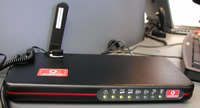
 (Hannover, Germany) Since November, Vodafone has been offering Vodafone At Home Talk in Germany. When using the service, calls that are made from the subscriber’s home cell are charged at a low cost, with one of the bundles available being 1,000 mins for €20 month.
Today at CeBIT Vodafone announced adding to this to include Vodafone At Home Web. By plugging in a Vodafone Connect Card into their computer, subscribers can connect over 3G (UMTS) at 384kbs for a fixed €34 month (£23/US$45>. In return you get up to 60 hours/ 5Gb of access.
In Q2 2005 they will be expanding this to Vodafone At Home Talk and Web. The subscriber will plug all of their current equipment (landline handset, DECT phone, computer, fax, etc) into the box (price being floated, €500/£348/US$671). This box will connect via GSM and UMTS (3G) to the Vodafone network to enable voice and data comms.
 In the UK BT Bluephone is designed to provide a similar service for phone calls.
We’re seeing this for the personal and professional nomad. The tech savy who land in an area for a period of time, then move on – eg consultants, or criminals on the run (please don’t confuse the two). It will also be of use in areas where broadband service don’t extend out (eg rural areas), but 3G networks coverage is possible – how ever limited this may be.
This could also be seen as a defensive move. Voice over WiFi is coming to the masses, from big, well known companies (witness AOL and Wannado) and deals like Skype did with Broadreach for free WiFi hotspot usage are going to start to hit the mobile companies hard.
 During the press conference I asked what they were doing to counter the threat of Voice over WiFi, in particular free service like Skype. Friedrich P Joussen (COO) said they were very aware of the threat and felt it was down to the speed that services could be rolled out to the public.
He referred to a lot of VoIP services (Vonage, etc) charging fixed-rate/catch-all monthly prices, to account for when call traffic leaves the IP network to interconnect with PSTN and charges are levied against them by the PSTN operators. Vodafone’s first move against this is by offering a 1,000 minute service for €20/month detailed above.
This doesn’t, of course, begin to address the competition that a zero-cost/month service like Skype offers.
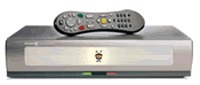 DVRs may well be the hot product in the home entertainment industry, but dusty old video cassettes still rule the roost in the US.
 However, take up is still very low compared to many other consumer electronics products: just 6% of all US households have a DVR, compared to the 87% with a VCR, 60% with a DVD console and 12% with Video on Demand (VOD).
 Unconfirmed reports are suggesting that Virgin Electronics, the consumer electronics division of Virgin, have become an early digital music casualty with the division discontinuing its product line.
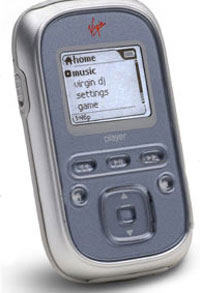 The company had pinned their hopes on the well-reviewed “Virgin player 5GB”, which had the audacity to try and take the iPod mini head-on.
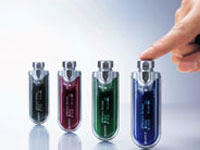 Apple Computer shares dropped Tuesday as Sony relaunched its famous Walkman line amongst concerns that increased competition from Napster might impact its dominance of online music and portable players.
 Over the last twelve months, Apple’s share price has gone from US$23 (€17/£12) to an all-time high of US$81.99 (€61/£42) just before the split was announced.
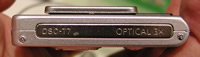 (CeBIT, Hannover) Wandering around the Sony products at the pre-CeBIT press conference, I came across the DSC-T7, the smallest, sexiest model whos roots lay with the DSC-T1.
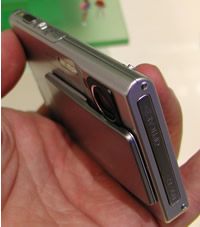 a sliding cover that both covers and protects the lens and switches the camera on. Measuring only 14.8 mm / 0.6 in at the lens cover, and 9.8 mm / 0.4in for the main body, it packs 5.1m pixel. The back is taken up with a 2.5″ TFT Hybrid LCD, displaying 230,000 pixels.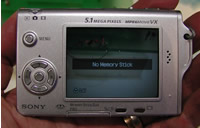
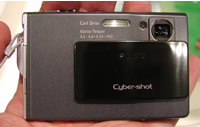 Nothing definite on release dates or price but the talk in the corridors is it should be around in May for around 375Euro, $500, 260 UKP.
 Symbian OS anti-virus specialist SimWorks, has announced that it has identified the first virus targeting the platform, that is capable of spreading itself via MMS messages.
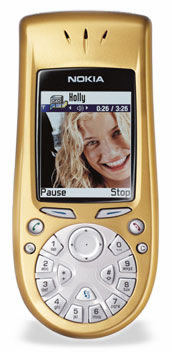 To add insult to injury, users will be punished financially by the virus, with MMS messages typically costing between $0.25 and $1.00 a pop.
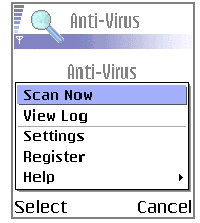 The good news is that like previous Symbian OS-targeted viruses, users are still required to accept the installation of the virus whether receiving it via Bluetooth or MMS.
 The world’s leading technology tradeshow, CeBIT, starts this Thursday in Hannover, north Germany with pundits expecting the show to reflect the recent stellar growth in the $2 trillion technology industry.
 As VoIP (Voice over Internet Protocol) continues to gain in popularity, there’ll be dozens of companies showcasing devices to make free calls as well as displays of corded and cordless Skype phones by Siemens, Motorola, Good Way Technologies and Greatwall Infotech.
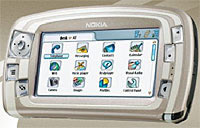 Finnish telecommunications equipment giant Nokia has announced a mobile television pilot, bringing live television broadcasts to mobile devices, starting in Finland today.
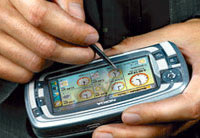 The mobile TV test uses IP Datacasting (IPDC), which conforms with the DVB-H standard.
 An episode of the new series of the sci-fi drama Doctor Who has been leaked onto the Internet, three weeks before the series is expected to begin on BBC One.
 The eagerly awaited new series, filmed in Wales, features the well respected actor Christopher Eccleston as Dr Who, with former teen pop singer Billie Piper as his assistant.