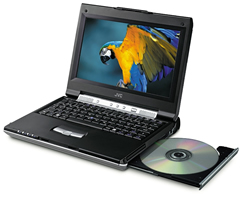
 The JVC Mini Note (MP-XV841GB) is what’s known as a sub-notebook, but for such a small system it’s packed with features. What is immediately noticeable is the fantastic screen which is extremely bright and sharp and in a widescreen format (about 9 inches across diagonally) perfect for playing DVD’s on the move. The screen resolution is 1024 x 600.
It’s powered by a 1GHz Pentium processor (Centrino) with speed-step technology, so it slows down to save battery when you don’t need the processing power. Unfortunately the base system only comes with 256MB of memory which is just about enough to run Windows XP (Professional, which came with the unit), though another 512MB can be installed by the user by removing a few screws in the base and inserting and clipping in a single expansion card.
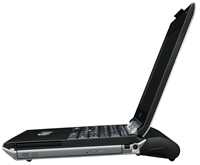
 The internal drive plays DVD’s (and comes with WinDVD so you can watch them) and also writes CD’s (both CD-R and R/W). There’s 2 USB ports, an i.link (or IEEE-1394/Firewire) port, 10/100 Ethernet, a V.90 modem, microphone and line out jacks. The in-built microphone is OK for Internet chat type applications and the stereo speakers have a virtual surround sound. You can plug in an external monitor with a supplied adapter, there’s a PC Card slot and a slot for an SD memory card. Not forgetting the built-in WiFi for connecting to wireless networks or hotspots. The disk drive is 40GB split into a drive C: and D:
 The docking station/port replicator which comes with is plugs into the same connector as the external monitor, giving you 4 USB ports, an Ethernet socket (LAN), standard VGA connector and an optical digital out so you can listen to your DVD’s through an external surround sound decoder.
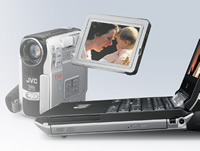
 JVC include some reasonable software. Pinnacle Studio v9 which is a simple video editing package (supporting capturing video from your DV camera through the firewire port), Real Networks RealOne player, Norton Antivirus (with a 3 month subscription), WinDVD for DVD playback and CC converter a sound enhancing utility.
All work makes you a dull boy
The Mini Note is a full featured PC, though definitely aimed at the user on the move who wants to use the media friendly features – at a light weight. Unfortunately though usable, the keyboard is just too small to do real work and plugging in an external keyboard is definitely needed if you want to touch type (unless you have tiny fingers). The pointing device is a small nipple type in the keyboard and again is usable, though I didn’t find it particularly easy.
 Summary
All in all it is a good system, the screen is one of the best out there, it’s got enough grunt to run most standard applications, but I found it too small to use as a desktop machine without external additions. For such a light and portable system it’s pretty usable for working on the move and watching DVD’s.
 Bulldog Communications, the Internet and telecom group owned by Cable & Wireless, is rolling up its sleeves and shouting “Oy! Let’s be ‘aving you!” at its rivals as it doubles the speed of its broadband offering to a super-swifty 8 megabits-per-second from 4 megabits, and spread it across the UK.
 “Eight meg from Bulldog, with no download caps, gives customers the freedom to use the Internet as they wish,” he growled before retiring to his executive kennel.
 Frontier Silicon has launched a new module that claims to bring personal-video-recorder (PVR) like capabilities to DAB digital radio.
 Recordings can be saved onto a memory card on the same radio or played back on any compatible audio unit.
 Frontier Silicon’s software provides an interface through which EPG and dynamic service information (DLS) can be viewed, with scrolling text allowing information ‘wider’ than the 16-character screen to be seen.
 A survey by Cingular Wireless has revealed that men spend more time yakking on mobiles than women.
 Women aren’t afraid to get snapping either, with 60 percent using their camera feature frequently or occasionally against 40 percent of men using it as often.
 Research from BT shows that the number of users connecting to the Internet via broadband has overtaken dial-up subscriptions for the first time, with 7.4 million broadband customers (including cable) now online.
 High speed connections are also good news to those selling goods and services online, with an explosive growth in the consumer market for buying media online, such as films, music and television.
 Two million cable customers now enjoy broadband connectivity through NTL and Telewest.
 Cardiff vicar Reverend Kimber is hoping that by introducing wireless broadband access from the pews of his city centre church, more people will be encouraged to join his flock at St John’s Church.
 After Kimber approached BT, the company agreed to fill in the gap in Cardiff’s wireless broadband network and fitted the church with its own Openzone node, providing access to surfers sitting in the corner of the north aisle at St John’s.
 The Training Foundation has launched its Ready for Work online training programme, an employment-awareness course free to all young people in (or recently in) full-time education and those in modern apprenticeships.
 Each self study course ends with a short test to check the learner’s understanding, with an 80% or better grade qualifying the student for an optional Ready for Work Certificate and Ready for Work Handbook.
 David Frost, Director General of the British Chambers of Commerce roared his approval: “We need initiatives such as Ready for Work, which can help to ensure that young people leaving full-time education and training are equipped with skills that are both relevant for the workplace and will help advance their careers.”
 It’s OK to say you don’t understand the ringtones business.
 This lead to three possible reactions – the haters, the lovers and the not-bovered.
 The draw of ringtones is to individualise the phone handset. But with ringtones, there is no scarcity of supply. Everyone can have one, if they pay for it.
 We covered the announcement of Orange’s 3G TV content to mobile handsets last week, but today we discovered who’s providing the content-to-mobiles technology powering the services.
 After much careful thinking and planning they’ve ended up with an end-to-end solution, spanning ingestion; digitisation; encoding; and distribution going initially to IP TV, now cellular and wireless.