 Listen to Howard Stringer’s speech
Those coming all the way to Tokyo from around Europe and the US, in a hope that Howard Stringer would continue his already well documented shake-up of Sony by making big announcements at his Keynote at the first day of Ceatec would have been disappointed.
If you’re interested in the development of Sony products and where Sony will be going in the future, you were in luck.
The queues to get in for press and punters were huge, with one wag wondering if the hall was full of Sony people trying to find out if they still had a job.
The message from Stringer was strong. It needed to be. Sony is undergoing a massive transformation.
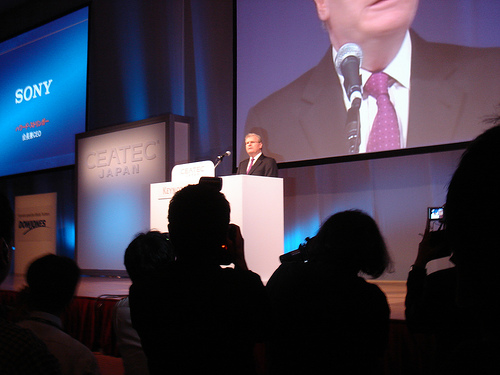 Politically, presenting in Tokyo was an important act – delivering this radical message in the home town of Sony’s head office.
The summary? The three pillars – Restructure, Sharpen, the use of software to “use Sony’s marriage of content and technology to create unique competitive advantages and compelling user experiences.”
While admitting that they have “fallen short in matching innovation with the expanding appetites of our customers,” he told those gathered that gone are the competitive businesses units (silos in Sony lingo) that many claim are partially responsible for Sony wobble. The future will be a united Sony, with a centralised management, looking across the business creation tools; content; phones; games.
Of all the tempting nuggets that Stringer, we’re going to focus on the PSP.
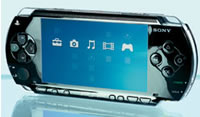 In the nine months that its been on the market, it’s sold 6m units worldwide, making it, they claim, the most successful portable games machine to date.
That’s all fine and dandy, but how will they change the way PSP users consume other media?
Well, here’s the exciting part, he promised that owners will “soon be able to deploy the device’s built-in WiFi, to watch video from home entertainment terminals, anytime, anywhere in the world.”
Now if that doesn’t excite, he also said “to expect to see” a PSP with a high capacity MemoryStick which can be synchronised a Digital Video Recorder (DVR).
The tempting morsels cry out for more details, ones that weren’t provided – which I guess is the point saying them at a big event like this.
Quite what Sony’s definition of a ‘home entertainment terminal’ is, wasn’t explained, nor was if it will require the purchase of another piece of kit.
It’s also unclear if the PSP that we should ‘expect to see’ will be a new model of the machine, or a new MemoryStick with increased capacity.
We’d imagine that PS owners will be prepared to put their hand in their pockets to get any of these and will be tempted by being able to download their choice of TV shows to PSP overnight ready for the trip to work does.
If you want to check out further details, feel free to listen to Howard Stringer’s speech (30Mb) yourself.
 Oh we like this!
 NYSee – a Web project by developers
 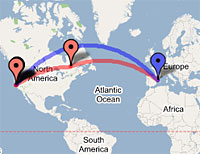 The locations of the cams can be viewed via the Google maps interface as a map, satellite view or hybrid.
 Finally, we took a shine to
  Japan’s largest annual IT show, Ceatec (Combined Exhibition of Advanced Technologies), opens today and will feature around 700 companies, according to the organisers.
 Toshiba has promised to display a super-slim 12.7 millimetre high drive designed for laptops which can read HD-DVD discs and read and write DVDs and CDs.
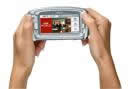 We saw it with the Internet in the late 90s and iTV in the early noughties, now mobile TV is the disruptive technology du jour.
 It’s easy to be swept up in the hype, and persuasive arguments abound.
 Claire Tavernier from Fremantlemedia (right), owner of Neighbours and Baywatch, said “Fremantle TV” would launch on US mobile networks before the end of the year.
 But is the industry is in danger of death by over-sell before it’s even arrived?
 This is all sounding very familiar – we’ve been here before. As with the early days of the Internet and iTV, business models are unclear. Hurdles include lack of appropriate content – including rights clearance on existing properties, lack of spectrum and unproven consumer demand.
 Tavernier also talked about rights, revealing that although Fremantlemedia owned worldwide TV rights to Mr Bean and The Benny Hill Show, both Rowan Atkinson and Benny Hill’s widow had said no to mobile distribution.
 The most telling figures came in the final session of the conference: “Viewers don’t see their mobile as an entertainment device” said Enpocket’s Jeremy Wright (right). “They see it first and foremost as a communicator.”
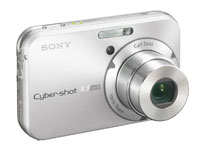 Sony’s new digital compact camera, the DSC-N1, cunningly attempts to combine the functions of a digital camera with a ‘pocket viewer’.
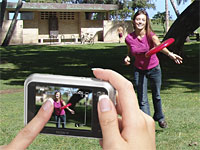 Stored images can be played back individually or as a slideshow, complete with options to add transitions, pans, wipes, fades and zooms, cheesy themes and background music.
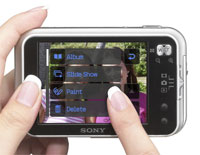 “The combination of these functions makes the N1 ‘more than just a camera’, because it takes sharing to a whole new level.”
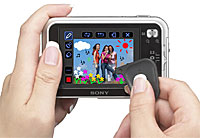 Although the camera can only record stills in JPEG format,
  Britain’s biggest cable operator, NTL, has agreed to shell out an eye-watering $6 billion (~£3.42bn, ~€5bn) for Telewest Global.
 According to a statement – which ends three years of speculation about the merger – Simon Duffy, NTL’s chief executive, will lead the combined company.
 Chairman Cob Stenham can expect his bank balance to increase to the tune of $20m (~£11.4m, ~€16.77m) while chief executive Barry Ellison will no doubt cackle wildly with joy as $17m (~£9.7m, ~€14.25m) rolls into his coffers.
 As the next-generation DVD wars between HD-DVD and Blu-ray Disc grind on, Paramount Home Entertainment has employed a time-honoured fudge and announced that it will be offering movies in both formats.
 Both formats serve up far more storage capacity than current DVD discs, with HD-DVD offering 15GB or 30GB and Blu-ray Disc 25GB or 50GB, depending on the disc.
 Paramount was one of the first major content players to back the Toshiba/NEC-developed HD-DVD format, with other major backers including Warner Home Video, HBO, New Line Cinema, Universal Pictures and Sanyo Electric, followed by Intel and Microsoft last week.
 Influential in Paramount’s decision was the PlayStation 3’s support for Blu-ray Disc.
 Happy Birthday!
 I found a screenshot of what Google used to look like on the Internet archive, and although it does obviously look a little old-school, it’s still much the same interface-wise as it is today:
 It’s in Space, it’s got to be cool. Oh, actually, no nukes, so forget it
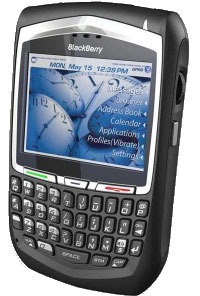 “Batman’s Blackberry”, but I still want one!
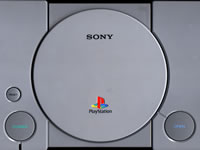 Sony’s Playstation has been awarded an Emmy for Outstanding Achievement in Technology and Advanced New Media for pioneering the 3D polygonal-based gaming experience, by the US National Academy of Television Arts and Sciences (NATAS).
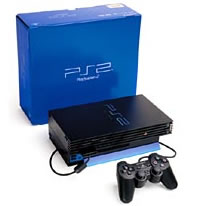 You can imagine that the awarding of this will make steam come out of the ears of those on the Xbox team at Microsoft
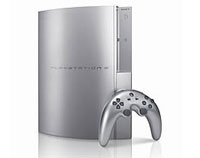 Is it only the cynical that would think that the timing of this award has anything to do with the wider entertainment business (read film) getting more closely involved with creation of film license games? Or even that they’ve finally woken up to the fact that the amount of money spent on video games out-sizes that spent on film.
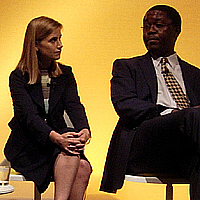 Hyacinth Nwana, (pictured left) speaking for Arqiva, and Jeremy Wright of Enpocket, both saw advertiser funded content – whether programming or entertaining video ‘spots’ – to be the key driver.