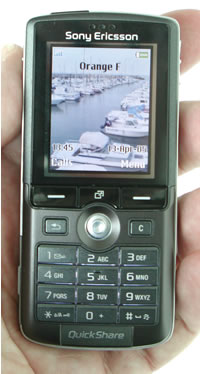
 About a month ago I had the chance to spend two days with a pre-release version of the Sony K750i handset and as it’s now closer to the release of the handset, I thought an overview of the product might be timely.
Despite it being a pre-release version of the phone, the couple of bugs that I came across were pretty small and inconsequential and in general it ran very well.
The form of the phone was, for me quite petit, but that�s to be judged against a Nokia N-Gage QD, which isn’t the lightest of fellows. I soon got used to the size and placement of the keys, picking the use of the central joystick up quickly.
The navigation through the menus is very simple and effective, which is heavily aided by the quality of the good-sized display which takes up the same space as the keypad.
One feature I particularly liked was being able to soft-program the joystick “User Controlled Interface” Hurrah! I set it up to start the built-in audio recorder (quality OK, not great) when I pushed the joystick right, and turn on the bright/near-blinding light that is the flash.
Despite its very handy form (~10cm H, 4-5 cm W, 2 cm D from memory), it has some impressive features.
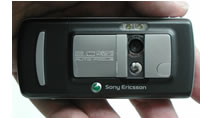 You morph it in to a camera by sliding the lens cover at the back of the device. Using the 2mpx camera you can easily captures clear pictures with vivid colours during light days.
When shooting in low light levels the quality is noticeably degraded, but what do you expect from a 1cm lens? To account for this they’ve provided a flash that can also be selected to flash SOS with retina-burning brightness!
 Video recording is OK, given the devices restrictions.
The biggest news I’ve left to last. It’s also an MP3 music player, which having been using the W800 a lot recently, appears to offer the same functions as the much anticipated first Sony Walkman mobile phone.
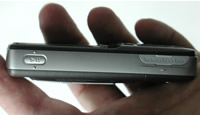
It has a play/pause button at the top left on the side, and volume controls on the opposite side (the shutter button is also on that side).
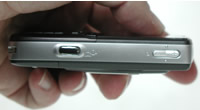 I’d just assumed the K750i would have a ‘normal’ headphone jack, letting me choose the headphones that excited me, but the provided headphones had to be connected via a Sony-interface at the bottom of the phone. This brings obvious advantages, like them having a mic, letting to let you use them as a hands-free set.
Connecting a uploading content was relatively straight forward to setup and use. I can’t comment on its information syncing ability as this wasn’t available.
Conclusion (based on two days usage)
Despite having to get used to a new phone interface, I fell for the K750i over the short period of usage I had. Frankly it was a real struggle for me to give it back. I think this is going to sell by the truck-load (and that’s a lot of phones, because they very small :) ).
Summary
Compact, quality, capable music player and camera phone.
Rating
4/5


We understand the k750i will be released in the next month in Europe.
 Vodafone execs spent the morning cackling wildly to themselves, throwing wads of dollar bills in the air and rolling around silk-covered beds covered in cash as record revenues and profits for its full year results were announced to the world.
 But in-between triumphant licks of triple-thick Cornish clotted cream, Sarin sounded a cautious note, warning that competition was rising.
 Vodafone performed particularly well in strong markets such as the US and Spain, with revenues growing at more than 20% year on year.
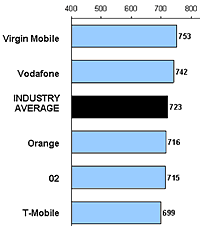 Orange has triumphed in a study rating customer satisfaction among mobile phone contract providers, with Virgin Mobile coming in top in the pre-pay sector, according to the 2005 UK Mobile Telephone Customer Satisfaction Study, run by J.D. Power and Associates.
 The authors of the study claim that the results reflect the positive impact of increasing competition and lower tariffs.
 The contract segment seemed a well-chuffed bunch too, with satisfaction levels rising to 733 index points from 720 index points in 2004.
 Mobile technology and photo messaging is still a hot potato, with 35 percent of all mobile owners snapping on camera phones and 21 percent sending photos from their mobiles.
 Like the spotty geek who turns up in the pub with a stunner on his arm, Bluetooth has confounded critics by reaching the significant milestone of five million Bluetooth units shipping per week.
 “When you couple that with the recently announced collaboration between the Bluetooth SIG and UWB,” Foley continued, “Bluetooth technology will further reinforce its leading position far into the future. Even today, we expect this will have a positive impact in Bluetooth uptake.”
 Seizing a convenient opportunity to squeeze in a bit of PR, Rosenberg added, “Already today, Nokia has introduced state-of-the-art mobile devices that allow data transmission using both high- speed cellular networks, WLAN hot spot access, and Bluetooth technology.”
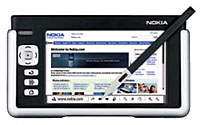 Nokia has surprised pundits at the LinuxWorld Summit in New York by announcing their new Nokia 770 Internet Tablet, a handheld Wi-Fi device for accessing the Internet around the home over a wireless broadband connection.
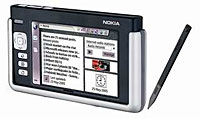 The included 1500mAh battery should keep going for about 3 hours of browsing or 7 days of standby time.
 Unlike some teensy-weensy mobile displays, Nokia’s sizeable 800×480 pixel screen should make browsing the web and interacting with email a reasonably practical proposition.
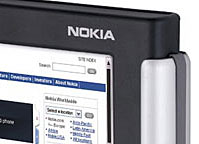 Naturally, there’s an orgy of acronyms detailing the zillion and one audio and video formats that the unit supports (deep breath): MP3, Real Audio, MPEG4, AAC, WAV, AMP, MP2 audio support, with MPEG1, MPEG4, Real Video, H263, AVI, 3GP video support and a slew of common graphics formats supported, including Animated GIF JPEG, BMP, GIF, TIFF, PNG and SVG-Tiny. Phew!
 “Linux is a logical choice for the Nokia 770 Internet Tablet as Linux and the Open Source development platform provide us with fast and efficient solutions to build products for this new Nokia product category,” added Janne Jormalainen.
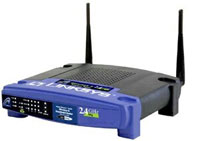 Despite prices being pushed downwards by fierce price competition, worldwide wireless LAN equipment revenue rose 20% to US$767.6 million (~£420m ~€610m) between the fourth quarter of 2004 and the first quarter of 2005.
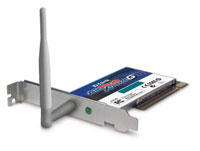 That’s a thumping great 37% increase in unit shipments, representing not-to-be-scoffed-at sales of 6 million.
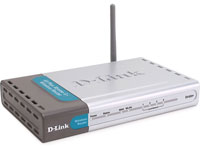 D-Link barged ahead of Cisco-Linksys to grab second place, with NETGEAR in fourth position.
 Here at VON Europe in Stockholm, Sweden, Niklas Zennstrom, CEO of Skype, has just announced the official launch of the Skype affiliate scheme. The scheme has been running as a trial for a few weeks, gaining 1,800 members.
 Part
Part 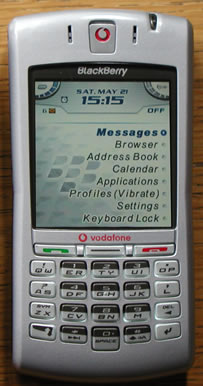 Screen
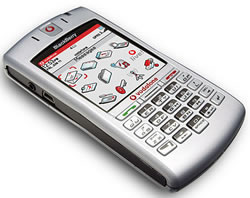
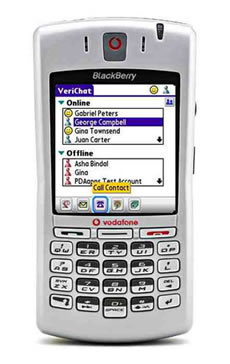 When Web pages are rendered, there are a lot of unnecessary images which would be represented instead by text. This text is usually shown in the ALT tags of the HTML from which the pages are rendered. On a lot of sites, there are a lot of navigation images, which are not good for render time on a low-powered device like the Blackberry: every time a page is opened containing images, these images are downloaded (this takes a long time with the Internet connection on a 7100v being at dial-up speeds). When downloaded these images are resized individually so as to fit on its screen.
 Back in the old days when Glastonbury was a field of medieval mud occupied by confused hippies and LSD travellers, the customary way to show your appreciation of the band was to flash the occasional peace sign or waft a spliff skywards.
 For today’s hi-tech toy generation, new ways of bigging up a band have developed.
 We’re not sure what the remaining 90% of the crowd thought of this pointless onscreen nonsense, but we’d be reaching for our phone zappers in double quick time.
 Time Warner is considering “spinning off” its AOL division to help finance acquisitions in the future, said chief executive Richard D. Parsons on Friday.
 With Time Warner’s pockets already considerably lightened, transatlantic regulators then accused them of overstating advertising and subscriber numbers from mid-2000, with the company settling all charges with thumping great payments of US$510 million (~£279m ~€406.6m) in the States and US$300m (~£164~€239m) in the EU.
 AOL is now trying to find new revenue sources to compensate for the loss of U.S. subscribers to its dial-up Web access service, which has declined by 5 million users in three years, to 21.7 million.