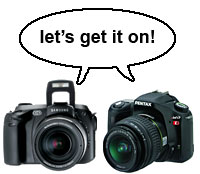
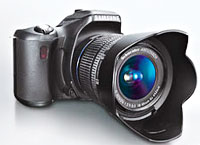
 Way back in October last year we reported that Samsung was cuddling up in bed with Pentax to make Digital SLRs, and the fruit of their digital loins has been announced today, the Samsung GX-1S.
Photographers hoping for a cutting edge, innovatory collaboration will be disappointed as the GX-1S is simply a rebadged Pentax *ist DS2, with a few new Schneider lenses lobbed in (although they appear to be smple re-badge/tweaked jobs too).
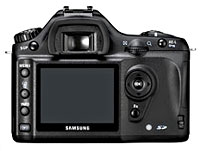
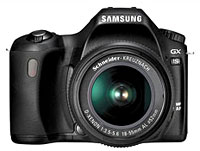 Still, it’s a very capable camera, offering a 6 megapixel sensor, 2.5-inch screen (210K pixels), expansive ISO range from 200 to 3200, a host of shooting modes and a Pentax AF lens mount.
The camera’s compact and lightweight (505 grams) design should make it tempting to travellers, with the Schneider Kreuznach D-Xenon lens system offers compatibility with Pentax’s extensive catalogue of KAF bayonet mount lens.
 Although some may not see the point in Samsung announcing what amounts to an already released product under a different name, there are clear benefits for both companies.
Pentax need to sell the *ist DS2 in greater volumes and what better way to do that than get the globe-spanning corporate might of Samsung onboard?
 With more units shifted, Pentax benefit from lower production costs, increased sales and a greatly increased user base for their lenses and their system, thus ensuring the future of its system.
For Samsung, the benefits are equally clear cut, as they get to make an immediate mark on the burgeoning dSLR market by releasing a capable, well-reviewed camera while working on new joint designs with Pentax.
 Then there’s the awesome might of Samsung’s marketing budget to consider, with some suspecting that the new camera will be sold as a “loss leader” to help establish the brand.
All this fits in with Samsung’s stated aim to become a world class digital camera manufacturer, with its growing ambitions reflected in the recent release of their high-end, prosumer Pro815 digicam.
SPECIFICATIONS:
Sensor: 23.5mm x 15.7mm CCD, 6.3 million pixels
Image sizes: 3008 x 2000, 2400 x 1600, 1536 x 1024
File formats: RAW (12-bit), JPEG (EXIF 2.21) – 3 levels
Lenses: Schneider D-XENON, Pentax KAF2, KAF, KA mount lenses
Power zoom not available
K mount lenses available with (function limited)
S mount lenses available with adapter (function limited)
67/645 lenses available with adapter (function limited)
Focus: 11-area AF, TTL Phase matching AF system, Focus point selectable
Focus modes: AF-Single, AF-Continuous (Action mode), Manual focus
Shooting modes: AUTO Scene, Portrait, Flash off, Program AE, Shutter Priority AE, Aperture Priority AE, Manual, Bulb
Scene (SCN) modes: Normal, Portrait, Landscape, Macro, Moving Object, Night scene
Metering: 16-segment, Center-Weighted Average, Spot
ISO sensitivity: Auto, ISO 200-3200
Shuttter speed: 30 to 1/4000 sec, Bulb
Shutter x-sync 1/180 sec
Flash: • Built-in P-TTL pop-up flash, Guide number 15.6 (ISO 200/m), Flash sync 1/180 sec
Power: 4 x AA batteries or 2 x CR-V3
Weight: (no batt/lens) 505 g (1.1 lb), (no lens) 605 g (1.3 lb)
Dimensions 125 x 93 x 66 mm (4.9 x 3.6 x 2.6 in)
 It might look like a run-of-the-mill Gameboy Advance SP, but the TAVI Portable Media Player packs a much mightier multimedia punch, with the wee fella letting you watch movies, playback music, look at your photos, listen to FM radio, read eBooks and record your own voice.
 Audio support is pretty generous too, with the unit offering MP3, WMA, OGG, AC3 and AAC playback.
 There’s also a built in FM radio and mic, line-in recording (audio only) and TXT reader support.
 SPECIFICATIONS
 PHOTOS & eBOOKS
 POWER
POWER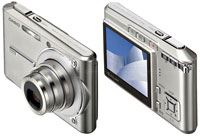 Casio have announced the European release of their super-slim 6 megapixel camera featuring an ‘Anti Shake’ DSP and MPEG-4 movie recording.
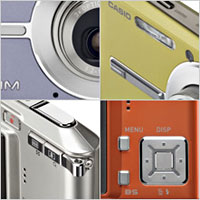 As the name suggests, its not a proper mechanical anti-shake gizmo – instead, the camera employs high ISO1600 sensitivity plus a faster shutter speed to minimize image blur.
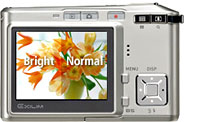 An improved battery allows up to 300 shots per battery charge, with the 2.2 inch LCD being “twice as bright” as previous models.
 It’s taken some considerable time for the Casio S600 to reach Europe – it’s been available in Japan since October 2005 – but you should be able to pick it on the High Street for around £230 (~€335, ~$406).
 In a feast of digital convergence, Pantech & Curitel have announced the launch of their new multimedia-tastic PT-S160 phone.
 The PT-S160 doubles up as a PMP (Portable Multimedia Player) and a satellite DMB receiver, with a sliding design only showing keys for DMB functions when closed.
 The screen can be switched between landscape and portrait formats.
 The makers claim a talk time of 300 minutes and a hefty standby time of 300 hours (although we’ve no idea how long you’ll get when watching TV).
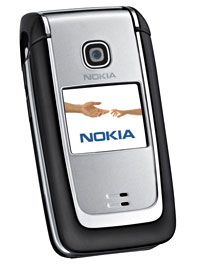 Nokia has shunted out a new addition to their mid-range mobile portfolio with the new Nokia 6125 clamshell phone, offering stereo audio streaming over Bluetooth and FM Radio.
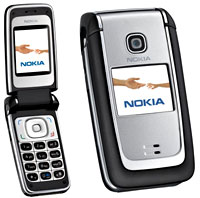 The quadband Nokia 6125 operates in GSM 850/900/1800/1900 networks and provides a flight mode, which enables the user to work with calendar or listen to music while on the flight – although we’ve heard of airlines like Virgin insisting that you turn off all phones – including those with ‘flight modes.’
 The buzz about the rebirth of the Internet has been getting louder for at least the last nine months as the label Web 2.0 was attached to the new generation of applications.
 Om Malik has the scoop on Toni Schneider, senior exec at Yahoo’s Developer Network, leaving the Internet giant to move to start-up Automatitic (
 WordPress, if you haven’t heard of it before (and you should have done), is a fully-featured blogging application that is being taken up in large numbers. It provides the same functionality of most pay-for blogging tools, but for zero cost. This has lead to it being used by both large-scale companies and community sites like the wonderful
  It’s based on the Open-source software principles that are integral to true Web 2.0 apps – by giving away the application and providing tools for interested developers, a large community has grown up providing plug-ins that extend WordPress in many different directions. This benefits the users as well as the people behind WordPress – see how giving things away is a good thing?
 Some people get rather too carried away with online communities, and we’re safe in saying that Scott Leo of the City of Toledo in Ohio, USA.
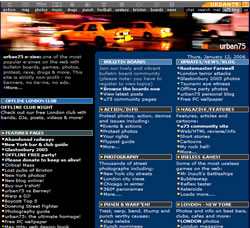 This kind of behavior isn’t unique online. To get the lowdown, we spoke to Digital-Lifestyles’ Mike Slocombe, who has a parallel life as head honcho and founder of UK discussion board Urban75. It’s a seriously busy board with nearly 2.5 million postings and over 26,000 members.
 Friday afternoon distractions.
 A huge photograph of the Orion Nebula taken by the Hubble Space Telescope has been released on the Internet. It is thought to be one of the largest images every produced.
 Around two years ago the previous version of this image was also distributed online, but that was a ‘mere’ 6,200 x 6,200, at that time, also claimed at the ‘largest image ever’.
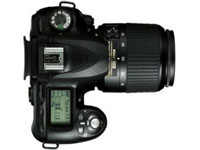 Yesterday afternoon, without much fuss, and with zero trumpets playing, Nikon UK announced that they are to stop production of nearly all of their analog cameras. Err … what did you say?