 She’s got a mission to eliminate mobile phone roaming rip-off charges. She’s Commissioner Viviane Redding of the EC, and today, Vodafone took PR action to keep itself out of her sights, by promising to “cut roaming by 40%” by this time next year.
Vodafone’s announcement says: “Average European roaming costs for Vodafone customers will be cut by at least 40% by April 2007, when compared to last summer.”
This, it says, “will benefit over 30 million Vodafone customers who roam every year, and will see the average cost of roaming in Europe fall from over €0.90 to less than €0.55 per minute.”
Ironically, Vodafone is probably not highest on Commissioner Redding’s hit list. It’s certainly possible to pay over the odds for Voda phone calls when overseas – pick the wrong contract! – but amongst the giants, Voda actually scores quite well on fair use, especially if you’re a Passport subscriber.
Arun Sarin, Chief Executive, Vodafone, said: “Customers want simplicity and value for money when they’re travelling abroad. They get it with Vodafone Passport, which we launched last year, allowing customers to take their home tariff abroad with a small additional per call fee. Today Passport provides savings of at least 30% for more than 6 million Vodafone customers.”
 But like many of the giants, Vodafone is suffering from the cost of providing phones. All the European operators, traditionally, subsidise handsets; they give them away, or sell them for a fraction of their cost, in the expectation of making substantially more out of phone call charges – and it works.
Unfortunately, we’re changing our phones too often. It’s mostly the shops that do this, because they are incentivised to do it by the networks.
The networks all pay a premium to a phone shop who “steals” a customer from a rival network. At the same time, paradoxically, they’re trying to make contracts longer: 12 months minimum, 18 months or even longer, as standard.
So the trend is to pay as you go phones – which tend to be paid for. And it’s PAYG agreements which most heavily penalise you when roaming. That is, assuming that your PAYG phone even makes it possible to use it overseas; many don’t.
Sarin said: “The success of Passport shows the demand for simple, great value roaming in Europe and today we’re showing that Vodafone will continue to lead the industry in providing it.”
What he probably means, is that Passport needs to be able to compete with PAYG, and Vodafone sees no harm in ingratiating itself with the Commissioner for Information Society and Media while doing so.
 There had been some excitement, well amongst UK media analysts at least, that BSkyB might loose its dominance of the control of UK football’s Premier League.
 Finally the other company, Irish broadcaster Setanta, had thrown its hat into the ring, originally saying they were going to bid for two of the packages. Those not in the broadcast world wouldn’t necessarily know who Setanta are, but most people will know of their 40% owners, Benchmark Capital.
 This weekend marks the start of Vodafone UK offering live coverage of international cricket and the Football League Playoffs from Sky Sports to their 3G customers.
 Bizarrely, Sky specify that the content is for Personal use only. Errr … it’s on a mobile phone Sky. It’s not like you’re going to get the throngs in the pub crowding around watching it on a tiny screen. That is until someone comes up with a huge magnifying glass that the phone sits behind.
 Last year took ourselves to Berlin to attend IFA. Being the first time we’d attended we were _totally_ blow away at the size of the place – it’s massive. Every side of the Consumer Electronics (CE) industry was covered, from the smallest to the largest with the later building their own houses (Siemens, Deutsche Telekom).
 Asked why IFA was so loved by trade visitors, his answer was simple, “We treat them as VIP’s. Nothing is too much and they feel very special.” Sounds like a recipe for success to us, one that could easily be learned by many other shows around the world.
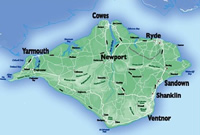
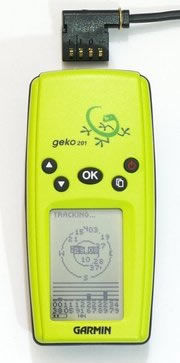 OpenStreetMap, an organisation that is using consumer technology to create copyright-free maps, is meeting this weekend (5-7 May) on the Isle of Wight – to map the whole Island and give the data away under a Creative Commons license.
 Once the GPS data is combined with notes of road names taken via audio recordings or even notebooks (shock horror), accurate mapping data will be put into the OpenStreetMap system for all to share. Quite different to the huge cost that the Ordnance Survey (OS) is asking for similar data.
 If you’re not submerged in this world, it may surprise you to find out that the United States actually gives its mapping data away for free. So through agents like Navtec, and Teleatlas, it ends up on applications like Yahoo & Google maps. Innovation like that isn’t possible in the UK as it falls at the first hurdle – that of huge expense.
 Organisation like the OS who do not let their data free will be be left clutching hold of something whose value has been severely diminished, if not zero’d.
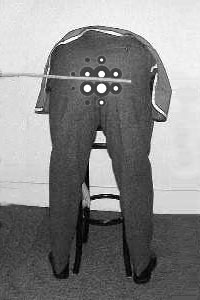
 Broadband giants Telewest have had to bend over and feel the sharp swish of the Advertising Standards Agency’s corrective ruler on their ample rumps after their broadband radio advert was deemed ‘misleading.’
 A Telewest customer – clearly already living in a Telewest area – liked the sound of the deal so much they rang up to sign on, only to find that they were clearly in the wrong sort of ‘Telewest area.’
 The ASA concluded, “We considered this important restriction should have been explained in the ad and that “Conditions apply” had not been adequate to cover such a significant condition to the offer. The ad breached CAP (Broadcast) Radio Advertising Standards Code section 2, rule 3.”
 The Cloud has announced plans to roll out a new flat-fee Wi-Fi tariff in the summer, slashing the current high cost of accessing the Internet on the move.
 The extra freedom of the ‘pay as you go’ version comes with a sting though, with your twelve quid giving you just a week’s unlimited access.
 The Cloud’s chief executive George Polk said that his company has been working their Internet-enabled socks off to “make the Wi-Fi mobility world real” (whatever that means).
 Channel 4 is offering a UK online exclusive of the entire first series of the cult hit show, Lost.
 You’ll have to be quick to watch the new series online though, as episodes one and two will only be free to view for two weeks (until May 11th 2006.)
 Obsessive fans hoping to work out the dark complexities of the series by analysing each show in infinite detail will be disappointed to learn that it’s only possible to watch episodes for a 24 hour period on a single PC before the pesky thing goes into auto-destruct,
 Lost video is only available to UK users using Windows Media Player 10 or above.
 The “Old Media” is still struggling with the idea of the Internet – and discovering that embarrassing mistakes can’t be swept under the carpet. On the Internet, insults are permanent, the Guardian has discovered.
 Read the story as it is today on the Guardian web site; you’ll see that Burgess is quite right to point out that the book in question was, as the cannibal admits, “The Vagina Monologues.”
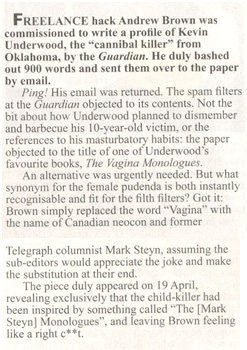 No insult, obviously, was intended to the eminent writer, Steyn. But it looks like some people have got cold feet. Today’s London Evening Standard, early editions, reported that the Guardian had not covered itself with glory: “Great copytaking of our time,” it crowed in its Wednesday Media section; “Yesterday’s Guardian included the correction…” and quoted the correction, as given above, in full.
 It’s with absolutely no surprise that news reaches us that the number of text (SMS) messages has reached a record high.