 In a flurry of press announcements, Sony have announced no less than four shiny new cameras to add to their popular range of digital compact cameras.
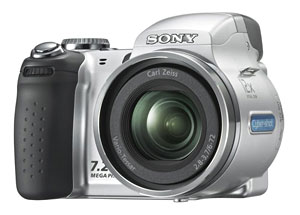
Sony Cybershot DSC-H5 and DSC-H2
It seems that they liked their Cyber-shot H1 so much that’s it’s spawned two new updates, with both featuring an image stabilized 12x optical zoom, electronic viewfinders and a host of exposure modes including manual, aperture and shutter priority.
The bigger brother Cybershot DSC-H5 sports a 7.2-megapixel CCD with a man-sized three-inch LCD screen, while the DSC-H2 serves up 6 megapixels and a more modest 2.5 inch screen.
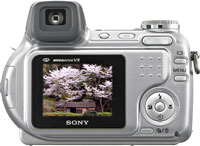 Both cameras come with optical zoom lens offering a huge range of 36-432mm (35mm equiv) at F2.8-3.7.
The combination of Sony’s Super SteadyShot optical image stabilisation and high sensitivity settings (up to IS0 1000) should let all but the shakiest folks on wobbly shoes get sharp pictures.
Offering 32MB of internal memory, both cameras take Memory Stick Duo or Memory Stick PRO Duo cards (now available in capacities up to 4 GB).
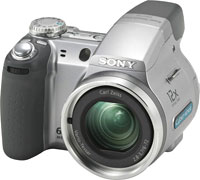 The DSC-H5 camera will be available in May for about $500 (~£287, ~€420) and the DSC-H2 a month earlier for around $400 (~£230, ~€337).
Sony Cyber-shot DSC-W70 and DSC-W100
Slipping in to the front of the W series pack are the DSC-W70 and DSC-W100 compact cameras.
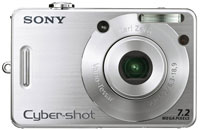 Featuring 8.1 and 7.2 million pixels respectively, the DSC-W100 cameras offer a 3x zoom (38-114mm), eye-level viewfinder and a 2.5-inch screen.
There’s some useful manual controls on the DSC-W100, with a manual exposure mode giving up to 46 steps of adjustable shutter speeds (30 – 1/1000 sec) but there’s only two steps of aperture control available.
Both cameras offer a wide range of ISO sensitivities with the DSC-W70 covering 100-1000 ISO and the W100 managing an impressive 80-1250 ISO.
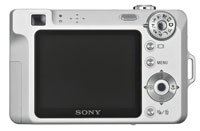 Battery life is an impressive 360 shots on a single full charge, with the W100 coming with 64MB of internal memory and the W70 58MB. Both cameras use Sony’s Memory Stick storage.
The Cyber-shot DSC-W100 will be knocking out for $350, and the DSC-W70 for around $300 (~£172, ~€253). Both models are scheduled for release in April and will be available in black and silver.
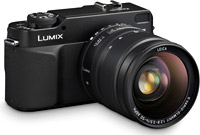 Panasonic’s first digital SLR camera with interchangeable lens has been announced at the PMA show.
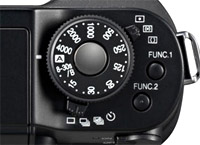 Do we like the sound of that? You betcha!
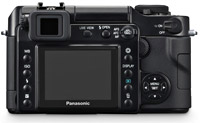 Onboard is Panasonic’s Venus Engine III image processing LSI, claimed to consume only 80% as much power as its predecessor, the Venus Engine II.
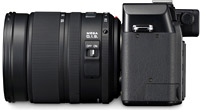 Although full details have yet to be announced, the camera does seem to share quite a bit in common with the Olympus E-330 EVOLT, although the new, Leica-branded lens looks to be a very classy number indeed.
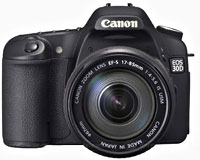 Canon have unleashed a veritable avalanche of new cameras today, with no less than ten new models being announced ahead of the PMA 2006 show.
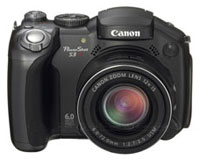 Canon PowerShot S3 IS
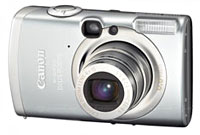 Canon PowerShot SD700 IS Digital ELPH (European name: IXUS 800 IS)
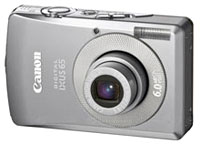 Canon PowerShot SD600 and SD630 (European name: Canon Digital IXUS 60 / IXUS 65)
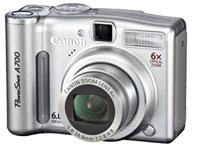 Canon Powershots A700 and A540
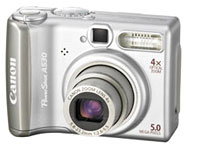 The 4-megapixel A420 serves up a 3.2x zoom and 5-point AiAF auto focus, the 4-megapixel A430 has a 4x optical zoom and 9-point AiAF auto focus while the A530 ramps up the resolution to 5 million pixels, a 4x zoom and ISO 800.
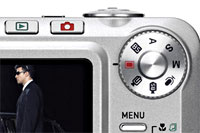
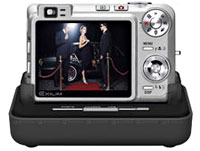
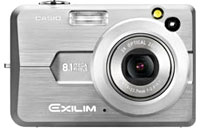
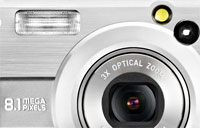
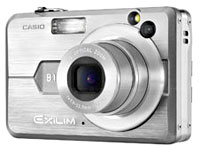 A shiny new 8 megapixel digital camera has just rolled of Casio’s well-used photographic slipway, the Exilim Zoom EX-Z850.
 Although effective, this is never as good as a proper optical stabilisation system, and relies on ramping up the ISO and shutter speed to freeze action – so you often get sharp pictures at the expense of increased image noise.
 We’re not quite sure what that means or how the effect is achieved, but we hope it doesn’t involve digital zoom.
 Apparently it does this by “automatically adjusting for obliquity even when photos are shot while still in the album” – whatever that means.
 ISO sensitivity Auto (Max ISO1600 when using ‘Anti-Shake’ or’ High Sensitivity’ BEST SHOT modes)ISO50, ISO100, ISO200, ISO400
 We covered
 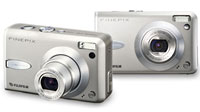 With PMA 2006 (Photo Marketing Association International) looming ever closer on the horizon, there’s been a flurry of new camera announcements, and of real interest is Fujifilm’s successor the award-winning
  The camera comes with a 3x (36-108mm equiv) F2.8-8 zoom and uses a sixth generation Super CCD and Fujifilm’s groundbreaking Real PhotoProcessor II.
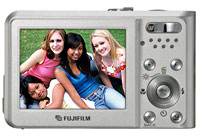
 As with the F11, the camera boasts a sizeable 2.5-inch LCD screen, coated with Fujifilm’s proprietary CV film for reducing glare and reflection.
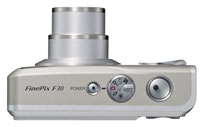
 We like the addition of a dedicated exposure compensation button on the back of the camera as we found some functions on the F11 to be annoyingly buried deep in menus.
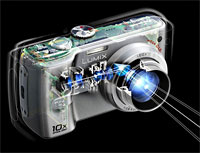 Panasonic have released two additions to their popular Lumix digital camera range which the company are claiming are the world’s smallest in their categories.
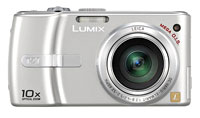 The 5 megapixel camera comes with Panasonic’s well regarded optical image stabilisation system (you’ll definitely need that at the far end of its monster zoom) and sports the newly developed Venus Engine III, offering quick response times and an improved battery life (250 shots).
 After the dire high ISO performance of the Lumix flagship model,
 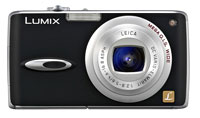 There’s also 13.4 MB of internal memory onboard, a SD/MMC card slot and a 2.5-inch, 207k pixel TFT LCD.
 The f/2.8, Leica zoom lens gives users a handy wideangle range of 28-102mm equiv., and the camera come with the usual smorgasbord of scene modes for every conceivable occasion.
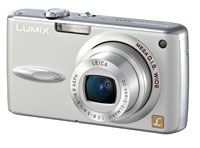 The camera is also expected to be out in March for $349.95.
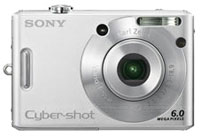 Ahead of the big PMA (Photo Marketing Association International) show at the end of the month in Florida, Sony has announced two new 6-megapixel cameras in their ‘W’ range.
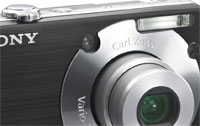 Looking somewhat reminiscent of the Canon Ixus / Elph range, the miniaturised, re-engineered W-series offers a compact, highly pocketable design (89x59x23mm) with a price that’s easy on the pocket too, with the DSC-W30 retailing for $230 (~£132, ~e193) and the DSC-W50 for $250 (~£143, ~e209).
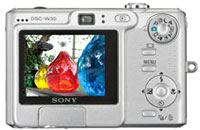 At higher ISO ratings noise can become a real issue, but Sony are claiming that their Clear RAW imaging technology keeps the multi-colour snow-storm effect to a minimum.
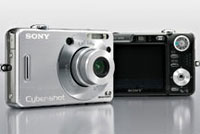 To help fumbling newbies and the easily baffled, Sony has added a new function guide which displays a short onscreen text explanation whenever a shooting mode is selected. This can be turned off once the user becomes familiar with the icons on the mode dial.
 Scene modes Twilight, Twilight Portrait,Landscape,Beach,Snow,Soft Snap
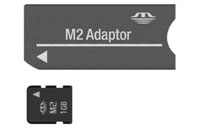 If you’ve owned a few digital cameras or PDAs and switched brands a couple of times over the years, you’ll probably already have a formidable collection of non-compatible memory cards wasting away in your drawer.
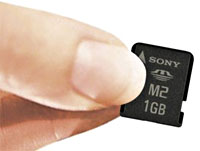 Much as we hate to give any kudos to yet another memory card format, that’s a mighty impressive capacity and offers enough storage space to turn mobile phones into fully fledged, iPod-worrying MP3 players.