 TV cables could provide broadband Internet access speeds up to a trouser-flapping 100 megabits per second as early as next year according to Finnish broadband equipment maker Teleste.
The technology is claimed to provide punters with access 50 times faster than the average broadband speeds now offered to cable TV homes.
Although similarly nippy data transmission speeds are possible over fibre networks, these would cost a lot more for operators to build.
 “This is a cost-efficient technology, as we use the cable TV networks which are already in place,” Teleste’s CEO Jukka Rinnevaara told Reuters.
Teleste has said that it will bring its Ethernet-to-the-home product to the market early next year, giving consumers access to speeds of up to 100mbps.
The company manages to achieve the Billy Whizz speeds by fitting Ethernet – your everyday, cheapo technology for shifting Internet data over broadband networks – into cable television networks.
Teleste reckons it’s way ahead of the market, predicting that rival technologies won’t emerge until the second quarter of 2007 at the earliest.
 The foxy Finns are currently running field trials with cable TV service provider Essent in the Netherlands, but are yet to reach the top speeds they predicts will be available to most homes in a few years time.
“Based on our research, 30 megabits per second is the absolute minimum in future homes,” Pekka Rissanen, a Teleste exec informed a news conference. “Just one TV programme would take 10 to 20 megabits per second of this alone. So, very fast we would reach a need for 30 megabits, and also for 50 megabits per second.”
 Rissanen calculated the cost of connecting a home to the high speed ethernet-to-the-home technology could range from US$60.30 (~£35, ~€50) and US$241 (~£140, ~€200).
For some inexplicable reason, the company has splashed out a fortune for a bizarre, near feature-length futuristic 3D-tastic cartoon fronted by a talking monkey to explain their new service.
We’re not quite sure what the connection with the service is, but it sure beats listening to some swivel action suit blathering on via Power Point.
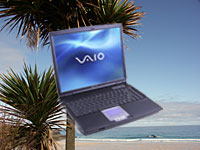 Feebly posing as some sort of independent study into the portable computer use, a recent US survey commissioned by Intel reveals that 34 per cent of respondents or their families have taken a laptop PC with them on vacation, with just over half likely to take a laptop PC on a future vacation. Oh that’s lucky … aren’t Intel involved with laptops in some way?
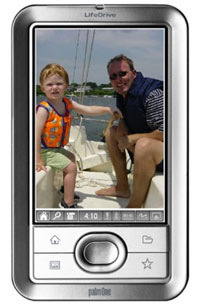 The growth of compact, wireless-enabled laptop PCs [cue: another plug for Intel Centrino here] and hotspots have made it easier for globe trotters to taunt their office-bound chums back home with beach photos, as well as keep in touch with work, news, sports and grab local information.
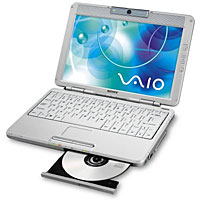 Of course, seasoned PC users have dragged laptops around with them for years on end, with many of the early adoptin’ cognoscenti choosing to travel even lighter by using PocketPCs/smartphones for keeping in touch while away from home.
 The rurmour mill continues to hum with speculation that Apple are set to introduce a video playing iPod-like device in the near future.
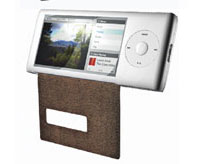 This has led to speculation that the company will be revising the iPod to create something like the ‘vPod’, a concept device created by design firm Pentagram which was published in Business 2.0 Magazine in March.
 The big problem with trying to create a multimedia device is that people demand quite different things for mobile audio and video.
 Armchair football fans around Europe will soon be able to enjoy live Champion’s League matches over the Internet and mobile phones.
 Champions League coverage in the UK is provided by BSkyB and ITV (both of whom look likely to retain their current rights), and the Internet simulcasts could provide a honey pot for new revenue streams with advertising and betting partners.
 BSkyB has already announced its commitment to
 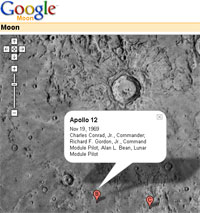 In honour of the first manned Moon Landing back in July 20, 1969, Google have launched an out of this world version of their Google Maps service – Google Moon.
 Although you can use a sliding scale to zoom into the surface – just like the terrestrial version – and view landing sites, there are limitations to how close to the surface you can zoom because of insufficient NASA imagery.
 Glad you asked, and yes, the development of our Lunar hosting and research centre continues apace.
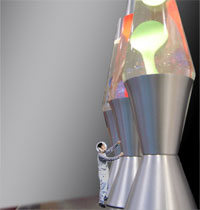 Google are also advertising jobs at their Google Copernicus Hosting Environment and Experiment in Search Engineering (G.C.H.E.E.S.E.), offering “high-density high-delivery hosting (HiDeHiDeHo) and de-oxygenated cubicle dwelling.”
 BT has announced that it will be doubling the speed of its entry-level broadband service.
 BT’s generosity knows some bounds though, with its no frills package retaining its monthly usage limit at 1 gig.
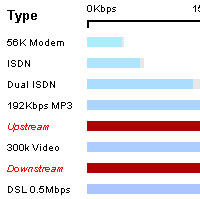 This is the second free upgrade that BT has introduced, with the telecoms giant upping the speed for all of its retail broadband customers back in February.
 I quickly learnt that not only was I paying more than most, but my BT connection was as swift as a sleepy sloth on a hot day compared to the rocket-like speeds quoted by others.
 The doomsayers were predicting a slow year for PC shipments, but a continuing shift to notebooks and falling PC prices have made it a bumper second quarter for the worldwide PC market, according to research companies IDC and Gartner.
 The company enjoyed big sales outside the US and remains the market share leader in many countries throughout Europe.
 Skype has teamed up with The Cloud – Europe’s leading Wi-Fi network provider – to offer low cost Wi-Fi access and Internet voice calls at 6,000 of The Cloud’s hotspots in the UK and Sweden.
 Skype users ambling into a Cloud hotspot will be connected to the service as soon as they flip out their Wi-Fi enabled device.
 “Skype is bringing affordable Wi-Fi and voice calls to millions of users, enabling them to talk, IM and surf conveniently and cost-effectively from thousands of great locations. Our users in the UK and Sweden will benefit from The Cloud’s extensive network coverage in places where people really want to use it.”
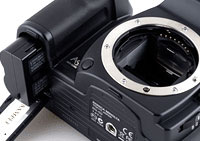
 Konica Minolta and Sony Corporation have reached an agreement to jointly develop digital Single Lens Reflex (dSLR) cameras.
 With Sony bringing their award-winning design expertise to the party – and their image sensor, image processing and battery technologies – we can expect some smarty-pants new product design to emerge from the partnership.
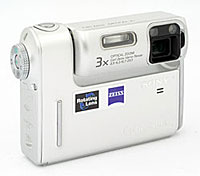 As prices of dSLR’s plummeted, the writing was on the wall for high-end fixed-lens models, so Sony’s move into the dSLR market was not unexpected.
 “Sony has powerful devices and technologies essential for digital cameras,” praised Tsuyoshi Miyachi, President and CEO of Konica Minolta Photo Imaging. “I am extremely excited to work with Sony. Together with Sony, we will endeavour to create new value in the field of imaging through increasing attractiveness of digital SLR cameras where we are strongly focused.”
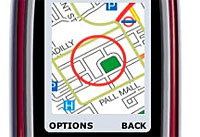
 KidsOK, a tracking service that lets parents locate their child using a mobile phone, has gone on sale in the UK today,
 Parents will then receive a text description and map of the location where there little Johnny’s phone currently resides, accurate to within 500m in built up areas using GSM location-based technology..
 The bit that may strike fear into parents trying to foist these phones on their offspring is that fact that kids have to opt in to the KidsOK service and they can turn off the service any time they like.
 Larger families can enable further handsets on payment of £4.95 p.a. per handset (~US$8.75, ~€7.25). Further ‘pings’ are purchased in bundles of 20 from KidsOK for £9.95 (~US$17.5, ~€14.5).