 Search company Blinkx have launched a free service that lets amateurs and pro filmmakers upload and store their video files to a searchable online library.
The service, called My Blinkx.tv, will make filmmakers’ work available for viewing to Web searchers via a clever conversion process.
Videos submitted to the library are automatically converted into Flash format, with speech soundtracks transcribed and indexed.
Metadata, such as creation date, length, title, owner’s name along with any other relevant information, will also embedded into the content.
Once indexed, uploaded videos can be retrieved and viewed by visitors to My Blinkx.tv via keyword searches.
 Users of the Blinkx.tv service will also be able to create custom channels, based on a specific search term.
Blinkx founder Suranga Chandratillake explained that users could, for example, create a channel for all video results from a My Blinkx.tv search for the term, “Hurricane Katrina.”
My Blinkx.tv service would then continue to add new videos matching the search terms in the background, so that returning users would be presented with up-to-date listings.
The system relies on cookies but Chandratillake said that the company would consider using a more reliable logging in system if there’s enough demand for it.
Users will also be able to access their channels without visiting My Blinkx.tv by setting up a “smart folder” on their PCs.
 This will be automatically populated in the background with videos that match a chosen search term, encouraging users to have the occasional rummage around in their smart folder to see what new videos have been added.
Chandratillake said that Blinkx will initially only feature non-commercial videos – mainly from grassroots groups, individuals and amateur video bloggers – but the company plans to cut deals with commercial video producers keen to include their videos in the service.
The service is free for visitors viewing videos, but Blinkx may introduce the option of charging for video views, with revenue split between Blinkx and the content owners.
The company may also consider raising revenue though video advertising.
According to Chandratillake, My Blinkx.tv already features user-generated video from 3,500 to 4,000 sources, with the service competing with video search services from Google, Yahoo, AOL and MSN. Notably, none of these services currently offer My Blinkx.tv’s automatic, continuous streaming video.
 Oh we like this!
 NYSee – a Web project by developers
 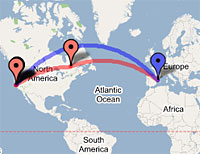 The locations of the cams can be viewed via the Google maps interface as a map, satellite view or hybrid.
 Finally, we took a shine to
  Japan’s largest annual IT show, Ceatec (Combined Exhibition of Advanced Technologies), opens today and will feature around 700 companies, according to the organisers.
 Toshiba has promised to display a super-slim 12.7 millimetre high drive designed for laptops which can read HD-DVD discs and read and write DVDs and CDs.
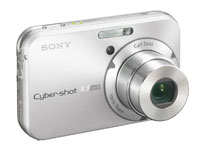 Sony’s new digital compact camera, the DSC-N1, cunningly attempts to combine the functions of a digital camera with a ‘pocket viewer’.
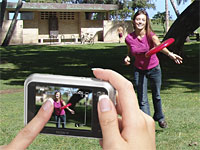 Stored images can be played back individually or as a slideshow, complete with options to add transitions, pans, wipes, fades and zooms, cheesy themes and background music.
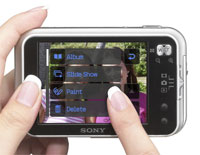 “The combination of these functions makes the N1 ‘more than just a camera’, because it takes sharing to a whole new level.”
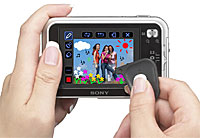 Although the camera can only record stills in JPEG format,
  Britain’s biggest cable operator, NTL, has agreed to shell out an eye-watering $6 billion (~£3.42bn, ~€5bn) for Telewest Global.
 According to a statement – which ends three years of speculation about the merger – Simon Duffy, NTL’s chief executive, will lead the combined company.
 Chairman Cob Stenham can expect his bank balance to increase to the tune of $20m (~£11.4m, ~€16.77m) while chief executive Barry Ellison will no doubt cackle wildly with joy as $17m (~£9.7m, ~€14.25m) rolls into his coffers.
 As the next-generation DVD wars between HD-DVD and Blu-ray Disc grind on, Paramount Home Entertainment has employed a time-honoured fudge and announced that it will be offering movies in both formats.
 Both formats serve up far more storage capacity than current DVD discs, with HD-DVD offering 15GB or 30GB and Blu-ray Disc 25GB or 50GB, depending on the disc.
 Paramount was one of the first major content players to back the Toshiba/NEC-developed HD-DVD format, with other major backers including Warner Home Video, HBO, New Line Cinema, Universal Pictures and Sanyo Electric, followed by Intel and Microsoft last week.
 Influential in Paramount’s decision was the PlayStation 3’s support for Blu-ray Disc.
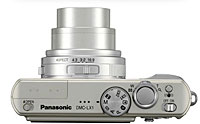
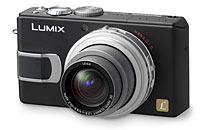 Bibs were hastily donned to soak up the undignified rivers of drooling dribble that appeared in the office when Panasonic first announced the latest addition to their high quality Lumix digital camera range, the LX1, back in July.
 The camera can also shoot in 3:2 and the more conventional 4:3 aspect ratio, with a switch on the lens barrel making it easy to switch to the format best suited for the composition on a shot-by-shot basis.
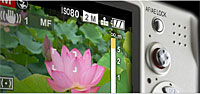 It’s no mean feat to fit an effective stabilisation system into a 4.2 by 2.2 by 1.4 inches camera, and users should find it an invaluable feature for low light photography – small cameras can be notoriously hard to hold steady at slow shutter speeds.
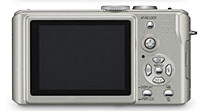 Sensitivity can be set to ISO 80, 100, 200, or 400, with the built in pop-up flash offering coverage up to 13.1 feet in wide-angle mode and 7.5 feet at the telephoto position.
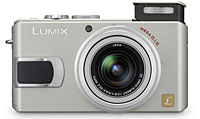 The Leica lens can focus down to two inches in macro modem with focus switchable from spot to single-point, three-point, or nine-point autofocus zones.
 In shooting mode, this presents a wealth of optional information including a handy alignment grid dividing the screen into vertical and horizontal thirds.
 SanDisk have unveiled their “fingernail-sized” new TrustedFlash cards, a technology that embeds Digital Rights Management (DRM) and decryption technology into memory cards, and also includes a subscription manager enabling the cards to be used for digital subscription music services.
 Harar stated that the TrustedFlash card would act like current SD cards, with the technology able to be extend into on-demand content such as feature films and online games.
 SanDisk are also hoping that content providers like music companies, film suppliers and mapping data companies will ship preloaded Gruvi cards with the content protected against copying by TrustedFlash.
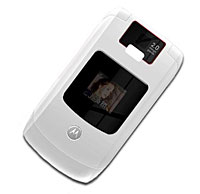 Motorola have offered more details about their forthcoming 3G RAZR V3x slim flip phone.
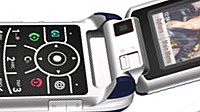 The onboard Bluetooth chip supports wireless stereo sound through Motorola’s Bluetooth Stereo headphones and other compatible hands free wotsits, with up to 512 MB of removable optional TransFlash memory.
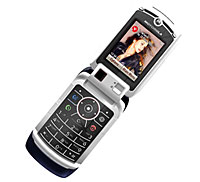 Motorola have also included an advanced speaker-independent voice recognition which lets users state a number/name and be connected without all that pre-recording palaver.
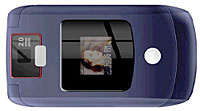 Meanwhile, as Motorola’s phones scoff the pies, rival NEC has launched the
 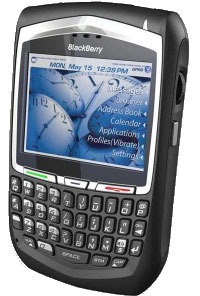 We’re still waiting for the official announcement, but Blackberry enthusiast site Pimstack has managed to unearth some photos and specs of the forthcoming Blackberry 8700.
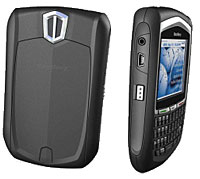 Connectivity is taken care of via quadband GSM/GPRS/EDGE connectivity with onboard support for Bluetooth 2.0. There’s also a hands-free speaker phone built in.
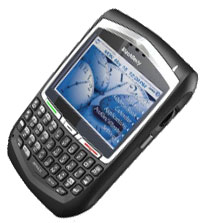 RIM Announce Intel Partnership