 Only 25% of US business travellers are using Wi-Fi hotspots in airports and on planes, despite the growing availability of high-speed, wireless connections.
A report by Gartner reveals that only a quarter of US business travellers want to log on when they’re flying off, and in the UK the percentage is even smaller, with only 17 percent of travelling Brit execs willing to whip out their Wi-Fi wotsits.
The low level of adoption is rather surprising considering the growing number of hotspots and Wi-Fi enabled devices springing up over last two years.
The study suggests that users have been shunning Wi-Fi in airports and in-flight because some are baffled by the process of using the technology.
“While Wi-Fi has come a long way, our survey shows that many business travellers remain uncertain as to why they should use Wi-Fi, what equipment they need, how they can connect and what they will be charged,” said Gartner analyst Delia MacMillan.
“If Wi-Fi providers really want to attract new customers they must convince both end users and organizations of its benefits.”
Although some airlines like Lufthansa and SAS in Europe are installing wireless Internet access in their planes, the majority of travellers (78 percent in the US, 75 in the U.K.) said they would rather stay out of contact while in the air.
 Those surveyed also said that they were more interested in increased onboard personal space, bigger baggage allowances and better entertainment than blasting out emails mid-flight.
It wasn’t all bad news though, with the respondents who actually used Wi-Fi expressing satisfaction with the speed of connection, ease of use and overall value.
The report revealed that wandering Wi-Fi folks were less chuffed with the price of the services and the limited availability of hot spots in useful locations.
“Many organisations will not reimburse their personnel for Wi-Fi access charges, as these fees are often not covered by their telecom contracts,” commented MacMillan.
“If airlines can commit to lower prices then the provision of Wi-Fi access could prove a key attraction to business travellers.”
Gartner’s report predicts that broadband-speed 3G cellphone networks could put pressure on Wi-Fi providers to cut prices.
 With Sony and Toshiba still enjoying a schoolyard scrap over which of their rival formats should become the standard format for next-generation DVDs, Samsung have announced a nifty compromise that plays both formats.
 Although both Blu-Ray and HD DVD use groovy blue laser light to dramatically increase the storage capacity of a DVD-sized optical disc, they work in completely different ways.
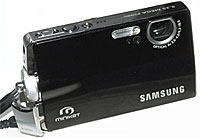 Samsung have unveiled their sleek, credit-card sized Miniket VP-MS15 digital camera at the Berlin IFA show.
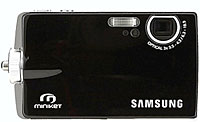 Connecting the Miniket via USB 2.0 also lets it be used as a Webcam or a ‘portable hard drive’.
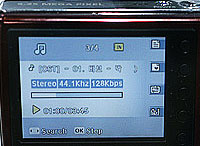 Samsung have also released two identical-looking smaller brothers to the MS15; the VP-MS11, with 128MB of onboard memory. and the VP-MS10 with 64MB.
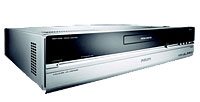 Philips has announced the Showline MCP 9350i, a media PC powered by Microsoft’s Windows XP Media Center Edition 2005 platform.
 There are two integrated tuners onboard letting sofa-reclining types watch one channel while recording another on the 250 GB hard drive or to CD or DVD.
 Philips’ Digital Natural Motion technology is employed to improve video quality and reduce stutter, with built in support for the UPnP protocol to allowing the unit to act as a media server for products in Philips’ Streamium range of media viewers.
 UPDATE – Thanks for the number of people who have written to us about this one, lead by Matt Lacey.
 The 6.8GHz behemoth is powered by AtomChip’s Quantum II processor (or four 1.7GHz Intel Pentium M processors) with a terabyte of Quantum-Optical non-volatile RAM (NvIOpSRAM-SODIMM 200-pin) onboard.
 Despite the nation-threatening amount of power on hand, Atom Chip are claiming an impressive battery life of approximately 8 hours for the AtomChip II processor and 3 hours for the 4 x Intel Pentium M processor version.
 Skype has slapped hands and manfully patted backs with German network operator E-Plus as the VoIP giant secures their first 3G partnership.
 The busy-bee Skypesters are said to be already hatching up schemes with a number of major handset and headset manufacturers – including Motorola – to develop a broader range of offer Skype-ready devices
 Skype currently claims more than 2.8 million Skype users in Germany.
 In a damning blow to the UK government’s love affair with identity cards, a British criminologist has warned that the new technology could actually increase, rather than solve, the problem of identity theft and fraud.
 “Studying the way that individuals disclose sensitive information would be far more valuable in preventing identity fraud than the evolution of technologically advanced but ultimately fallible measures to prevent misuse of personal information after it has been obtained,” she added.
 Prototype cellphones capable of transmitting data faster than a startled squirrel on speed have been demonstrated by NTT DoCoMo in Japan, according to the New Scientist.
 During the tests, another smartypants wireless networking trick was employed to send data via various routes across a network to further increase data capacity.
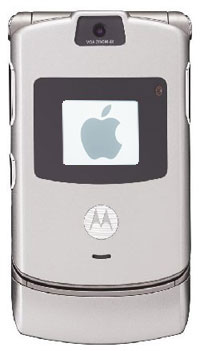 Pop stars are falling over themselves to fill their pockets with corporate cash as the Apple/Motorola iTunes phone promotion machine switches into overdrive.
 The Brand Republic article goes on to say that, “The ads may debut from next week, at the same time the Motorola phone with iPod personal music system is launched.”
 For the first time since its UK launch May 2004, the online music store Napster has dished the dirt on its usage and membership figures for the UK.
 This represents an amazing turnaround for Napster who famously started life as the brainchild of an 18-year-old college dropout named Shawn Fanning in 1999.
 Napster folded in September 2002, but the brand was revived as a legal P2P service by the owners of the Napster name Roxio in 2003, quickly growing to become a major competitor for market leader iTunes.