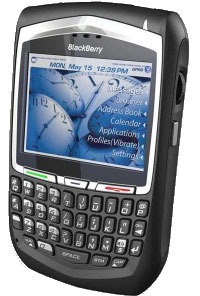
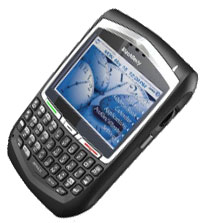
 We’re still waiting for the official announcement, but Blackberry enthusiast site Pimstack has managed to unearth some photos and specs of the forthcoming Blackberry 8700.
Expected to be released around December/January, the matt-black and silver smartphone looks sure to appeal to blokes who like their technology beefy, manly and without a girly curve in sight.
Thinner and narrower than the 7200 series, the Darth Vader-esque case sports “high-end ornamental accents” (huh?) with a large 320 x 240 (1/4 VGA) colour LCD screen and a light sensor to automatically adjust brightness.
Below the screen is a full QWERTY keypad with dedicated Send & End Keys, a mute key and two User-Definable Keys.
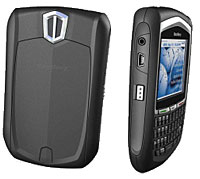 Connectivity is taken care of via quadband GSM/GPRS/EDGE connectivity with onboard support for Bluetooth 2.0. There’s also a hands-free speaker phone built in.
Powering up the Blackberry is a 312 MHz processor, with 16MB RAM and 64MB ROM built in.
Research in Motion (RIM) are claiming that their updated OS will offer an improved user interface and better performance across the board, so users can look forward to nippier navigation, faster web browsing and speedier programs.
The new phone (codenamed Electron) will also provide contact-specific ring tones, better support for viewing attachments and Enhanced Power Point slide viewing.
 RIM Announce Intel Partnership
Elsewhere, RIM have announced that they will be using Intel’s XScale PXA9xx mobile phone processors in upcoming BlackBerry devices.
The Intel processor, with the strange codename of “Hermon”, will run on Enhanced Data Rates for Global Evolution networks (EDGE).
This technology lets users connect to the Internet and send and receive data at broadband comparable speeds.
The chip is also expected to support video conferencing, which suggests that there’s 3G support going on.
RIM’s co-chief executive, Mike Lazaridis, commented that the next-generation BlackBerries would boast increased browser speeds and help the company push into new markets, while predicting that the new platform would also appeal to third-party application developers.
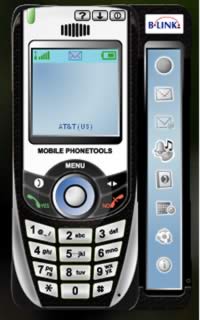 If you’ve ever spent hours shouting at the little blinking blue light on your laptop screaming, “what do you mean you can’t find my phone? IT’S THERE!!”, then you may find Broadcom’s new BLINK Bluetooth software (Bluetooth-Link = BLINK, getit?) bringing your blood pressure down.
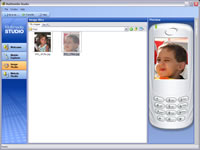 BLINK software claims to soothe the troubled brows of baffled Bluetooth uses with an intuitive graphical user interface (GUI) that makes complex Bluetooth-related tasks “as simple as browsing the Internet.”
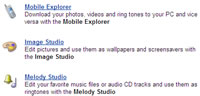 Once fired up, the BLINK software serves up a graphical representation of the user’s mobile phone on their desktop or notebook PC screens.
 “Digital photos, phone numbers and calendar appointments are literally trapped inside users’ cell phones because of the complexity involved in transferring this information to PCs and other devices,” said Brian O’Rourke, Senior Analyst at In-Stat.
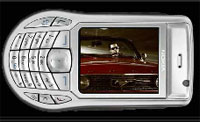 Virgin’s ‘independent-style’ record label, V2 Music has teamed up with mobile video solutions developer Rok Player to announce the release of an ‘indie music video album’ for playing on mobile phones.
 Using Rok Player technology, indie kids can play back audio-visual content preloaded on memory cards at an impressive 24 frames a second (full screen) on compatible mobile handsets.
 “This is such an exciting development in the distribution of music videos” enthused Beth Appleton of V2 Music “as nearly everyone has, or will have, a compatible mobile phone and ROK Player turns those into portable DVD players. So now, for the first time, people can watch as well as listen to their favourite artists perform”.
 Bruce Renny of ROK , commented, “We’re already seeing tremendous interest in our music video albums for mobile phones, and to be able to include this new title in our portfolio is tremendous. We’re expecting the V2 album to prove very popular indeed because of the high quality of the artists it features”.
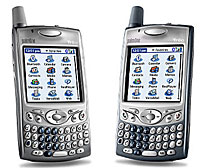 To the sound of a thousand wailing Palm Pilots, Palm has unveiled a version of the classic Treo smartphone running on Windows Mobile 5.0.
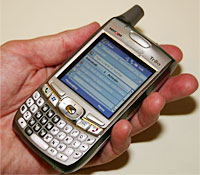 Palm users still waiting for the Wi-Fi card categorically promised at the
 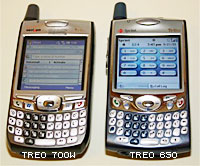 Carmi Levy, Senior Research Analyst at Info-Tech Research Group commented that the new Treo signals a massive shift in the handheld/smartphone market, adding that “when viewed in conjunction with the sale of PalmSource earlier this month, it’s an acceleration in the demise of the Palm OS platform and final confirmation that its once-dominant position in the broader handheld market is gone for good.
 There’s been no release date set for the Windows-based Treo yet, but it is expected to be available “very early” in 2006.
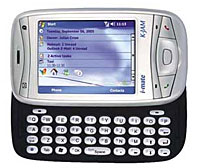 Building on the success of their hugely popular JAM phone, i-mate have announced the new K-JAM smartphone/PDA.
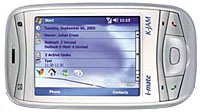 The display comes in the form of a 2.8″ QVGA (240 x 320 pixels) 64k Transflective screen, and the device runs on the latest Windows Mobile 5.0 OS.
 The phone offers support for a wide range of music formats, and claims 10 hours running time in PDA mode and 4-5 hours talk time.
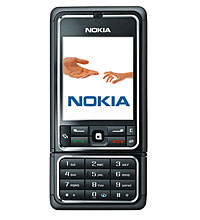 Finnish mobile giants Nokia have come up with the Nokia 3250, a new music-driven mobile phone featuring dedicated music keys and storage for up to 750 songs.
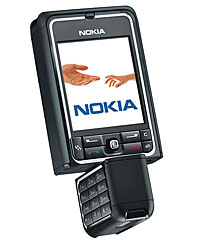 Songs can be converted from CD and transferred from home PCs using the “drag and drop” Nokia Audio Manager software.
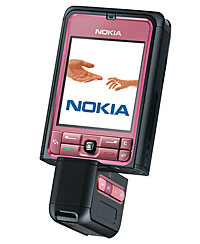 “Nokia connects people to their passions – music – and as the world’s largest manufacturer of digital music players, Nokia is leading the charge to make mobile music widely accessible. The XpressMusic feature brand, also introduced today, makes it easier for consumers to identify those Nokia devices which are specifically designed to listen to music,” purred Kai Öistämö, Senior Vice President, Mobile Phones, Nokia.
 An Australian production company has made what they are claiming is the first music video shot entirely with mobile-phone cameras.
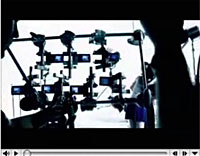 A multiplicity of mobiles (which look like Sony Ericsson k750i’s to us) were set up on frames and tripods with handheld footage recorded by four crew members who wandered around the band as they played, with the footage being sent via Bluetooth to laptops.
 The director of music video, Grant Marshall from Film Headquarters tries to explain, ‘We came up with this idea 18 months ago but couldn’t find a band that would embrace the risk and vision. P.U.S.A loved the concept and were brave enough to undertake the risk. This was a fantastic experience for all of us. The band was fabulous and incredibly professional.”
 Neat Idea!
 They’ve done it again
 It’s like the Middle Ages all over again!