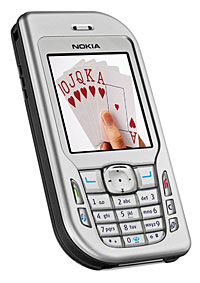
 Forget mobile gaming – the big money’s in mobile gambling, according a report by Informa Telecoms & Media
The ‘Mobile Gambling’ report predicts that the market for mobile gambling content is going to soar from US$1.2bn (~£0.67bn. ~€0.98bn) of annual revenues in 2005 to US$7.6bn (~£4.30bn, ~€6.21bn) by 2010, with more than 200 million consumers gambling the odds using mobile devices.
There is a joker in the pack however, with the report warning that the growth of the mobile gambling market is dependent upon mobile gambling operators being able to sidefoot legislative, technological and cultural hurdles.
“Mobile gambling is already generating significant revenues, but there is room for sharp growth in the years ahead,” says Stuart Dredge, the report’s author.
“Operators recognise that there is a strong demand for mobile gambling services, and there is no shortage of companies looking to provide them. However, the industry must keep in mind its responsibilities to tackle underage and problem gambling.”
The report looked at the three key types of mobile gambling – sports betting, lotteries and casino-gaming – and predicted that lotteries are going to be the number one form of mobile gambling in the next five years, spurred on by widespread handset support.
 With casinos continuing to migrate their games to mobile, the report predicts growing popularity, although sports betting is expected to be a niche sector by comparison, despite bookmakers being keen to launch mobile applications for their customers to bet on the move.
The report sees Europe remaining the largest market for mobile gambling, generating a hefty US$3.2bn of annual revenues by 2010.
Hot on its heels will be the Asia-Pacific market, forecasted to generate US$2.7bn (~£1.52bn, ~€2.20bn) by 2010.
North America emerges as the dark horse, as the size of the market there will be dependant on mobile gambling being legalised in the US and the impact of any restrictions placed upon it.
Even with these caveats, the report still predicts US$979 million (~£553m, ~€800m) of annual revenues for the region by 2010.
 Those of you struggling to maintain a Wi-Fi connection from next door’s access point may be exclaiming a Victor Meldrew-style, “I don’t belieeeeve it!” at the news of a mighty new world record being set for an unamplified Wi-Fi link.
 There is now talk of attempts to smash the current Bluetooth record of 1.08 miles.
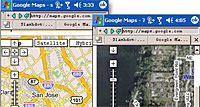 The Mozilla Foundation has released a technology preview of a mobile-phone browser, based on the same code that powers the popular Firefox browser.
 Hackers have made chumps out of Microsoft, successfully bypassing their Windows Genuine Advantage (WGA) Programme only days after the anti-piracy scheme was activated.
 Figures from the Mobile Data Association (MDA) reveal that U.K. mobile phone users sent an astonishing 2.6 billion text messages in June.
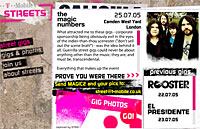 Following a long tradition of The Man stealing ideas off the street to flog their products, T-Mobile is organising a series of impromptu ‘street gigs’ to promote their new Sony Ericsson D750i camera phone.
 Keen to milk every last ounce of PR potential from the gigs, T-Mobile will be broadcasting the performances online, with company bods on hand to encourage T-Mobile subscribers to test the new handset
  “T-Mobile Street Gigs is the first of our new initiatives to deliver unique experiences for customers,” grooved Phil Chapman, UK marketing director, loosening his tie and turning down the David Gray.
 As part of Motorola’s strategy to tempt home and business with new services, the company has announced that it will add Yahoo! Web services to their Linux-based mobile devices.
 Ron Garriques, president of Motorola’s mobile device business, said: “By optimising these products for our leading Linux and Java software platform, we’re making it just that much easier for operators to maximize revenue while delivering the most innovative consumer experiences.”
 Elsewhere, the company have also announced that Vonage will offer the new Motorola VT2442 voice over Internet Protocol (VoIP) gateway to its Internet telephony customers.
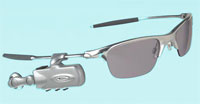 Put two cool branded products together – Motorola mobiles and Oakley sunglasses – and what do you get?
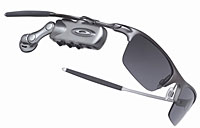 The Bluetooth box clamps on to one of the arms of the sunglasses and sports volume controls and an answer button on its lower edge.
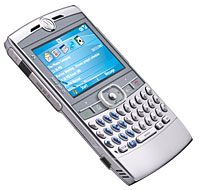 Billed as the “thinnest, lightest, coolest QWERTY on the Planet”, the new Q phone from Motorola has set a few hearts pounding in Chez Digi-Lifestyles.
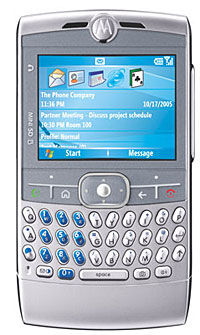 There’s a Mini-SD slot provided for extra storage and connectivity is taken care of via Bluetooth, IrDA and mini-USB.
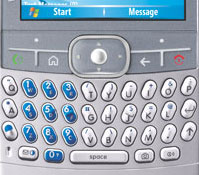 “With the Moto Q, we’ve combined the best voice, data and design technology in one ultra-thin, intelligent, hard-working, and incredibly must-have device. Today’s office space has the potential to be any place you want it to be with Q.”
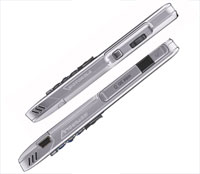 The Moto Q is expected to be available in Q1 2006.
 Skype has teamed up with The Cloud – Europe’s leading Wi-Fi network provider – to offer low cost Wi-Fi access and Internet voice calls at 6,000 of The Cloud’s hotspots in the UK and Sweden.
 Skype users ambling into a Cloud hotspot will be connected to the service as soon as they flip out their Wi-Fi enabled device.
 “Skype is bringing affordable Wi-Fi and voice calls to millions of users, enabling them to talk, IM and surf conveniently and cost-effectively from thousands of great locations. Our users in the UK and Sweden will benefit from The Cloud’s extensive network coverage in places where people really want to use it.”
 KidsOK, a tracking service that lets parents locate their child using a mobile phone, has gone on sale in the UK today,
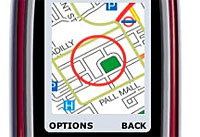
 Parents will then receive a text description and map of the location where there little Johnny’s phone currently resides, accurate to within 500m in built up areas using GSM location-based technology..
 The bit that may strike fear into parents trying to foist these phones on their offspring is that fact that kids have to opt in to the KidsOK service and they can turn off the service any time they like.
 Larger families can enable further handsets on payment of £4.95 p.a. per handset (~US$8.75, ~€7.25). Further ‘pings’ are purchased in bundles of 20 from KidsOK for £9.95 (~US$17.5, ~€14.5).
 In an initiative led by the Finnish Population Register (VRK), a department of the Finnish Ministry of the Interior, mobile specialist SmartTrust is helping mobile users in Finland to securely identify themselves and sign for goods and services across a range of public and private sector providers using just their mobile phone.
 “The mobile phone and SIM card have, by default, become the world’s most pervasive smart card / card reader combination,” explains Paul Cuss, CEO of SmartTrust. “Unlike the existing credit-card sized ID cards that Finns carry around in their wallets, the SIM-based certificates do not require the user to be present when authenticating himself via an independent card reader. In this instance, the handset acts as the card reader, requesting the user to authenticate himself through a PIN code request, and sends an electronic digital signature to the service provider.”