
Thanks to Mathew for corrections to this piece
Google has slapped down a big leathery gauntlet to the communications industry with the beta launch of its instant messaging service with voice-over-IP capabilities today.
Currently in beta, the Google Talk program will link its instant-messaging service to its e-mail service, Gmail, letting users contact each other over email, IM or a VoIP call.
 The program, Google Talk, is based on the open source Jabber protocol and competes directly with the three major providers of instant messaging – AOL, Microsoft and Yahoo.
With the company trumpeting the service’s integration with GMail, Google Talk will use the same log-in information as their email account, with users able to access their inbox from within the Google Talk interface and send e-mails from there too.
Interestingly Google appears to refer to the accounts as a Google User Account – an interesting shift, pointing to the continued rise of additional Google services.
Users will be able to chat via IM and then talk to contacts on Google Talk by clicking on a “call” button in an open chat window or by clicking on the phone icon next to names on the contact list.
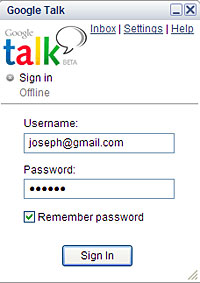 The software will let users have multiple voice sessions open at the same time, but only one can be active at any given time.
Gmail contacts will be loaded automatically into the Google Talk interface, letting users exchange instant messages with those who have downloaded the IM software.
Jabber is an open standard messaging protocol called eXtensible Message and Presence Protocol, or XMPP, and Google have stated that the company hoped to use the standard to interconnect the messaging industry. Many feel XMPP have advantages over SIP (Session Initiation Protocol, commonly used for VoIP) for voice communications.
 Currently, the three major messaging services are closed shops that generally don’t permit users to send messages to and from competing services – a source of continuing frustration for many IM users.
Jabber have been reported as preparing to interconnect with AOL, whose AOL Instant Messenger system is the largest provider of messaging.
“We are going to start working to federate all the other networks,” said Georges Harik, a Google director of product management who is responsible for Google Talk and several other services.
According to figures from comScore Media Metrix, more than 80 million Americans chattered on instant-messaging services in July, with 30.9 million using AIM, 23.3 million chatting on MSN Messenger and 23.2 million connecting via Yahoo Insider.
 Peter Saint-Andre, executive director of the Jabber Software Foundation, estimated that 13.5 million use the Jabber standard, based on figures from Osterman Research.
The company is yet to announce how the new service may earn its keep, but Google has stated that it intends to look for revenue opportunities in the future.
Google Talk reveals the company’s continuing ambitions provide to extend beyond Web searching, with some analysts predicting that Google will soon be taking on voice-over-Internet phone services like Vonage and Skype as well as the communication industry big boys.
How the industry reacts to this onslaught should be entertaining.
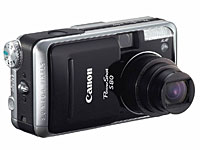 Canon has announced its new PowerShot S80 consumer camera, an eight megapixel compact camera with a wide range of auto and manual controls.
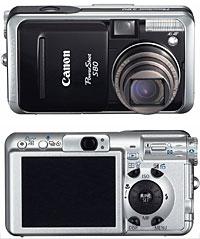 The camera packs in some advanced features including real-time histogram display, FlexiZone AF/AE with a freely movable focus point and manual focus override with 21 shooting modes taking care of most lighting conditions.
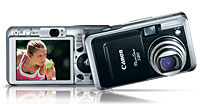 Surprisingly, RAW capture has been left off the spec list, although there’s USB 2.0 compatibility to help speedily transfer images to a PC speedily.
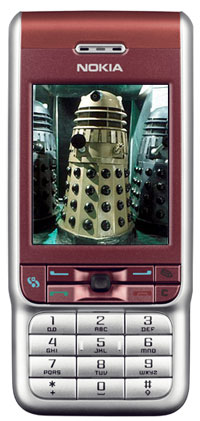 The BBC has announced that it will be offering classic episodes of “Doctor Who” and “Red Dwarf” on digital video chips for viewing on mobile phones.
 Films can be fast forwarded, rewound and paused, just like a conventional movie player.
 The first scheduled release is The Five Doctors, a 90-minute Dr Who special originally shown in 1983, followed by three episodes of cult sci-fi hit, Red Dwarf.
 Warner Music Group has announced a new digital music distribution mechanism based on downloads rather than physical media like CDs.
 With far lower production costs, Bronfman claimed that the e-label will give recording artists a “supportive, lower-risk environment” (I think this means “less cash from the record company”) without as much pressure for huge commercial hits – something that could benefit artists with a more “selective audience”.
 Bronfman called on the technology industry to work on digital rights management (DRM) standards, arguing that compulsory licensing – with support from P-to-P vendors – would set a price for downloaded music while forcing music companies to make their products available online to P-to-P users.
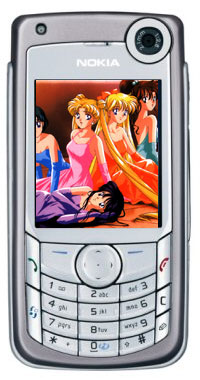 Sony Pictures Entertainment is set to triple the number of comic books it offers as mobile downloads in Japan, making the company the number one provider of “manga” downloads.
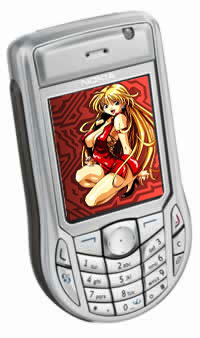 Sony intends to offer more comic books than competitors like NTT Solmare, (unit of telecom firm NTT) and Toppan Printing.
 Many who used the original of Google Desktop Search loved it. If you had a mention of the word you’d searched for, whether it be in a word document, an email or even in a IM session, up would come the list of mentions.
 Last week a lot of fuss was generated in the blogging world when Microsoft decided to refer to RSS as Web Feeds in their upcoming updated browser, Internet Explorer 7 Beta 1. It will be interesting to see if equal vitriol will be reserved for Google as they ‘rename’ RSS to Web Clips.
 After a brief look at it, we found that it appears to have rectified one of the problems with the old version – primarily that it slowed your machine down when it was loaded. This slow down often was so significant that it caused those with slower/older machines, or those who actually needed the power of their processors, to remove it – despite its benefits.
 Thanks to Tim for the update on the details of this story
 While not the first synth, it became popular as it grabbed musicians attention in its flexibility, enabling them to express themselves.
 I was lucky enough to see the film Moog, by Hans Fjellestad a couple of week ago and if you haven’t seen it I’d highly recommend that you do. It was clear that Moog was a man who was not only admired by the people around him, but genuinely liked.
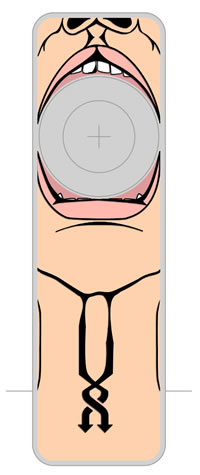 Shortly after the launch of the Apple iPod shuffle, if not simultaneously, manufacturers were quick to jump on the bandwagon by producing and offering thin cases or skins.
 Design your own shuffle cover Shuffle Art Archives is an enterprising Japanese Web site which has assembled collections of designs for decorative stickers that you can apply to your little white pride and joy.
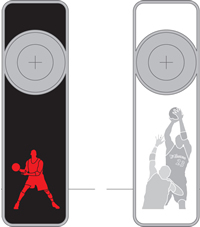 While some people take the simple approach and cover only one face of the player, others are more devoted and produce stickers for
  Amazon is testing its new A9 mapping service that lets users view street-level photos of city blocks surrounding a requested address.
 Amazon first introduced street-level photographs of specific addresses as part of its Yellow Pages listings, but the company believes that consumers will find the A9 service a more helpful view than Google mappings satellite views.
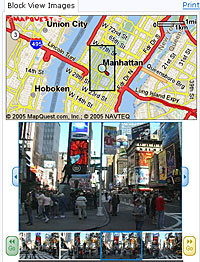 Not surprisingly, the horizon-challenged photographs ably illustrate that there’s none of Bresson’s magic in evidence, with pictures being automatically snapped by trucks equipped with digital cameras and GPS, receivers.
 First of all, space is cool from the perspective of a teenager, and there’s no worrying about how much tax payers money is put into these kind of projects. With this in mind, I was delighted to hear that the Shuttle