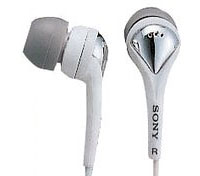
 It’s almost always worthwhile upgrading the cheapskate headphones that invariably come bundled with MP3 players and phones – especially if you’re currently strutting around with a pair of ‘Mug Me Now!’ Apple iPod ‘phones.
Sony has acquired a fine reputation for their consumer headphones and we looked forward to testing the Fontopia MDR-EX71SL in-ear headphones.
Sony have cottoned on to the fact that a lot of people won’t want half a mile of excess cord flapping around, so have fitted the headphones with a short lead, ideal for plugging into lanyard remote controls.
If you need a longer lead, you can simply attach the extension cord to extend the cable to 1m.
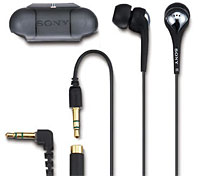 The closed-type Fontopia design is powered by super-small 9 mm drivers kitted out in Spinal Tap black with go-faster silver accents (they’re also available in Mac-like white, but that’s just asking for trouble).
Looking and feeling disturbingly medical, the headphones come with three sets of attachable soft silicon earbuds in small, medium and large sizes.
These floppy bits of thin, rubber-like material fit on the headphones to provide a tight seal around your ears.
We have to say that fitting them felt a little strange, but once our ears were suitably isolated, we tried the Sony Fontopias through a variety of sources; an MP3 player, PDA smartphone and high end hi-fi system.
Playing back a selection of tunes on the MP3 player, we immediately noticed a huge improvement in the sound quality, with a deep, smooth bass making itself felt with vocals being rendered more crisply.
The same improvement was heard on the smartphone, but the hi-fi system merely served to highlight the limitations of the ‘phones – not unreasonable considering the $32 (~£18 ~€26) price tag.
Suitably impressed with our tests, we decided to take the headphones with us on a business trip and here’s where the problems began.
With the silicon earbuds forming a super tight seal around your lug holes, everything starts to sound a bit weird and distant when you’re walking the streets.
Your own footsteps resonate through your head like you’re King Kong going for a walk in diver’s boots and if you hum along to a tune it sounds like there’s several hives’ worth of bees joining in.
It was really, really unnerving and, frankly, rather unpleasant and we wished we’d stuck with our original ‘phones.
However, once on a train, the Fontopias came into their own, doing a wonderful job of delivering high quality sounds while almost silencing the screaming kid and Cock-er-nee Geeza shouting into his mobile opposite.
So we’ve got mixed feelings about these headphones: if you don’t mind sounding like a leaden leviathan going for a stroll, then the Fontopias represent great value, with their sonic quality improving vastly on headphones bundled with popular MP3 players.
We loved relaxing in splendid sonic isolation on the train, but as soon as hit the city streets we couldn’t bear the disorientating feelings we got from the Fontopias.
As a result, we strongly recommend trying these ‘phones out before buying.
Sound quality 4/5 

Build Quality 4/5
Overall 4/5 (on the train) 1/5 on the streets
Specs:
Frequency Response: 6 – 23,000 Hz
Headphone Output: Power handling capacity: 100mW
Impedance: 16 ohms at 1 kHz
Cord: OFC; Neck Chain, 4 feet (1.2m)
Magnet: 400-kj/m3 a Ultra-High-Power Neodymium Magnet
Diaphragm: PET, long-throw
Driver Unit: 9mm diameter
Other: Lateral, In-the-ear, Closed, Dynamic
Plug: Gold-plated, L-Shaped, Stereo Mini Plug
Sensitivity: 100 dB/mW
Weight: 0.1 oz. (4g), without cord
 The festival has been developed by Bloc (Creative Technology Wales) and Chapter Arts Centre, Cardiff. They have managed to accommodate a large number of complex yet accessible projects. This collaboration is all the more impressive in its scale when you realise that both organisations have their own projects running concurrently (Bloc are developing Northern and Southern pilot projects in Wales with accompanying seminars; Chapter are hosting the first UK showing o the artists Olaf Breuning).
 To join in you can access a number of computer terminals at the National Museum and Gallery or at one of the festival hubs at Chapter or g39 (cor). If you are unable to visit you can play from your own
  The artist group Second Site will be displaying new video works in the windows of a empty bank on Bute Street, while Chris Evans will project his interactive game onto St John’s Church in the centre of Cardiff.
 It’s a fact of life – almost everywhere we turn we are surrounded by technology. From mobile phones and digital cameras to TVs and video games. But as well as making our lives easier and providing us with entertainment, more and more artists are now turning to everyday technologies when they create their work.
 “The event will be held at various sites across the capital and will illuminate the city with dynamic and individual work using a range of new and existing technologies,” said festival co-director Emma Posey.
 “We want to create a vibrant creative technology sector in Wales, with the festival celebrating this every two years.”
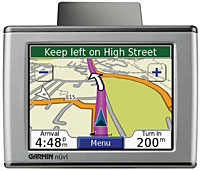 Quickly earning a We Want One Now Please accolade, Garmin have announced the nüvi, a feature packed GPS travel assistant the size of a deck of playing cards.
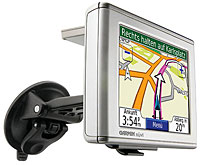 Garmin are claiming that the built-in lithium ion battery offers between 4-8 hours of battery life.
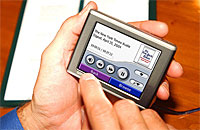 With the guide, travellers can look up and translate more than 17,000 words or 20,000 phrases per language with a text-to-speech interface letting users talka da lingo.
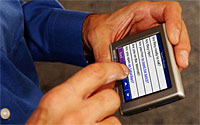 Sold exclusively in Europe, the nüvi 300 comes with approximately 200 MBs of internal memory for storage of supplemental maps, MP3s, and audio books (available from Audible.com). Pricing to be announced.
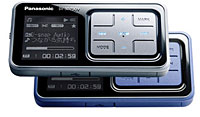 Panasonic has announced a new range of attractive music players with battery lives that make the Duracell bunny look like a fag-smoking sloth in lead boots.
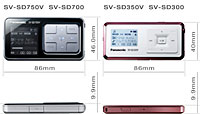 The SD350V/ SD300V models come with a smaller display (5 lines), less fancy navigation buttons and a battery claiming up to 94 hours of SD audio playback.
 The site also bangs on about Panasonic’s “Double drive in side phone” which, apparently, has separate drivers for bass and treble raising, the, err, “shelter density”.
 The SV-SD750V/700 measures up at 87.3x46x11mm and 48.4g, while the SV-SD350V/300 is marginally smaller at 87×40.5×10.3mm and 47.9g.
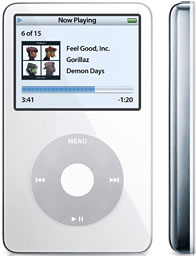 After weeks of frantic speculation that a video-capable iPod was on the way, Apple have sure enough announced the very thing at their event in the California Theatre in San Jose and BBC Television Centre in the UK.
 New iMac G5. A bit faster, but the big thing is FrontRow. It’s Apple’s Media Centre-killer. The new Apple Remote, a svelte 6 button remote control that looks like a shuffle, controls any media you have on your iMac. Makes the MS Media Centre 26+ button remote look very wrong – too tech. Simplicity reigns. iSight camera is built in. Parallel output to bigger screen, projector. Price is very tempting starting at $1,299 (17″ £899 inc vat, €1379) (20″ £1199, €1799).
 Video-capable iPod. Next gen iPod with 30% thinner than current generation player but with a bigger 2.5″ colour screen. 320×240 QVGA (quarter VGA), but not wide screen as rumoured. Video playback supports MPEG-4 and h.264 playback. 30Gb & 60Gb. S-vdeo out through the doc, but video will appear pixelated on full size TV screen. The 30GB should go for $299 (~£219~€349), and the 60GB for $399 (~£300~€469). They’re on the Apple online Store and will be shipping next week.?
 “It’s never been done before, where you could view hit TV shows and buy them online the day after they’re shown,” Jobs said. While this may be true that people have not been able to _Buy_ it, but let’s not forget that the BBC has the iMP trial running, where you can get shows straight after they’re shown – but for nothing.
 BPI, the UK record label industry association has released its third-quarter report revealing that it’s boom time for the Brit digital music industry.
 Digital is also claiming a bigger share of the Top 75 singles chart, growing from 15.9 percent when the combined chart launched in mid-April to 25.5 percent at the end of August.
 Once again, the death of vinyl has been exaggerated with the 7-inch physical singles market registering 80 per cent growth with 800,000 sales.
 “While the record label model of investing in the best new music talent remains the same, the emergence of innovative new digital services means that the record companies can offer consumers even greater choice as to how to access their music.”
 Virgin’s ‘independent-style’ record label, V2 Music has teamed up with mobile video solutions developer Rok Player to announce the release of an ‘indie music video album’ for playing on mobile phones.
 Using Rok Player technology, indie kids can play back audio-visual content preloaded on memory cards at an impressive 24 frames a second (full screen) on compatible mobile handsets.
 “This is such an exciting development in the distribution of music videos” enthused Beth Appleton of V2 Music “as nearly everyone has, or will have, a compatible mobile phone and ROK Player turns those into portable DVD players. So now, for the first time, people can watch as well as listen to their favourite artists perform”.
 Bruce Renny of ROK , commented, “We’re already seeing tremendous interest in our music video albums for mobile phones, and to be able to include this new title in our portfolio is tremendous. We’re expecting the V2 album to prove very popular indeed because of the high quality of the artists it features”.
 An Australian production company has made what they are claiming is the first music video shot entirely with mobile-phone cameras.
 A multiplicity of mobiles (which look like Sony Ericsson k750i’s to us) were set up on frames and tripods with handheld footage recorded by four crew members who wandered around the band as they played, with the footage being sent via Bluetooth to laptops.
 The director of music video, Grant Marshall from Film Headquarters tries to explain, ‘We came up with this idea 18 months ago but couldn’t find a band that would embrace the risk and vision. P.U.S.A loved the concept and were brave enough to undertake the risk. This was a fantastic experience for all of us. The band was fabulous and incredibly professional.”
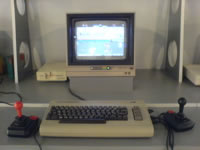
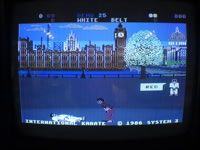
 Mention the name “Commodore” to old skool gamers of a certain age, and you might see a tear welling up in their eyes as they recall long, blissful hours playing Frontier Elite, Sensible Soccer and Lemmings on the legendary gaming platform.
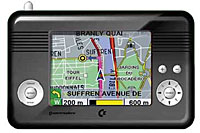
 Codenamed ‘The Navigator Combo’, the Windows CE-based handheld comes with a 30GB hard drive (preloaded with maps), a big 3.6in touch-screen display and an integrated GPS receiver, all packed into a refreshingly chunky case.
 Videos can also be downloaded from the Internet or transferred from PCs via USB 2.0, or stored on SD memory cards.
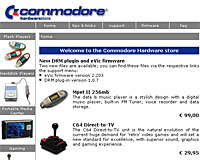
 The two companies presented a wide range of shiny new consumer electronic products for consumers and the retail market, including MP3/MP4-players, C64 gaming joysticks, multimedia download dispensers and home media centers.
 Building up to the required mutual backslap, he added, “Therefore the management of Yeahronimo and SupportPlus believe it is an obligation, when using the Commodore name, to continue offering the electronics consumer with products that have a high-quality and are attractive in price. SupportPlus already has showed they are an excellent partner in the historic re-launch of Commodore.”