 BT has today set-up a new division, known as OpenReach. They’ve been under pressure from some time from competitors and regulators to curb their monopolistic tendencies (they still own over 85% if the infrastructure in the UK). There has even been talk of splitting BT up – although OfCom has currently reject this.
BT’s response is OpenReach. A division that runs the copper in the ground, which will give equal access to BT Wholesale (who can sell it on with services to BT Retail and others) and non-BT operators in the local loop unbundling (LLU) game (such as Bulldog, Easynet etc). OpenReach (Don’t you find that Open seems to be BT’s buzzword – OpenWorld was first, perhaps BT Open will be next, then all their divisions will convert with the word Open tacked to it) will still be a division of BT Group (maybe now OpenGroup?) but will be run by the EAB (Equal Access Board) which is made up of both BT, and more importantly, non-BT people.
Smoke and mirrors
Though this is a look like a commendable approach, it may also be a huge gambit that BT are playing in order to keep everyone’s eye off their real game.
Ofcom (the Super Regulator) are under tremendous pressure to maintain a level telecoms playing field, this is added to by the UK government putting further pressure on them, as broadband is seen to be a key economic marker. This has made Ofcom wield a double-edged sword – forcing BT to maintain wholesale pricing on their ADSL services (i.e. not lower them), until there at least 1.5m unbundled lines in the UK.
At first glance this sounds like a good idea, as it gives the LLU operators a chance to launch their services without BT suddenly reacting and putting everyone out of business by massive wholesale price cuts. However, the other side of this is that there are 5m+ BT Wholesale customers (via broadband ISPs) out there now who won’t see massive price cuts.
What’s good for LLU is probably not so good (at least in the short term) for the majority of broadband users in the UK – and by implication the population of the UK.
OpenReach doesn’t help those users either, in fact it just adds another level of confusion.
Distraction
BT’s competition now have to worry about what OpenReach are up to, and gives the opportunity for another several years of arguments and Ofcom intervention. While everyone’s arguing with each other (sadly not BT), they are taking their eye off BT’s long term plans. This is a big mistake, and if they don’t correct this, they won’t be in business in the future.
BT to a degree want this, they have teams of regulatory lawyers who, after long period of discussion, can agree to certain things and make life look lovely in one sentence, while tying things in red-tape in another. It’s well worth noting that BT have a bigger regulatory department than Ofcom have staff.
What’s to be done with LLU in the UK?
LLU operators are slowly gaining a foothold and launching innovative services, leaving BT to catch-up. Unfortunately there are less than 100,000 unbundled lines compared to BT’s 5m+ DSL customers and their 25m connected premises.
To make LLU economic, the operators are picking exchanges that have a high population density and the ‘right’ demographic – leading to all the operators tending to pick the same exchanges. There are 5,600 digital local exchanges (DLEs) in the UK, even an operator with a LOT of money is likely to target less than 1,000 of them, most seem to be averaging around 400.
The real boost to LLU that’s needed is co-operation. If all the non-BT operators pooled their resources and built a operator-neutral broadband network that any of them could run services over, they would end up with a network that would start to compete with BT’s. Telecoms operators and ISPs need to realise the real competition isn’t each other, but BT.
21CN, BT’s OpenReach killer?
In the medium term BT are rolling out their 21CN (21st Century Network) which links all of BT’s DLEs using IP. All phone calls become VoIP (voice over IP) and every home has a high speed broadband IP connection.
BT will also launch a range of services to go with their new IP only offering such as IPTV (Internet TV).
By 2009 BT expect to turn off the existing PSTN (public switched telephone network) and all of the UK will be running on the IP 21CN.
This will be great for consumers, potentially 24Mb/s broadband into every home, plug in a VoIP phone and it will just work, High Definition (HD) TV into every bedroom. The downside is it has the potential to put all of BT’s competition out of business in one fell swoop.
BT deregulated with VoIP
BT have been very clever. They’ve supported Ofcom in their views of not heavily regulating VoIP, allowing “new wave” VoIP providers to flourish without being burdened in regulatory red-tape.
Seems strange doesn’t it? Until you realise that when BT’s 21CN rolls-out, it will ALL be VoIP. Suddenly BT are free to do things with it that under the current telecoms environment they might face regulatory scrutiny.
Ofcom are then in a difficult position as they can’t make one rule for BT and another for everyone else. Their choice? They leave VoIP lightly regulated, or make it very regulated and make it difficult for all those new players.
BT OpenReach is a good start, is it too little too late?
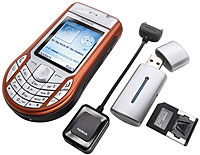 Acting like they’re fearful of not appearing hip to the mobile music revolution, Nokia have added their own rival to the Apple/Motorola ROKR and Sony Walkman phones, a special edition of the highly rated Nokia 6630 – despite having had music-playing on their phones for yonks.
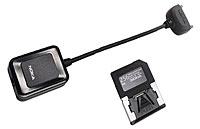 The phone comes in two colours – Aluminum Grey for hip, fast living, city slickers and Rustic Red for cow-bothering, straw chewing, country types.
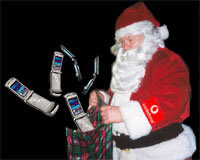 Vodafone plans to unleash a swarm of new 3G mobile handsets in the run-up to Christmas as the company tries to turbo charge mass market adoption of its third-generation (3G) mobile service.
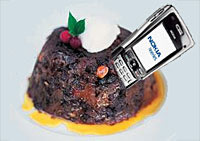 The non-exclusive handsets will include the hugely popular Motorola RAZR V3x phone, the Nokia N70 and 6280, and Samsung’s SGH-Z500V and SGH-Z140V phones.
 It’s funny, laugh!
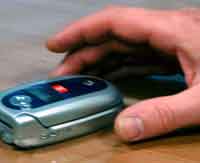 Ew… That’s not nice!
 Flogging a dead horse… Literally
 The Times have covered Richard Freudenstein, COO of BSkyB, speech at the RTS Cambridge Convention
 Sony’s boffins have announced the addition of a new hybrid camcorder/digital still camera to their Cyber-shot range.
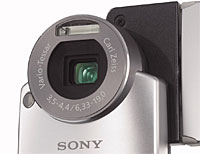 Designed to be used with one hand, the M2 features a slightly tilted lens axis which allows a more natural wrist position according to Sony.
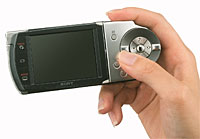 This automatically records five seconds of video before the still picture is taken, adding three more seconds of movie footage afterwards.
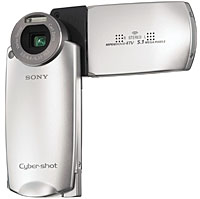 Those really wishing to inflict pain on their friends could insist on using the Slide Slow plus Movie function.
 Google’s virtual world domination plans continue afoot with the beta launch of their new blog search service, making the company the first major search engine to offer comprehensive blog and feed search capabilities.
 Google’s new service (sporting its trademark, no-frills interface) can be found at
  The Blogger version comes with a branded interface with an extra “use search options” link giving access to most common search advanced options, like searching in specific posts, entire blogs or specifying a date range to search within.
 Cool, I want one!
 Ooh, Shiny, new and it rolls up!
 Allah says no
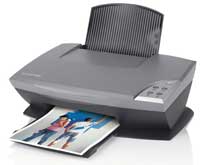 “Drop the ink cartridge and put your hands on your head!”
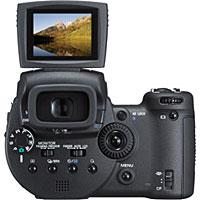 Sony has announced the ground-breaking Cyber-shot DSC-R1, a high-end enthusiast digital camera offering a 10.3 million pixel CMOS sensor with a fast 24mm -120mm zoom lens.
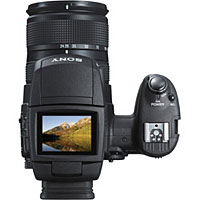 Supporting the fancy pants sensor is a high quality Carl Zeiss Vario-Sonnar T 5X optical zoom lens covering 24mm to 120 mm (f/2.8 to f/4/.8.)
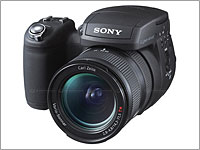 The camera’s $1000 price tag puts it in the heart of dSLR territory and we can’t help wondering how it’s going to compete.
 No matter how hard we try, when we see someone wandering about with a Bluetooth headset in their lughole we don’t think, “there’s a cool, go-getting professional”; we tend to have an irresistible urge to shout unprintable things in their direction.
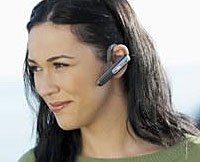 Designed to be compatible with Sony VAIO BX laptops, the HBH-608 connects the computer with the headset via Bluetooth making it possible to handle calls over the Internet (VoIP) without faffing about with troublesome phone cables.
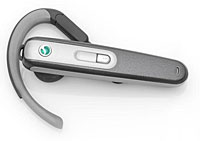 “The knowledge from two strong brands in the communications industry comes together in this solution. We believe that our joint experience benefits the user, making telecommunication as smooth as possible.”
 Best of all, when you need to pop out for a double skinny frappuccino with Bolivian gnu’s milk, the same handset can be kept in your ear and used with your Bluetooth mobile phone on the street.