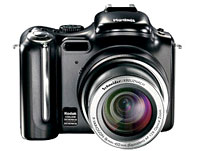
 With a flurry of clicking and whirring, Kodak have announced their new Easyshare P712 superzoom digital camera, offering a 12x image-stabilised Lens, a 7.1 MP sensor and enough manual modes to please compulsively tinkersome photographers.
The camera sports a veritable animal of a zoom, with the f2.8 – f/3.7, Schneider-Kreuznach Variogon lens covering a whopping 36 – 432 mm range (35mm equivalent).
With such a long lens, things are likely to get wobbly at the telephone end, so there’s built in optical image stabilisation to help ward off blurificartion.
Faster than the blink of an eye
The boys and girls at Kodak are making bold claims for their new camera, saying that P712’s auto-focus system boasts a ‘best-in-class’ click-to-capture rate – literally faster than the blink of an eye, they say.
 We’ve never bothered to work out how fast we blink, but Kodak tell us that their 0.07 seconds capture rate is faster, and who are we to argue?
Made for sharing
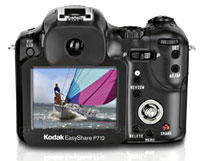
The Easyshare comes with a large 2.5-inch, high-resolution, LCD and electronic viewfinder for framing and reviewing pictures, with the Share button making it easy to, err, share pics using Kodak’s, err, Easyshare software which, like Quality Street, was apparently made for sharing.
As is de rigueur with consumer digicams, the camera can record video at a TV-quality, 30 frames-per-second VGA video with sound (MPEG4), with onboard facilities to split, cut, merge and trim footage or create single-frame or multi-frame “storyboard” still pictures.
 Flashing it about
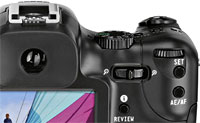
As well as the built in flash (guide no. 11, ISO 100 ), there’s a also a hot shoe connector for attaching the optional Kodak P20 zoom flash (which knocks out for around a ton).
Rounding off the feature set is the usual legion of scene, program, aperture/shutter priority and manual shooting modes, a hefty wad of preset scene modes and multiple burst modes for action shooting.
There’s also a live histogram display; 25 selectable AF points; custom white balance with selectable compensation; highlight/shadow clipping displays; and, in line with its semi-pro aspirations, RAW file support.
The P712 camera should be shuffling onto UK shelves around about now, with a suggested retail price of £350 – which, puts it in direct competition with the highly rated and far more versatile Nikon D50 dSLR, which starred in our ‘Best of 2005’ list.
 Kodak EasyShare P712 specifications
Sensor 1/2.5 ” Type CCD, 7.1 million effective pixels
Image sizes 3072 x 2304, 3072 x 2048 (3:2), 2592 x 1944, 2048 x 1536, 1280 x 960
Movie clips 640 x 480 @ 30fps, 320 x 240 @ 30fps, QuickTime video, motion JPEG
File formats JPEG (Exif v 2.21), RAW, TIFF
Lens 36 – 432mm equiv, Schneider-Kreuznach Variogon lens, 12x optical zoom
Image stabilization Yes
Conversion lenses Optional
Digital zoom 5x advanced
Focus Hybrid AF system using TTL contrast detection method and external passive sensor
Focus modes Normal AF, Macro AF, Infinity AF, Manual focus, Multi-zone, Center zone, Selectable zone (25 zones selectable)
AF assist lamp Yes
Focus distance Normal: 50cm – infinity (wide) 1.9m – infinity (tele)
Macro: 10-60cm (wide) 90cm – 2m (tele)
Metering Multi-pattern, Center-weighted, Center spot, Selectable zone (25 zones)
ISO sensitivity Auto, ISO 64/80/100/125/160/200/250/320/400/800
Exposure compensation +/- 2.0 EV, 1/3 EV steps
Exposure bracketing +/- 2.0 EV, 1/3, 2/3, 1.0 EV steps, 3 or 5 images
Shuttter speed 16 – 1/1000 sec in 1/3 step increments
Aperture F2.8 – 3.7
Modes Auto, SCN (scene mode), P (program mode), A (aperture priority mode), S (shutter priority mode), M (manual mode), C (custom mode), video
Scene modes Pportrait, self-portrait, sport, party, landscape, night portrait, night landscape, snow, beach, text/document, flower, sunset, candlelight, backlight, manner/museum, fireworks, panorama White balance Auto, daylight, cloudy, open shade, sunset, tungsten, fluorescent, click WB, custom
White balance fine tune Blue/red bias and magenta/green bias, ±7 stops
Self timer 2 / 10 secs, 2 shot option
Continuous shooting First burst (approx. 1.6 fps up to 14 frames at standard JPEG), Last burst (approx. 1.6 fps last 5 frames at standard JPEG)
Image parameters High colour, natural colour, low colour, sepia, black and white, Contrast (3 levels), Sharpness (3 levels)
Flash Guide no. 11 (ISO 100)
Range: wide – 0.9-4.7 m (2.9′-15.4′), tele – 2.0-3.6 m (6.6′-11.8′)
Modes: auto, fill, red-eye, slow sync (front, front-red-eye, rear), off
Compensation: ±1.0 EV with 1/3 EV steps
Viewfinder Electronic, 237 K pixels with diopter adjustment
LCD monitor 6.35 cm (2.5″) indoor/outdoor colour TFT display with adjustable brightness setting
Connectivity A/V output (NTSC or PAL, user-selectable)
Storage SD/MMC card (none supplied), 32MB internal memory
Weight (no batt) 403g
Dimensions 108 x 84.2 x 72 mm (4.3″ x 3.3″ x 2.8″)
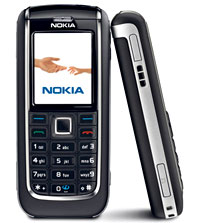 Slipping and slithering down the well oiled product slipway at Nokia is their latest swishy tri-band phone, the Nokia 6080 (no relation to their 1997 phone of the same name!).
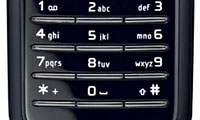
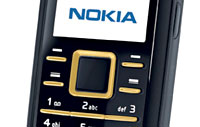 Sporting a backlit keypad and bright colour display, the handset comes bundled with a stereo headset and offers all the usual customisation options (with wallpapers, themes, annoying ring tones etc) to keep da kidz happy.
 Talk time is a distinctively average 3.5 hours with a standby time of up to 12 days.
 In the wake of the dot com boom, then the dot com collapse, equipment vendors have been feeling the fall-out and mergers seem to be the way to reconcile the collapsing markets. The Nokia-Siemens merger announcement bears witness to this.
 Siemens, a German giant
 Companies such as Huawei (“wu why” sometimes pronounced “who are we” which fits their appearance into markets that they had no presence in until recently) are starting to make serious dents into the Tier 1 telecoms/ISP markets.
 Now they’ve established themselves in the ISP market, the surrounding markets are being worked on (and since most ISPs are now owned by telecoms companies, it’s the telecoms markets that are easiest to move into).
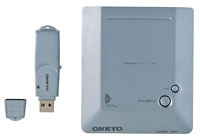
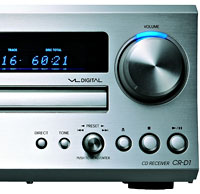 New from Onkyo is the CR-D1, a natty mini Hi-Fi CD/FM receiver with options to control docked iPods (volume/stop/start etc) and wirelessly stream music from PCs.
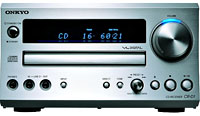 When it comes to expansion options, this fella’s well stacked, offering 1 x optical, 3 x RCA, and stereo mini-jack inputs and 1 x optical, 2 x RCA, subwoofer, and headphone outputs.
 Specifications
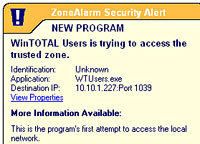 After happily using Zonelabs’ freebie Zonealarm firewall product for years on end, we were keen to try out their commercial Zonealarm Internet Security Suite 6, which bolts on a ton of extras to tempt skinflints.
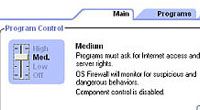 Zone Alarm’s anti-phishing widget has also been enhanced, and the privacy protection feature lets users specify what personal information they want protected, e.g. phone numbers, addresses, bank accounts etc.
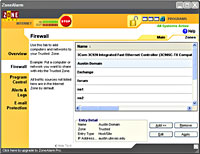 Fine tuning and advanced options were also available, but for many users the default settings should be enough to get them up and running within minutes.
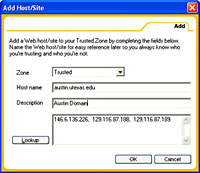 Although there’s not a great deal new on offer here – save the anti-spyware feature – the Internet Security Suite is a solid product that gives you all the protection you need for a reasonable fifty quid.
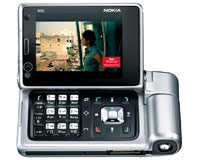 Nokia has announced a partnership with TeliaSonera Sweden to trial a complete DVB-H system, using Nokia’s Nordic know-how, their Mobile Broadcast System 3.0 and Nokia N92 mobile TV devices.
 “Nokia is very pleased to be working so closely with TeliaSonera Sweden in this new area of DVB-H based mobile TV. We believe strongly in the capability of this technology as well as in the mobile TV service, and we are looking forward to verify the full potential of mobile TV together with TeliaSonera Sweden,” purred Jan Lindgren, Vice President, Networks, Nokia.
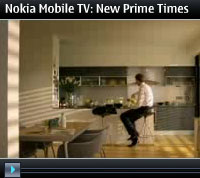 About the technology
 LG Electronics has rolled up its beefy sleeves, raised its fists and shouted, “Come oooonnn!!!! Let’s be ‘aving you!” to the electronics world, declaring its intent to more than double its share of the world’s top products by 2010.
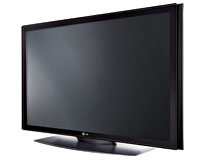 With a direct hit on the spittoon, he continued, “By substantially increasing the number of flagship goods through our technological prowess, we aim to evolve into a bona fide powerhouse.’
 Pointing aggressively, Myung-wo says he wants the global market for plasma display panel (PDP) modules, PDP TVs, liquid crystal display (LCD) TVs, side-by-side refrigerators, built-in air conditioners and drum washers to be pwned by LG.
 Similarly, when it comes to domestic air conditioners, LG rules the roost, and the company is now wrestling for the crown of King of Flat-Panel Displays, knocking out 730,000 plasma units last year to nudge past market leaders Samsung SDI.
 We’re frequently impressed with the observations of Marc Freedman from
  As illustrated, average weekly sales during the first four-week periods of 2006 decline from 17.56 million units/week in the 1st period to 16.68 million units/week in the 4th period (a drop of .9 million units or 5.1%). Compare this to average weekly sales for the first four-week periods of 2005 when average weekly sales grew from 7.38 million units/week in the 1st period to 8.73 million units/week in the 4th period (an increase of 1.4 million units or 18.3%).
 Digital music sales rose to a point where they essentially offset the decline in CD sales in 2005. (Bainwol was right on that point, but that was for last year.) With the hypergrowth behind it, digital music sales can no longer make up for the hemorrhaging of physical music sales nor will it return the music industry to its prior glory days.
 Unlike the transition from albums to CDs or video tapes to DVD, ‘going digital’ is not a simple format media transition. The use of digital technologies and the Internet has and will continue to fundamentally change how entertainment is created, stored, distributed, and consumed. Technology has undermined the entertainment industry’s pretense of control despite its best efforts.
 Vodafone Netherlands got in touch with us to tell us how wildly popular the World Cup has been on mobile phones on their service – breaking previous records of simultaneous viewers.
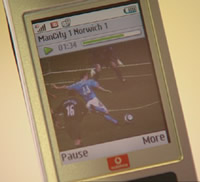 This would have been a big test for their mobile network, delivering something as bandwidth hungry as video all at the same time. Without any reports to us to the contrary, we can only assume it all went smoothly.
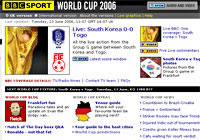
 Auntie Beeb has been very nice and decided to make all of the World Cup matches it broadcasts simultaneously available through the wonderful Interweb thang.
 Many companies will be using broadband, which is mainly ADSL (Asymmetric Digital Subscriber Line), meaning more bandwidth down to the company than from the company to their ISP. Great for streaming, but without clever equipment, those streams will even stop upstream traffic working properly. It’s entirely feasible that all the companies bandwidth will be hogged by employees streaming.
 Are there any exceptions?