 This just in, Steven Carter, Chief Executive Officer of UK communication uber-regulator Ofcom will be standing down with effect from 15 October 2006.
Luke Gibbs of OfcomWatch covered Carter possible departure this back in January this year.
At the time of writing this article, Ofcom hasn’t given an official explanation of why Carter is leaving, just that he is.
As to the process of him leaving, the official Ofcom line is a little bewildering, “He will continue to lead on all operational and financial matters until that date (15 October 2006), but from 1 August 2006 will not be party to Ofcom’s economic, competition and policy decisions.”
What’s special about 1 Aug 2006? Given Carter’s contract prevents him from securing future employment whilst at Ofcom, is this perhaps someway for him to hasten taking up another role with another organisation? Carter’s contract also contains “appropriate gardening leave restrictions” up to a maximum of 12 months at the discretion of the Chairman.
 The next role for Carter has been the matter of some conjecture, nay gossip. Given Ofcom is seen by a lot of the world as a leader in communications regulation, there are many possible roles. Amoung those mentioned so far have been BSkyB, and with James Murdoch rumoured to be shifting upstairs the position may be open. Hey … how about the FCC?
From 1 August, David Currie will act as Executive Chairman and will chair the Policy Executive, until a permanent replacement can be found.
Prior to joining Ofcom in 2003, Carter was at UK cable company NTL during its time of financial troubles.
More details on the story when we have them.
 Yamaha’s YSP-1 is a marvel of technology, it’s about 42 inches long by 4 inches high and about 4 inches deep but can produce 5.1 audio that really does sounds like a conventional set-up with speakers in-front and behind you.
 A box is a box without careful set-up
 All of those children who have been struggling to get their parents to buy them the playground-must-have, an iPod, now have the ultimate excuse – “But it’s for my edukashon!”
 Deja Vu
 Students will be able to download study guides that work with Pearson’s educational texts and listen to review notes to prepare for exams.
 Apple has used this approach previously. Many years ago Apple started selling their computers to school children at a discount, with the logic that if they were hooked early, they’d be in the Apple-way for the rest of their lives.
 PayPal is to be the exclusive online wallet across Yahoo’s product and services. In a wide-ranging, four component, business arrangement announced today, eBay and Yahoo will be stroking each other commercial departments.
 Interestingly Yahoo will also be offering sponsored search for complementary products on some eBay.com search results pages in the U.S.
 For us, this part of the announcement is a bit of a strange one. Yahoo has Yahoo Messenger with Voice and eBay has Skype, so who would provide the voice services in which circumstances is pretty unclear, and we would have though, an area for friction.
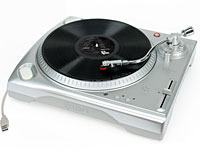 If you’ve got a big stack of top notch vinyl gathering dust at home, you may want to consider using this natty USB Turntable to record the platters that matter straight on to your desktop or laptop PC.
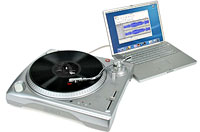 The turntable can also be hooked up to any home stereo with CD or auxiliary inputs so you can rock out to your old punk rock 45s after a night in the pub.
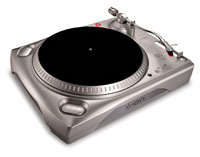 Using your existing turntable
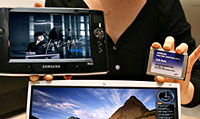 Samsung has announced the imminent release of the world’s first solid state laptops, in the shape of the Q1,an Ultra Mobile PC and the Q30-SSD, a 12.1-inch screen notebook PC
 The company also said that it was only selling the SSD laptops in South Korea to reduce the risks from teething problems.
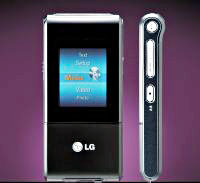 It may not have the swish designer lines of the iPod and the name may roll off the tongue as smoothly as a mouth full of dry nuts, but LG Electronics new MFJM53 MP3 player looks more than a bit useful.
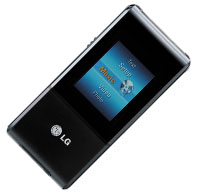 Although we like the look of this fella – the feature set particularly impresses – the lack of a scroll/clickwheel is going to seriously hamper its ability to challenge the dominance of the uber-iPod.
 At the W3C conference in Edinburgh today, in a move to get the mobile industry (and possibly more) to standardise on a single Web browser, Nokia has released the source code for the mobile Web browser it developed last year.
 “We want to reduce the fragmentation currently in place in mobile browsing,” said Lee Epting, VP of Forum Nokia, Nokia’s software development support program.
 Over a third of all packaged software installed on PCs worldwide in 2005 was pirated, according to a study released by the Business Software Alliance (BSA), a trade group charged with fighting the use of unauthorised software.
 In fact, some have claimed that BSA’s accounting methods are so inaccurate that it amounts to scaremongering, especially when extrapolating figures from third world countries where just a few programs at full price would cost more than a citizen’s average annual income.
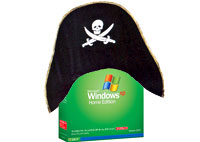 In third place was France which notched up losses of $3.2 billion, accompanied by a piracy rate of 47 percent, while in Brit-land, 27 per cent of PC software used in the UK was claimed to be illegal.
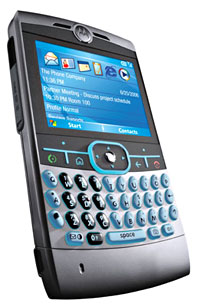 Months later than expected, Motorola’s new ‘Blackberry-killer’ smartphone, the Moto Q has finally been launched on the Verizon network in the US.
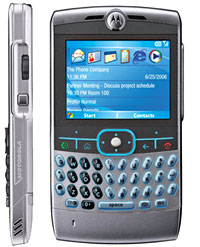 Shockley insisted that the Q is for people with a “life balance” (a what?) who want to use their phones to listen to music, take photos, record short videos and play games.