 Not content with having a café on every street corner in the known universe, Starbucks has announced that it’s considering expanding its entertainment business to offer a MP3 download service at their stores.
The coffee giant already offers compact disc sales and in-store CD burning, but Ken Lombard, president of Starbucks Entertainment, says that his customers are “asking for device fill-up” (do people really talk like that?) and that the company intends to “go forward and do that.”
There’s no firm plans yet, as Lombard went on to say that Starbucks are still talking to various companies about the technology and that a date hasn’t been set for the introduction of their MP3 download service,
Starbucks – the US’s biggest coffee chain – boasts 10,000 retail outlets globally and Lombard stated that their decision to get into MP3 music sales represented “perfect” timing, seeing as he believed that the music industry currently “found itself in the midst of a tremendous amount of chaos.”
 Starbucks have already stuck their espresso-scented tentacles deep into the music business and established themselves as a major CD outlet, shifting around 3.5 million CDs in their fiscal year ended 30 September.
They also co-produced Ray Charles “Genius Loves Company”album of duets, and have announced plans to promote movies and offer DVDs and soundtracks at 5,500 of their US and Canada stores.
The CD burning service will remain on offer at Starbucks coffee shops (via the in-store Hear Music outlet) with the company keen to continue striking deals to exclusively offer artists’ CDs before they go on general release.
Being old punk rockers at heart, we can’t imagine what could be worse than forcing fans to visit an expensive multi-national coffee shop instead of their local record shop and it seems that some retailers don’t like it either.
 Last year, HMV Canada refused to stock Alanis Morissette’s records (good move anyway, we say!) in protest at the wallet-stuffing exclusivity agreement she’d signed with Starbucks.
Of more concern to music fans is the growing influence of mainstream retailers who can wield their corporate buying power to influence record sales – and even the bands themselves – by refusing to stock records that don’t appeal to their ‘values.’
Way back in 1996, Sheryl Crow had her record shunted off the shelves of Wal-Mart because one of the songs contains an unflattering comment about the company’s gun sales policy, and the Fugees lost all credibility by releasing a Wal-Mart friendly version of their album, ‘The Score’ with all the naughty words taken out.
And it’s the same story at Starbucks, who recently decided that seasoned rock’n’roll veteran Bruce Springsteen’s new record was too racy for their stores, refusing to stock the album because of its challenging, explicit lyrics.
 If the Starbucks service takes off, we can expect more pressure on artists and record companies to conform to their wholesome values – and this can only be bad news for music fans.
Quietly oiling the wheels of his global-domination tank, Lombard also added that Starbucks will test selling books at its stores later this year.
Lord help us.
 Mobile operator 3 has launched an innovative service that, for the first time, pays customers to receive calls and texts.
 Designed to boost usage of data services, 3 also hopes that the cash-back scheme will prove attractive to new punters and tempt customers from other networks to switch.
 The WePay top-ups come as all-cash vouchers available in £10, £15 and £20 denominations, with no expiry date. However, the WePay cash credits are only valid for 30 days.
 BT’s dominance of the UK home telephone is coming under fresh pressure as the phone call market becomes the most liberal in Europe. Previously, their pricing levels have had to be agreed in advance with the UK regulator Ofcom, but with it understood that this is going to be lifted soon, price cuts are expected.
 Technical-savvy Skype callers have for a long time taken advantage of VoIP calling to obtain free or cheap calls.
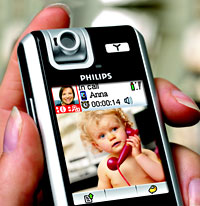 It’s been a long time coming, but Dutch enormo-corp Philips are looking set to finally roll out their innovative Wi-Fi-enabled VoIP telephone, the VP-5500.
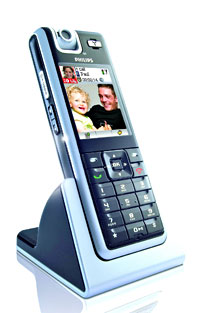 Announced way back in Sept 2005, the VoIP phone comes with a VGA camera that rotates up to 240 degrees, letting users check out their look on the built-in, high-resolution LCD display before committing a potential videocall fashion catastrophe.
 Built around established standards-based technologies like Wi-Fi and Linux, the VP5500 can be upgraded wirelessly, opening the door to future upgrades – giving operators the chance to add value-added services as the becmoe available.
 To be honest, we’re still a little unsure about video calling.
 A few years ago, you’d be greeted with a blank face or a call to the local psychiatry service if you started going on about ‘listening to your downloaded podcasts’, but figures released from the BBC show how the format is continuing to grow in popularity.
 The chart also revealed that nearly two million downloads took place during the BBC podcasting trials over December.
 Simon Nelson, controller of BBC Radio & Music Interactive was enthusiastic: “It’s fantastic to see how the demand for radio downloads has grown since we first offered them in 2004. These figures underline the enduring relevance of radio in the digital world.”
 Over the last couple of weeks there’s been a lot of speculation that Disney are going to be bidding to buy Pixar, the digital animation studio that’s supplied the majority of Disney’s successful computer-generated animation successes.
 According to an online survey conducted by brand-meisters Brandchannel.com, Google has held on to its title as the world’s most influential brand in 2005, pushing Apple out of the numero uno spot for the second time this decade.
 Globally, top honours went to Google, who outflanked brand rivals Apple with an avalanche of punter-pleasing freebies like Google Mini, Desktop and Google Earth, described by Brandreport as, “arguably the greatest thing to hit the Internet since porn” (steady on, chaps!).
 Although Google whipped Apple globally, the company still rules the roost on their home turf, with Steve Jobs’ outfit being declared the leading brand in North America in front of their rivals.
 It’s a story of booze and beer in the central & Latin America segment, with Corona and Bacardi sitting proud in first and second places respectively.
 Digital-Lifestyles has been informed, and can exclusively reveal, that BT is looking to shed its OU operations from its Media and Broadcast (BT M&B) division.
 Despite BT as a whole being determined to move into new revenue opportunities like TV, there’s new breed of technology solutions for linking signals which are outside BT’s control. This bothersome issue is further squeezing their previously healthy profits, and the current cost base for BT’s OU services makes it difficult to justify continued operations, indeed we’ve been told that the OU is currently unprofitable. It’s hoped that a buyer will be able to make the operations pay, by reducing costs and realising synergies.
 Further deals for incumbent European telecoms operators are on the cards as they retreat into their core businesses. See France Telecom, who recently off-loaded one of its Paris Earth Stations to the satellite operator
  A heady mix of ever plummeting digicam prices, larger memory card capacities and more capacious hard drives means that it’s easy to end up with photos and videos scattered to the four corners of your PC, making it nigh on impossible to find your pictures.
 A start-up screen gives new users an overview of features to help them get started while upgraders will be glad to see the program sticking to the tried and trusted three-paned interface, coupled with a useful ‘image basket’ function.
 Unlike many other image management programs, you don’t have to ‘import’ images into the program before they can be viewed, so the program also doubles up as an excellent image file browser.
 At times, the sheer weight of features can prove a little overwhelming to new users, but for keen photographers keen to keep a vice-like grip on their growing photo collections and looking for a strong, all-round image management solution, we strongly recommend ACDSee.
 So where do we start?
 Naturally, there will always be those who say regulatory decisions made by organisations such as Ofcom are ‘independent’ and ‘evidence-based’ and therefore would be valid whoever happened to be in government. However, most people know Ofcom is ultimately a product of the government who created its remit – New Labour – and who on occasion have allowed the notion of ‘evidence-based’ regulation to underpin a culture of third party ‘experts’ who decide policy matters with a minimum of public participation or scrutiny.