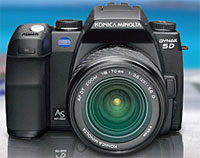
 It wasn’t that long ago that digital dSLRs were the sole preserve of well-heeled enthusiasts and the pestering paparazzi, but with prices continuing to fall, digital dSLRs are coming within the reach of the mainstream.
Canon started the revolution, slapping down a hefty gauntlet in the face of their competitors when they introduced their 6.3 megapixel Canon EOS 300D (aka Digital Rebel) in 2003 for around US$1,000 (~£572, ~€828).
The camera immediately found favour with amateur snappers, semi-pros and some newspaper reporters, who wanted the immediacy and flexibility of a single lens reflex camera without the eye-watering price of a pro camera.
Nikon took some time to respond, but hit back hard with the Nikon D70, a well-specified camera that offered the same resolution as the Canon, but with a more comprehensive feature set – and a lightning fast start up time (often the bane of digital cameras).
Pentax, Olympus and Minolta also weighed in with affordable dSLRS and consumers got happier as prices kept on falling.
 In February this year, Canon returned with its cheaper-faster-more featured next generation 8 megapixel camera, the EOS350D (Digital Rebel XT) retailing for US$880 (~£503, ~€728) while Nikon’s similarly priced D50 was introduced in April.
Trying to wedge their elbow into the highly competitive and lucrative affordable dSLR market is Konica Minolta’s new Dynax/Maxxum 5D digital SLR, announced last Friday
Aimed more at the beginner market, it’s a smaller and lighter version of their Maxxum 7D camera, with fewer external controls, a bright 2.5″ display, “easy and intuitive” operation and a shedload of exposure presets on hand.
The highlight of the camera is Konica Minolta’s unique in-camera Anti-Shake system, which works by stabilising the sensor instead of the lens element.
This can be of real benefit when shooting in low light and gives the Dynax/Maxxum 5D digital SLR a real edge over their rivals, and it’s the first time this system-wide feature has been seen on a sub US$1,000 dSLR.
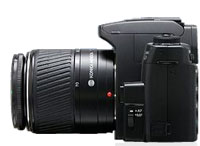 The rest of the specs of the camera are impressive but not cutting edge: 6.1 megapixel sensor, JPEG and RAW image capture (RAW: 3 fps, up to 5 frames), white-balance bracketing, 100-3200 ISO, built-in pop flash and USB 2.0.
With its bigger name rivals winning plaudits for their new budget dSLRS, it may be hard for new punters to be won over to Konica Minolta’s new offering, although it looks like a winner for those already using Minolta bayonet mount lenses.
Maxxum 5D will be available in early August, with pricing yet to be announced.
 A report from consultancy firm BroadGroup has revealed that the deployment of wireless hotspots in Europe have soared by 67 percent in the six months up to May 2005.
 As many a disgruntled transatlantic traveller may tell you, Wi-Fi access in Europe still remains considerably more pricey than the US market, although the report suggests that “price declines are continuing to trend downwards” (I think this means, “prices are going down”).
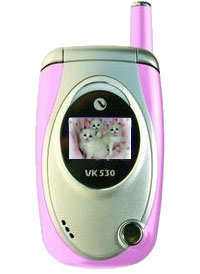 With a survey that could be described as pointless fluff at best and patronising drivel at worst, Vodafone D2 have trotted out the details of their ‘Women and Mobile Phones’ market research survey.
 Neatly half of women use the camera on their phone with 37 percent of respondents citing the provision of Bluetooth for wireless data transfer as important.
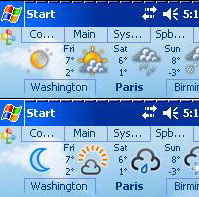 For travelling PocketPC users unsure whether to pack away a brolly or load up with the sunscreen lotion, Spb Weather could prove to be an essential tool.
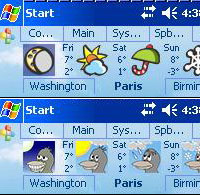 Once installed, it’s simply a case of choosing the cities you want displayed (you can manually add unlisted locations), and then having a fiddle about with all the fun display options lurking in the options dialog.
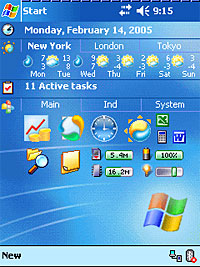 For travellers, tourists and stay-at-homers with a passing interest in the weather, this is a handy, fun application that adds real value to a Pocket PC. Recommended.

 Us in UK-land have long been fans of SMS messaging, with button-pushing Brits banging out 3 million text messages every hour, with 2.5 billions text being sent in January 2005 alone.
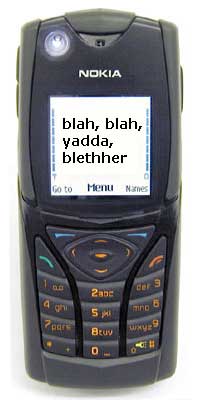 GSM operator T-Mobile was particularly chuffed with its performance as its customers belted out a total of 3.6 billion messages during Q1 2005 – that works out at around 67 texts per subscription per month.
 Developed by Nick Bradbury, the smart fella responsible for creating the fabulous Homesite (still our fave HTML editor) and the superb Top Style CSS Editor, FeedDemon 1.5 is a powerful RSS aggregation tool.
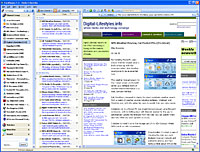 We found this approach intuitive and fast, although users with small monitors may have to indulge in an orgy of scrolling to view all the content in its default layout.
 FeedDemon’s new podcasting tools let news-hungry junkies download audio files and automatically copy them to their iPod (and, notably, other media players) with the bundled FeedStation utility allowing the scheduling of downloads – letting users charge up their iPod with new content while they’re snoozing.
 palmOne transmogrifies into Palm, Inc today, following an announcement on May 24 that the company had acquired unencumbered rights to the Palm brand after buying out the share of the brand formerly controlled by PalmSource, Inc.
 Palm have a bit of a history with faffing about with their name. palmOne was created in October 2003 when the earlier Palm, Inc. spun off PalmSource and acquired Handspring, Inc.
 Research has revealed that two thirds of UK Internet users are deeply unchuffed about having to pay a BT line rental on top of their broadband subscription.
 Vonage has demanded ‘Naked DSL’ in the UK, which would enable consumers to independently subscribe to telephone and broadband services and allow users to subscribe to a VoIP service instead of a traditional fixed-line service,
 “The broadband infrastructure will support a variety of services, one of which is telephony. Customers should be able to decide what services they want to ‘plug’ into their broadband network in the same way that they choose their electricity provider,” he added.
 “We are aware that applications providers that don’t contribute to the cost of building and supporting that ever improving broadband network have little appreciation of the economics involved,” said a BT spokesman. “Our customers, however, do”.
 We had a report from a reader today that he’d been … ehm, carrying out tests on his content filtering service. This entailed going to sites with photos of naked bodies – purely to test that the content filter blocked his access to them you understand. One of first sites he went to was the well known UK tabloid, The Sun.
 The piece in the Gizmo section of the site and paper features BT’s new model to promote BT Communicator, Michelle Marsh.
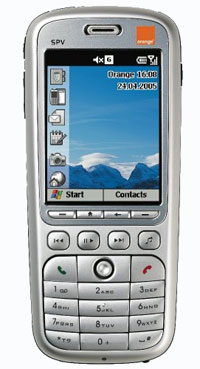 It’s been a long time coming, but Orange have finally announced that their Windows Mobile-powered SPV C550 smartphone will go on sale later this month
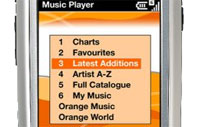 Songs downloaded through the phone’s Music Player software are DRM-protected, although the built in Fireplayer application will let punters remix their fave tunes into ringtones.
 Matthew Kirk, Director of Devices at Orange was ready and willing to spin out the PR schmooze: “Since the launch of the first SPV handset three years ago, Orange has led the development of smartphones and provided its customers with a choice of the latest and most powerful devices. The Orange SPV C500 was the world’s smallest smartphone and today its successor provides the first realistic alternative to carrying around a separate MP3 player, phone and PDA.”