 London’s Ravensbourne College is launching a new program called the School of Computing for the Creative Industries.
It’s quite hard to work out what it actually involves as their overview reads like a missive from a Hoxton style bar, babbling on about the “learner-practitioner” using the Internet “as an inspirational resource, drawing on that vast, interconnected meme-pool, but returning far more to it than s/he ever withdraws.”
We had to reach for the dictionary to make sense of this part:
“As the creative industries bifurcate into the twin realities of intellectual property businesses, and crafts-for-hire, the new creative has the skill, and panache, to exploit the opportunities of the new creative landscape.”
Apparently these new creatives are connected citizens, “whose passions and campaigns, ideas and innovations appear first on their blog.”
 We would have thought that most of the passion manifests itself in the student bar, but the School insists that the new creative “understands that s/he is defined by the impact and credibility of their online presence.”
Now, some of you may be rightly thinking that this sounds more like The School of Buzzword Bullsh*t, but there is some interesting stuff lurking within the industry-speak.
It seems that School will release its learning materials under a Creative Commons license in an attempt to maximise usage and dissemination.
 All the technical facilities in the School will be built on open source platforms, with support offered to students wishing to release projects under free and open source licenses.
Although it’s easy to scoff at their daft Nathan Barley airs, this looks to be a brave and innovative move by Ravensbourne College, which may prove a portent for colleges coming to terms with the impact of new technology on teaching.
Overview of the School of Computing for the Creative Industries
Creative Commons
 Punters are being invited to get all interactive with the BBC’s TV and radio schedules as part of their Backstage experiment. The call to action was trumpted at the London hosted Open Tech grass roots conference that ran at the weekend.
 The BBC has already received more than 50 prototype ideas for using BBC feeds and content for non-commercial purposes since the project’s launch in May.
 A British court has fined a man £500 ($870, €720) for using a residential wireless broadband connection without permission.
 We have to say this seems a little harsh as there appears to be no evidence that there was any hostile motive behind his actions.
 Champagne corks were firing off at Google like a military salute as the Internet search engine kings revealed that their profits had jumped more than 300 per cent in the second quarter this year.
 The company’s fortunes are currently on a stratospheric trajectory, with April’s first-quarter profit almost six times higher than a year earlier.
 What with the summer in full swing, and the weather in the good old UK being as warm as it has been, I have observed some serious heat issues while using my Mac Mini.
 At first, I had put it down to my Mac simply not running as well as it used to for whatever reason, but today it’s been considerably cooler because it’s rained, and all of a sudden my Mac Mini is running perfectly again.
 After a morning of fishwife-hot rumours, it’s been officially announced that the next version of Microsoft Windows – previously code-named Longhorn – will be known as Microsoft Vista.
 Possibly because of a fear of failing to release the product in the year bearing its name, Microsoft has once again shied away from its earlier practice of releasing dated operating systems (Windows95, Windows98 etc).
 The long-awaited results from the Welsh Digital TV trial were published today.
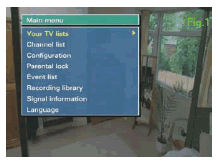 The digital signal was switched on in November 2004, running simultaneously with current analogue for three month.
 Transmission and Coverage – No one lost their TV service during the trial. Only three homes, which were previously in poor reception areas, could not receive the digital service and these were given a digital satellite service. Broadband was introduced during the trial and is seen as an alternative form of delivery to satellite.
 Content – Having an EPG went down well with the residents, particular when they used it to record programs on their PVR. The trialists also enthused about the ability to receive extra TV channels – after all the major benefit to consumer if the expanded choice they will be given.
 The North American voice over IP (VoIP) market is about to go completely bananas, with phenomenal growth predicted for the next six years, according to a report by Frost & Sulllivan.
 The VoIP’s operator’s joy could be the incumbent local exchange carriers (ILECs) misery, as Internet telephony represents a direct threat their market share and revenue.
 The report concludes that it’s the quality of service and the VoIP feature set that’s attracting punters to the service rather than a desire to get in with the hi-tech crowd.
 TV cables could provide broadband Internet access speeds up to a trouser-flapping 100 megabits per second as early as next year according to Finnish broadband equipment maker Teleste.
 “This is a cost-efficient technology, as we use the cable TV networks which are already in place,” Teleste’s CEO Jukka Rinnevaara told Reuters.
 The foxy Finns are currently running field trials with cable TV service provider Essent in the Netherlands, but are yet to reach the top speeds they predicts will be available to most homes in a few years time.
 Rissanen calculated the cost of connecting a home to the high speed ethernet-to-the-home technology could range from US$60.30 (~£35, ~€50) and US$241 (~£140, ~€200).
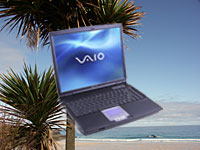 Feebly posing as some sort of independent study into the portable computer use, a recent US survey commissioned by Intel reveals that 34 per cent of respondents or their families have taken a laptop PC with them on vacation, with just over half likely to take a laptop PC on a future vacation. Oh that’s lucky … aren’t Intel involved with laptops in some way?
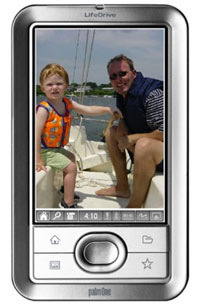 The growth of compact, wireless-enabled laptop PCs [cue: another plug for Intel Centrino here] and hotspots have made it easier for globe trotters to taunt their office-bound chums back home with beach photos, as well as keep in touch with work, news, sports and grab local information.
 Of course, seasoned PC users have dragged laptops around with them for years on end, with many of the early adoptin’ cognoscenti choosing to travel even lighter by using PocketPCs/smartphones for keeping in touch while away from home.