 Neat Idea!
A UK student has thought up a unique way of financing his way through university: Selling online advertising space. That on its own isn’t unique, but the twist he has applied to it is: He is selling it by the pixel on his “Million Dollar Homepage”.
This guy is getting so much media attention as a result of the novelty value of his site that a lot of companies are getting interested in buying pixels from him. The going rate is $1/pixel, and there are 1,000,000 up for grabs… I wonder if he can make it to a million bucks?
This revenue concept started me thinking about what I could do to finance my way through University… I have just under 3 years to come up with something, and it better be good! It seems that finding a niche in the market for something unique and not actually that useful, and then attracting a load of media attention to give it artificial value is a good way of making cash on the Internet. Look out for me following suit in a few year’s time!
 They’ve done it again
Done what? I hear you ask. Google have launched a Beta version of their Wi-Fi service following a host of rumours since an article mentioning a possible Google Wi-Fi appeared in Business 2.0 back in August.
The service is only available in selected parts of San Francisco Bay (well two locations) for now, but knowing Google I am sure that it will spread relatively quickly.
Part of the evidence is a new product, for free download, that basically works as a VPN client and encrypts all data sent over the Google Wi-Fi hotspots to secure it. Only downside with this is that this application could cause privacy concerns, as Google will apparently record data about people’s Web-browsing habits. Still, it has to be paid for somehow and recording the sites people visit fits in with their analysis of the Web so as to aid its online advertising business, Ad-sense. A link to Google’s FAQ about their Secure Access product can be found here.
From the point of view of a teenager like me, this sort of service is very good: I don’t personally mind giving up a small amount of my privacy to be able to use a service that I could no way afford if it wasn’t free. Hell, at 16 I’m not even legally allowed a credit card with which to pay for commercial Wi-Fi services!
As regular readers, Mike caught this story earlier on in the week.
 It’s like the Middle Ages all over again!
This story is quite apt as I am currently suffering from the current real-life equivalent of the virtual plague documented by The Register. Yes, that’s right, I’ve caught the flu :-(
Anyway, according to The Register, World of Warcraft, a popular massively multiplayer online role playing game (MMORPG), has been hit by a plague. Blizzard, the company behind the hugely succesful game, introduced a new god character to their game called Hakkar. What’s special about him is that he carries some sort of disease, similar to HIV, that spreads to some of the people that he attacks. These people then spread the disease further and further, which has resulted in a large quantity of the World of Warcraft servers becoming infected by it.
It’s a new concept and just brings us even closer to where we start blurring the line between reality and virtual reality. It also shows that virtual reality can have all the nasties that the real world does too.
Anyway, I am off to bed, forget World of Warcraft, I’m ill and need to go to school tomorrow. Just hope I don’t spread the “plague”>
 UK operator O2 has announced a mobile TV pilot letting 400 customers in Oxford to choose from 16 channels, featuring popular shows such as Lost, EastEnders, Coronation Street
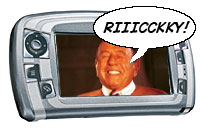 O2’s chief technology officer, Dave Williams, feels that the trial will help in establishing a model for more projects in the future, commenting. “By establishing relationships through activities such as this, we hope that potential challenges will be minimised and mobile TV becomes a commercial reality sooner than is currently possible.”
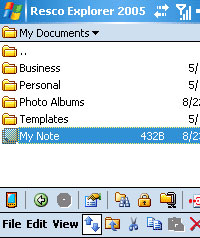 With Pocket PCs offering more and more storage space and applications shunting files all over the place, it’s getting increasingly difficult to manage the data held on a handheld device.
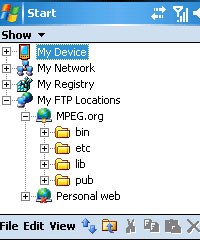 Serving up an arm-long list of features, Resco manages to combine the functions of a host of different applications and meld them into one sophisticated, do-it-all, integrated solution.
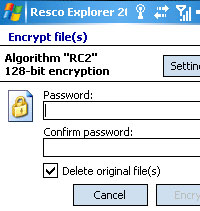 Files can be encrypted from within the program (and from a desktop applet) enabling data to be organised and secured within the same interface. Neat.
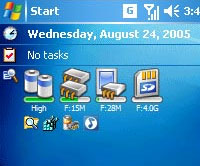 Add to that the improved support for compression – letting users save files at different levels of compression – and a new Today plug-in providing on battery status and free storage/memory and you’ve got a Five Star application that is an absolute must for all Pocket PC users.

 BT has today set-up a new division, known as OpenReach. They’ve been under pressure from some time from competitors and regulators to curb their monopolistic tendencies (they still own over 85% if the infrastructure in the UK). There has even been talk of splitting BT up – although OfCom has currently reject this.
 The trouble with CRT monitors is that they often go fuzzy at such a leisurely rate that you don’t notice the deterioration, but find yourself slowly sitting closer and closer to the screen.
 Height, pivot, tilt and swivel could all be adjusted effortlessly, so it’s easy to shimmy monitors into the exact desired position – particularly useful if you’re arranging a multi-screen set up.
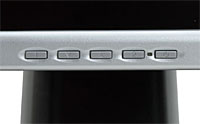
 The front panel sports five small buttons – four for monitor adjustments and the fifth for turning the monitor on/off.
 The 800:1 contrast ratio and 250 cd/m² brightness on offer served up vibrant and colourful images – in fact, we had to turn the monitor down from its default 100% brightness setting for fear of being permanently dazzled.
 Humax have dished out detailed information about their new dual-tuner, Freeview-enabled PVR, the PVR-9200T.
 Receiving and recording of pay TV channels is possible through a special CA module.
 There’s also a handy USB2.0 port provided for MPEG A/V file transfers between the Duovisio and a PC, letting users play back their digital photos or listen to MP3 files downloaded from a PC.
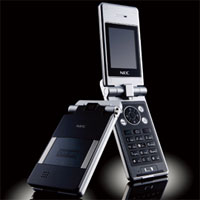 NEC ruled the early days of mobile phone, now with a battle cry of “Thin Is In!” NEC are waving their technological prowess around to the world with the launch of the world’s thinnest foldaway mobile phone.
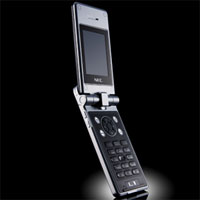 The clever boffins at NEC have also managed to wedge in PictBridge support, MP3 playback, Java and Bluetooth connectivity.
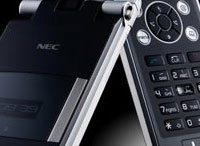 “We will continue to strive to offer the latest, most innovative and most attractive mobile terminal solutions on the market. Boasting compact shape and the latest technologies, our phones allow our customers to choose the right phone for their individual needs in all of our target markets across the globe,” he continued, while laughing at the bulky dimensions of a nearby Motorola RAZR phone.
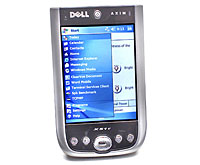 Dell has announced three updates to its popular Axim PDA series, headed up by the powerful, VGA-enabled X51v.
 One big difference from previous models is the use of non-volatile memory, which means that the new Axim X51v uses RAM exclusively for running programs and stores all programs and data in flash.
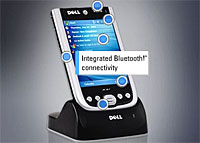 Connectivity is taken care of with integrated Bluetooth 1.2 and Wi-Fi 802.11b support, with WPA and LEAP security for the latter.
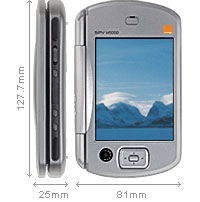 Orange has become the first UK operator to sell an own-brand Windows Mobile handset operating on 3G networks, with the launch of the SPV M5000 smartphone.
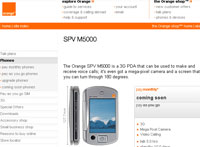 The silvery device stuffs in a loudspeaker and microphone for making conference calls, with a built-in modem and fax capability letting users blast off emails and check their appointments whilst making calls on the hands-free kit.
 Are Google about to launch a free wireless Internet service?
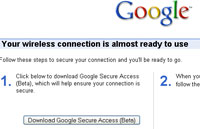 So far, Google have only introduced two wireless access points in Silicon Valley, at a pizzeria and a gymnastics centre, but it has been reported that the company were in talks with San Francisco officials about setting up public wireless networks in the city (Google currently share a single access point in Union Square in partnership with Feeva.)
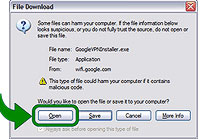 Although rolling out a nationwide Wi-Fi service would be a formidable task, with Google’s energy, enthusiasm (and zillions of $$$), it’s entirely possible and would no doubt be supremely popular.