All Your Google Base Are Belong To Us – headline explained
 The web wires are waxing wildly with rumours about Google Base, a hush-hush Google project that “accidentally” appeared on the Web for a few hours yesterday.
The “inadvertent” (yeah, right) unveiling of base.google.com sent bloggers into a screengrabbing frenzy, prompting the search engine giant to confirm that the fleeting snapshot was indeed a legitimate Google page.
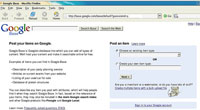 Under pressure from bloggers, Google company product manager, Tom Oliveri, revealed a little in his blog:
“You may have seen stories today reporting on a new product that we’re testing, and speculating about our plans. Here’s what’s really going on.
We are testing a new way for content owners to submit their content to Google, which we hope will complement existing methods such as our web crawl and Google Sitemaps.
We think it’s an exciting product, and we’ll let you know when there’s more news.”
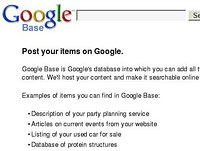 The screenshots revealed an entry page where Google suggests the type of information to submit to Base, with one sharp eyed Dutch blogger Wouter Schut, saying that the test pages also included presets for housing, products, reviews, services, travel, vehicles and want ads.
A Google Base screengrab posted on flickr revealed the following text:
“Post your items on Google.
Google Base is Google’s database into which you can add all types ofcontent. We’ll host your content and make it searchable online for free.
Examples of items you can find in Google Base:
• Description of your party planning service
• Articles on current events from your website
• Listing of your used car for sale
• Database of protein structures
You can describe any item you post with attributes, which will helppeople find it when they search Google Base. In fact, based on therelevance of your items, they may also be included in the main Google search index and other Google products like Froogle and Google Local.”
Naturally, the speculation-o-meter has been in overdrive ever since, with many believing it to be the start of a foray into the online classified field, with Google placing popular services like eBay and Craigslist directly in their sights.
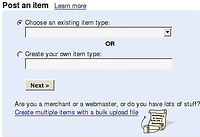 This service would let individual punters submit classified adverts for free on Google Base and could possibly signal the imminent arrival of the much rumoured Google Payment (aka Google Wallet) product.
Rumours have spun up to tornado force by a recent Classified Intelligence report which claimed that Google had been discretely asking job boards and other classifieds providers to submit feeds of their listings.
And while we’re speculating with such wild abandon, we can’t help thinking that if Google Base does indeed materialise, Google could offer sellers a GoogleTalk button for their listings and offer similar functionality to the much-anticipated SkypeMe buttons on eBay listings…
 BSkyB’s Director of Product Management, Gerry O’Sullivan couldn’t help sounding smug as he took centre stage at The Connected Home conference in London today.
 While Microsoft’s Cynthia Crossley and Telewest’s Mark Horley nodded collaboratively to Merlin Kister of Intel’s assertion that “We mustn’t be close minded and pick a winner. It’s important for all players to work together,” O’Sullivan looked disinterested.
 “There’s zero tolerance (among our customers) for that sort of unreliability and pain…we can only roll out products that you switch on and they work.”
 Horley mentioned that Telewest was launching its own 160GB PVR in early 2006, with the WHOLE disc available for recording “as we already offer video on demand”.
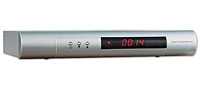 After several years of battling with the clunky interface and weird quirks of our museum-ready OnDigital digital terrestrial television box, we decided it was time to replace it with something a little more contemporary.
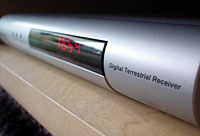 For the princely sum of just £35 (~$62, €52), the Wharfedale offers a digi box with a 7 day electronic programme guide (EPG), digital text, digital interactive services, DVB subtitles, auto scan and setup and 2 SCART sockets.
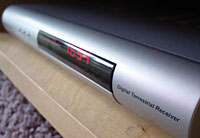 Onscreen menus
 Picture quality
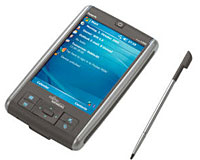 Fujitsu Siemens have launched the “first handhelds with fully integrated GPS functionality”, the Pocket LOOX N500 and Pocket LOOX N520 PDAs.
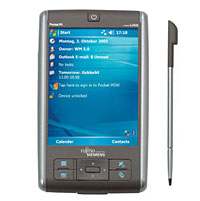 Powered by an Intel XScale PXA270 312 MHz CPU, the devices come with a SD/MMC slot (with support for SDIO), USB 1.1, IrDA and Bluetooth, with the Pocket LOOX N520 offering integrated wireless LAN 802.11g Wi-Fi.
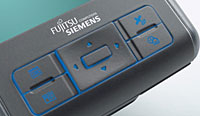 There’s also a ton of Fujitsu Siemens-branded applications bundled in the package, including Voice recorder, AudioPath and Key Look, along with a Microsoft Mobile suite including Excel, Power Point, Outlook and Internet Explorer.
 A Hong Kong doleboy has been slapped down by The Man after he was found guilty of distributing three Hollywood films using BitTorrent’s peer-to-peer file sharing technology.
 The OpenSource BitTorrent software has become one of the most popular means of downloading large files, with the technology allowing users to download fragments of a large file from multiple users, rather than in one hefty lump.
 The futuristic vision of a connected home with content moving seamlessly from our TV to our PC and on to our mobile device is still a long way off, according to key speakers at The Connected Home conference in London today.
 It took Dimitri Van Kets (pictured left), from Belgian telco, Belgacom, to voice what many were thinking by announcing that the networked home was “little more than a mass of standards” and “too confusing” for the average consumer. Unless the service providers get together and educate customers, he said, true home connectivity was never going to happen.
 Paul Szucs of Sony said that service providers should “try not to lose the plot with content protection”, adding that “consumers simply want their devices to work together and share content.”
 BT is planning to turbo-boost broadband connectivity by quadrupling basic connectivity speeds to 8mbps nationwide and giving the service a snappy name, “ADSL Broadband Max”.
 The 8mbps service will see BT reaching the theoretical top ADSL speeds it announced when the broadband service first launched in 2000.
 With the industry rapidly consolidating, BT is coming under increasing pressure from newly merged uber-telecos like Telewest/NTL and Sky/Easynet, with the former already offering speeds of more than 8mbps for no extra charge on existing broadband subscriptions.
 Elsewhere, BT has started trialling optical fibre broadband services in Wales, connecting business to ultra-high-bandwidth services using strands of blown fibre run along using existing telegraph poles.
 Released today in Korea, the land where they get all the cool gadgets first, Samsung’s new SCH V700 handset has the honour of being the first PMP (Portable Media Player) phone in the world.
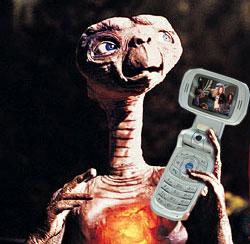 The V700 comes in Samsung’s favoured clamshell design with the added twist of a tilting display which lets users rotate the screen 90 degrees to take advantage of a wider display (it looks a bit like ET to us in this position, but maybe we’ve been overdoing it a bit recently.)
 We’re impressed with the onboard TV out port which could prive a great way of sharing your photos with chums.
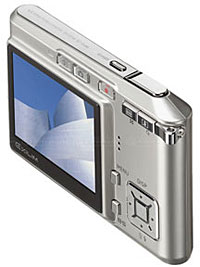 CASIO have announced their new, wafer-thin EXILIM CARD EX-S600 digital camera.
 According to Casio’s announcement, Revive Shot mode “adjusts for obliquity as well as brightly refreshes faded colours.”
 As is de rigeur on consumer compacts, there’s a built in movie mode with the Casio capturing MPEG-4, VGA (640×480 pixels) at 30 frames/second.
 Macrovision, a company who sell content protection (DRM) system, have today released a report they commissioned into content copying.
 This is on the basis of what to us appears, from a quick once over of this report, a pretty unscientific approach, as the following paragraph from page 10 illustrates.
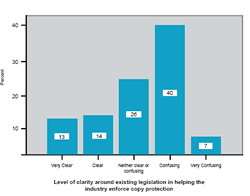 I hope that each time a ‘report’ or so called research like this is published, that it is gone through with a fine tooth comb pointing out its weaknesses. This kind of nonsense needs to be countered.