 History will be made in a small corner of Wales today when the residents of two Carmarthenshire villages – situated on either side of the River Tywi – switch to digital-only TV.
Around 450 households in Ferryside and Llanstephan will become the only areas in Europe with digital-only TV signals (along with slightly more glamorous Berlin).
Closing down the analogue television transmissions marks a milestone for the government in its quest to install digital TV in every British home.
The government is keenly perusing its pledge to switch off the analogue TV signal and replace it with digital by 2008 in Wales.
A provisional timetable for the UK-wide switchover has earmarked ITV’s Border region – covering south-west Scotland and Cumbria – as the first to lose its analogue signal in 2008.
The government has said switching to digital would provide a major one-off boost for the UK economy, leaving Chancellor Gordon Brown free to flog off the lucrative old analogue frequencies to telecom companies.
The west Wales households agreed to run trials with the digital set-top boxes when digital transmissions in the area began last November. Each house was given digital receivers for each of their televisions.
 To help smooth the transition, a helpline was set up for residents’ teething problems, with one-to-one support made available to the elderly.
After three months, the households were asked if they wanted to keep the digital services or revert to analogue only – and the overwhelming answer was “Ydw plîs!” (Yes please), with 98% voting to retain the digital services (out of the 85% of households who responded).
Project director Emyr Byron Hughes said residents had taken to digital because it provided more services, commenting: “It is such a leap forward even with the basic digital service, they have just taken to it.”
The trial had been run to discover how people coped with the new digital equipment and to learn from any technical problems experienced in the switchover.
Officials from the Department for Culture, Media and Sport, and the Department of Trade and Industry, joint co-ordinators of the project, seemed well chuffed with the progress so far, with Stella Thomas, one of the project team members, adding: “People have been more open to change than perhaps we have given them credit for in rural areas.”
 There are concerns, however, that these fancy-pants new digi-boxes could be a problem for the elderly and those on poor incomes. The government is discussing with charities about how to protect the vulnerable while promising not to authorise a complete switchover until support measures are in place.
The trial results come on the day that Ofcom publishes its Digital Television Update for the fourth quarter of 2004, examining the latest data provided by the main digital television platform providers.
The update shows that by 31 December 2004 a total of 59.4% of UK households received digital television; an increase of 3.5% from 55.9% at 30 September 2004.
By the end of last year, the total number of digital television households grew by 914,980 to 14,773,881, representing growth over the quarter of 6.6%.
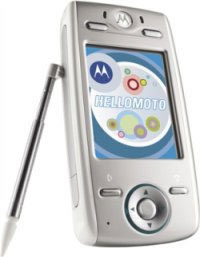 After the humiliating no-show of their much hyped (and currently in-limbo) iTunes phone at CeBIT earlier this month, Motorola have hit back with two new music phones.
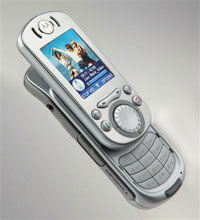 Sporting a ‘slider’ form factor, the E725 is a music player-cum-smartphone featuring a 1.9″ display (176 x 220 pixels resolution) with dedicated music keys, 5-band graphic equaliser and dual stereo speakers with virtual surround sound.
 Research carried out on by Infosecurity Europe has revealed that 92% of people were willing to freely dish out all the personal information needed to steal their identity in exchange for the chance to win a theatre ticket.
 When they were told that it was a combination of their pets name and mothers maiden name, they were asked what they thought their stage name would be. Like a bunch of chumps, ninety four percent (94%) of respondees then blabbered out their mother’s maiden name and pet’s name.
 Incredibly, the researchers did not give any verification of their identity, offering only a trusty clipboard and the offer of the chance to win a voucher for theatre tickets.
 A British company has unveiled its cunning plan to roll out high-speed wireless networks and location-based services using street lampposts.
 Shrier believes that revenue could be generated by persuading companies to store their information on lampposts, paying Last Mile whenever someone accesses data using the MagicBook.
 Microsoft has agreed – with all the enthusiasm of a child being made to eat spinach – to adopt all the “main changes” requested by the European Commission to its new version of Windows without Media player components.
 Horacio Gutierrez, a lawyer for Microsoft, was clearly not too happy, telling Reuters that the company has “some misgivings about the chosen name, as we fear it may cause confusion for consumers about the product, but we will adopt the Commission’s name in order to move forward and accelerate the pace of the implementation process.”
 And there’s more! Microsoft are also in disagreement with the EU over plans to appoint a trustee to monitor Microsoft’s compliance (or the complete lack of) – if the company fail to comply with the Commission’s decisions, they could face a daily slapdown of up to US$5 million – the equivalent of a cup of coffee in Bill Gates’ world.
 New figures released by the BPI (British Phonographic Industry) confirm that UK music fans are the numero uno, mad-for-it music buyers in the world, with each tune-loving Brit buying on average 3.2 CDs per person per year.
 It also raises questions about recent BPI lawsuits against alleged P2P file-swappers and the promotional role the networks may be playing.
 With album bundles and sales of digital EPs also doing good business in the UK, the Official UK Charts Company estimate that the total UK market for downloads topped 9 million units in 2004.
 An updated version of the hugely popular Voice-over-IP (VoIP) application Skype has been released.
 The soaraway Luxembourg-based company has so far signed up 29 million registered users for its free peer-to-peer based Net phone calling, making it one of the fastest-growing services on the Net.
 Mobile operator Orange has announced a GSM-based tracking service which it claims is both cheaper and easier to use than GPS technology.
 Electronic Tracking Systems (ETS), makers of battery powered security tracking devices under the mtrack brand, is one of the first to pilot the product.
 Channel Five yesterday became the first UK broadcaster to launch a legal video download store, offering DVD-quality downloads of some of the most popular features of its flagship car show, Fifth Gear, from its Web site.
 Powering the UK’s first legal video downloads store is a system developed by 7 Digital, the company behind download stores for a raft of leading music companies including Universal and EMI.
 Legal music download sites have become hugely popular in recent years, but TV companies have so far not used the same technology to put programmes online – despite British viewers being the
  Commuters on London’s Tube network could soon be able to bellow out, “I’M ON THE TUBE!” if trials to introduce mobile and wireless Internet connections underground from 2008 get the green light.
 LU director of strategy and service development, Richard Parry commented, “The process we launch today is to start getting information from the market about how we could best provide a mobile phones service”.
 An LU spokesman added “Passengers would like to have mobile coverage at Tube stations but they are less keen to have it on trains”.