 Yahoo has slapped a king-sized gauntlet on the floor as it announced plans to roll out an aggressively-priced online music service.
The new service, unsurprisingly dubbed Yahoo Music Unlimited, will give downloaders unlimited access to over a million music tracks for US$6.99 (~£3.70 ~€5.42) a month, or, alternatively, for US$60 (~£31.86 ~€36.58) a year.
The service, which also lets users transfer the songs to compatible portable music players, massively undercuts its rival’s services.
RealNetworks, for example, charge a comparatively hefty US$179 (~£95 ~€139) a year for a near-identical service while Napster charging US$14.95 (~£7.95 ~€11.60) a month for a portable music subscription service and US$9.95 (~£5.25 ~€7.72) a month without the portability option.
“We look at subscriptions as a way to get people to pay as little something for digital music as opposed to ripping their own CDs or stealing music.” Yahoo Music General Manager David Goldberg said.
Yahoo hopes that the low, low, low price is designed to get users hip to the subscription music model, which allows consumers to play downloaded music and “streamed” tracks whenever they want — as long as they keep shelling out for the privilege.
Just like Napster’s similar service – which offers a similarly vast online music library – the second a customer’s cash flow stops, their opulent oasis of a record collection will rapidly turns into a tune-free desert.
Yahoo’s price pruning bonanza looks set to spur further expansion of the online music business, which despite huge growth still only accounts for about 2% or less of total music sales, according to analyst estimates.
 Yahoo’s hugely popular Website – visited by 100 million US users every month – should give their music service a big head start, with the company being able to let rip with the kind of massive marketing muscle that few online music rivals can match.
“It’s a hugely aggressive move, a shot in the arm to the subscription notion,” says David Card, an analyst at Jupiter Research, predicting subscription revenue will be larger than downloads within a few years, from roughly equal shares today.
iTunes, the current online music market leader, provides a different service, preferring to charge users on a song or album download basis, with Apple previously being critical of the subscription model.
Some suspect that they may be pressured into adopting a similar offering once Yahoo’s PR machine rolls into action.
Although it’s generally accepted that subscription services are more lucrative than charging per download, some analysts are wondering whether Yahoo will actually be able to make any dosh at the US$60 (~£31 ~€46) annual subscription level.
Yahoo’s David Goldberg has expressed confidence that the service will be profitable, although conceded that the company could eventually raise its fees. He’s been a bit sketchy with the small-print details too, but says Yahoo will pay music labels royalties linked to its revenue and subscriber numbers for the service.
 Yahoo’s subscription service will work with selected portable MP3 players that use Microsoft’s digital-music format – there’s currently around compatible 10 devices available, including Dell’s DJ player and Creative Technology’s Zen Micro.
Owners of compatible devices will have to install new software on them to be able to use the service, with newer models offering built-in compatibility.
Apple may be slightly perturbed to learn that the Yahoo’s service will not work with their iPod, despite it being the biggest selling digital music player on the planet and probably elsewhere.
Yahoo’s testosterone-charged move reflects their determination to grab a Brobdingnagian chunk of the online music pie, with the company splashing out US$160 million (~£85m ~€124m) last year to acquire MusicMatch, a company already offering a song/album download deal with a non-portable subscription service.
MusicMatch’s subscription charges have now come down to match the new service with Yahoo expected to merge the two services shortly.
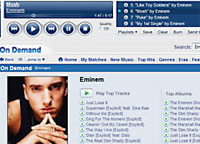 The new service will include free software a la Apple’s iTunes jukebox, with the bonus of letting subscribers rummage around in their friends computers for songs, and then listen to their tracks if the music is part of Yahoo’s catalogue.
To further entice subscribers, Yahoo is looking to incorporate the social aspects of listening to and discovering music through tie-ins with other Yahoo services -like gamers on Yahoo’s site being able to listen to the same music as friends they are playing with.
Yahoo Music users not ‘down’ with this subscription thang will still be able to buy tracks under the traditional download model, with fees of 79 cents (~£0.42 ~€0.62) per song for Music Unlimited subscribers and 99 cents (~£0.53 ~€0.77) for nonsubscribers.
 Broadband is taking off everywhere, speeds are increasing and everybody’s happy. Well almost. Broadband isn’t available to all, especially those in more rural areas.
 Other approaches to HAP involve lightweight aircraft, such as the European-funded Capanina project.
 Figures from a new study by ABI Research reveal that annual global sales of “dual-mode” mobile phones – clever-clogs handsets that can connect to either a conventional cellular service or a Wi-Fi network – are likely to exceed 100 million during the final year of this decade.
 Despite all the travelling through different locations, the smartypants handset would sense the available signals and switch automatically from one network mode to another, keeping the user connected at the lowest cost.
 With ne’er a whisper or a parp on the PR trumpets, Apple has quietly released an updated version of the iTunes software as a free download from its Web site.
 Mindful of the marketing value, Apple has made music videos available initially on purchase of albums or tracks from the Dave Matthews Band, Morcheeba, Gorillaz and The Shins.
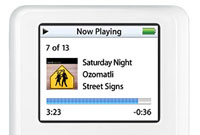 The new version also includes a security fix to patch up a vulnerability relating to MPEG4 file buffer overflows (they sound rather painful).
 According to industry insiders, trials of mobile phones doubling as payment tools will be taking place in Taiwan shortly, marking a big step for the nation’s contactless technology development.
 NFC handset payment services are already tickling the public’s imagination in Japan and South Korea.
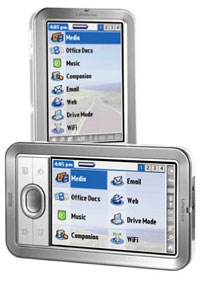 After months of rumours on the Web, details of palmOne’s new LifeDrive PDA have finally shown up on Amazon.
 NormSoft’s Pocket Tunes is able to play MP3, WMA, Ogg Vorbis, and WAV files and the unit will also support full screen video and photo playback.
 The LifeDrive comes with USB 2.0, so transferring files onto the microdrive should be a fairly nifty business.
 Research In Motion (RIM) have announced that that the BlackBerry wireless communicator now boasts 3 million worldwide subscribers, with one million subscribers added in less than six months.
 BlackBerry Enterprise Server’s ability to integrate with Microsoft Exchange, IBM Lotus Domino and Novell GroupWise (and other existing enterprise systems) has proved a hit with corporate customers keen to take advantage of push-based wireless access to e-mail and other corporate data.
 With the NTP lawsuit now resolved, RIM is free to follow its European initiative and license its Blackberry Connect software to US mobile phone vendors, so we can expect to see more third-party phones and handsets connecting to the service.
 It was a bad weekend for Google as the entire site was rendered unavailable on Saturday night and their new Web Accelerator application drew criticism on privacy and security concerns.
 Deeply unchuffed, Fried complained that “Google’s Web accelerator can wreak havoc on Web-apps and other things with admin-links built into the UI.”
 Sadly, things went from bad to worse on Saturday night when the world’s leading Internet search engine shut down from 6:45 to 7 p.m. eastern time, with some users experiencing longer outages.
 Games developers have included Internet access in their products. The best example of this is Wipeout Pure, which includes a browser, allowing the user to download new game levels and features. Since the game has a browser built-in, it can be reasonable to assume that Sony have actually put all the code to access the Internet in the PSP itself (and made it available to developers).
 Rather than everyone set-up spoof servers, some nice people have done it for you, and these then point to a PSP portal which someone has set-up PSP friendly content. You can access the spoof DNS servers by amending your Internet set-up configuration (on the PSP) and leave everything to automatic except for the DNS settings, into which you enter the spoof server settings.
 Once updated versions of the firmware come out, or there are 3rd party applications, the system will have all the features to be a powerful media hub. It supports WiFi, has a decent screen and video capability now, adding other Internet capabilities will just add the finishing touches to a superb product.