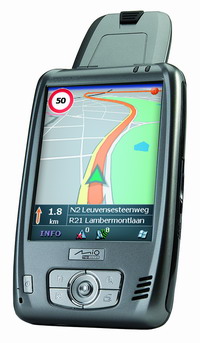
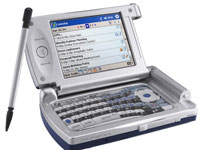
 Out just in time for overgrown boys to stick it on their Santa wish list, Mio Technology have announced their new Mio A201 integrated GPS model.
In an increasingly crowded marketplace the Mio A201 aims to stand out from the pack by offering a rotating GPS antenna, letting users navigate in both portrait and landscape mode.
Screen modes can be automatically switched by rotating the antenna or tapping a button, with the addition of the latest 20-channel SirfStar III GPS Chipset enhancing GPS satellite signal pick up and reception.
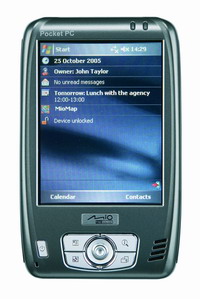 Mio are promoting the device as a ‘go anywhere’ portable sat-nav device which can be used for drivers, mountain bikes or walkers ambling through the countryside.
The Mio A201 is fully compatible with the TMC (Traffic Message Channel) which provides constant updates and routing options on nearby traffic problems, automatically calculating alternative routes through problem areas.
That all sounds great except users have to fork out extra for the required TMC receiver and even then the service doesn’t work in the UK and France. But thanks for telling us what we can’t use Mio!
The Mio A201 will, however, support the latest version of the Mio Map software, version 2 for Pocket PC, now sporting what the makers call a “fresh new interface.”
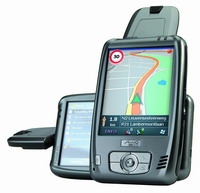 There’s the usual Outlook synchronisation options available, and we rather liked the new Compass Mode designed for navigating off road on foot or on a bicycle.
The onboard Points of Interest (POI) database has also been updated to include restaurant telephone numbers, with the ability to download new or customised point of interest lists from a Web-based subscription service.
Running on Windows Mobile 5, the Sat Nav PDA sports a 320 x 240 pixel, colour LCD touch-screen and purrs along on a 312Mhz Intel Bulverde processor supported by 64MB of RAM.
Bundled software includes Outlook Mobile Contacts and Calendar, Word Mobile, Excel Mobile and PowerPoint Mobile, games and Windows Media Player.
There’s Bluetooth connectivity onboard with the swappable lithium-ion 1200 mAh battery delivering a claimed 4.5 hours of operation.
The Mio A201 will be available mid- December priced at £239, with the stingy fellows not including any mapping software.
 In the week that BT and Sky both saw their triple play offerings potentially trumped by a possible NTL/Virgin ‘quadruple play’, BT chose to release details of its upcoming content deals with BBC Worldwide, Paramount and Warner Music Group.
 Against a backdrop of whispered rumours of delays with Microsoft’s IPTV Edition, the BT service is slated for launch next year.
 Problems won’t be confined to BBC programmes if ITV programming is carried, advertisers are bound to be unhappy that time-shifting viewers will skip the paid for messages.
 Real have announced the launch of its new online music service, imaginatively called, err, RealMusic.
 RealMusic will be creating a chart of the top ranking tracks and ringtones created, submitted, and rated by users, with an editorial team producing content and commentary on artists, music releases and videos.
 “This demonstrates that there is a strong demand for services that mix the way in which consumers access music, from downloading the latest chart hits and ringtones to sharing tracks from unsigned bands. RealMusic gives music enthusiasts all these options as well as the opportunity to effortlessly discover music to suit their mood,” he continued.
 Sprint and MSpot, have announced the launch of MSpot Movies, a new service which streams mobile-optimised feature films to mobile phones.
 The streaming content will be cut up into ‘chapters’ (short segments optimised for a mobile audience) and will also include music concerts and stand-up comedy specials.
 Although there’s no denying that mobile video is set to grow – Strategy Analytics reckon they’ll be 150 million viewers by 2008 – we really can’t raise much enthusiasm at the prospect of burning up our bandwidth by watching a selection of crap movies on a tiny screen in 5 minute chunks.
 A UK company is introducing a “StealthText” service which sends self-destructing mobile phone text messages.
 “The ability to send a self-destruct message has massive benefits for people from all walks of life, from everyday mobile users, through to celebrities and business people, but this is just the start,” said Staellium CEO Carole Barnum, adding that the company intends to extend the service to include self-destructing email, voice and picture messages in spring 2006.
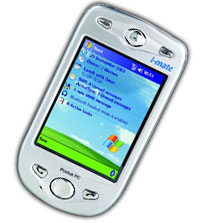 Pocket PC software company SPB ran a survey of its users during November 2005, and discovered that a staggering 96% of those taking part were blokes.
 As for accessories, memory cards, unsurprisingly, were the essential purchase for 85% of respondents, with 69% forking out for screen protectors.
 The vast majority of Pocket PC users (85%) connect to the internet with their machines, with 72% browsing the web, 65% checking email and 35% using instant messaging.
 A US federal appeals court has upheld the mammoth $22,500 (£12,760, €18,930) fine slapped on a 29 year old Chicago mother caught illegally distributing songs over the Internet.
 After Ms Gonzalez rejected an earlier proposed settlement from music companies of about $3,500 (£1,950 €2,950), a federal judge later filed a summary judgement ordering her to shell out $750 (£425) for each of 30 songs she was accused of illegally distributing over the Internet.
 Ms Gonzalez’s case was part of first wave of civil lawsuits filed by record companies and their trade organisation, the Recording Industry Association of America (RIAA), back in September 2003.
 Ofcom has published its Digital Television Update for the third quarter of 2005, revealing that two thirds of UK households now watch digital television.
 The number of households with Freeview as their only source of digital television viewing was estimated at 5,775,000 – up by 600,000 homes during the quarter.
 Digital cable subscribers now account for more than 2.6 million of the total cable television homes, increasing by more than 43,300 in the quarter, while subscriptions to analogue and digital cable television decreased slightly to just below 3.3 million in the quarter (due to a fall in analogue cable subscribers outweighing the increase in digital cable subscriptions).
 When we saw MSI’s feature packed StarCam 370i knocking out for a mere £15 online ($26, €22), we thought it would make an ideal replacement for our elderly (and somewhat battle-weary) Sony cam, currently gazing out over the delights of Brixton.
 A rudimentary software control panel lets users fiddle about with image/video parameters (gamma, brightness, contrast etc), and budding Jean-Luc Godard’s can select the black and white option for arty scenes.
 The cam also features a built in microphone which was, as you might expect, fairly basic and lo-fi, but good enough for Internet calls.
 We can, however, recommend it for anyone looking for a basic, cheap as chips Webcam for video chats with friends and relatives.
 Woof … I mean, Hello?
 From what I gathered, the device lets you set a fixed area in which your dog is allowed to be. If your dog goes outside this area, the unit sends you a text message. I personally think that this is kind of like shutting the door after the horse (or dog) has bolted.
 Now if only one of these could be invented that’s small enough to be fitted on valuable items like my laptop, or my wallet. Now that would be useful, and save me looking for either of them when they get stolen. And when they do get stolen, I will know where they are and possibly who stole them.