 The BBC is hoping to get Dr Who fans reaching for their red buttons en masse with a video-rich interactive TV application scheduled to run straight after the airing of the Christmas Day special (7:00PM GMT).
Dubbed “Attack of the Graske,” the application hopes to get sofa-loafing viewers taking part in an interactive adventure with the aim of preventing an evil alien creature, called the Graske, from taking over the earth.
 It looks that the BBC has invested muchos cash into the venture, employing live-action video and “state-of-the-art” special effects produced at the high end visual effects studio, The Mill.
Christmas-pud gorged viewers will be tasked with using the arrow keys on their remote controls to perform a series of challenges which will test observation, dexterity, memory and – according to the BBC – their bravery.
There’ll also be an opportunity to fly around in the Tardis with the Doctor “on hand to give advice, encouragement, and even step in when things go wrong.”
 Produced in Cardiff by BBC New Media and BBC Wales, producer Sophie Fante commented, “Attack of the Graske gives the viewer the unique opportunity to immerse themselves fully in the world of Doctor Who.”
“We aimed to make the challenge with the same scope and feel of the main series and, in ‘Attack of The Graske,’ the viewer finds themselves not only flying the Tardis with the Doctor but fighting the Graske on the planet Griffoth and hunting him out in Victorian London,” she added.
Filming the program involved creating an authentic Dickensian Christmas scene, complete with snow, in Cardiff.
 We can’t wait to watch this latest installment of the highly rated Dr Who series and are hoping to witness another kind of winter wonderland the day after when the mighty Cardiff City FC take on Plymouth.
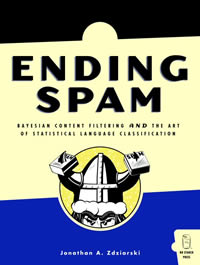 The full title of the book, “Ending Spam: Bayesian Content Filtering and the Art of Statistical Language Classification,” gives you a pretty strong indication that this book is going to provide a depth of information.
 The appendix (Shining Examples of Filtering) explains some of the programs out there, how they work and interviews with the authors.
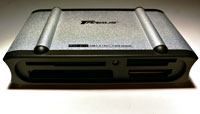 As your collection of digital devices grows, you’ll probably find it near-impossible to stick with just the one memory card format as the pesky things keep on changing.
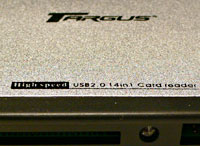 Getting data off these various cards usually means a trip to the back of the PC to install the various cables that came with all your camera/smartphone etc (when will they standardise all the ruddy USB connecters?!).
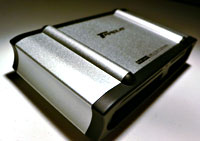 With most memory card readers offering support for a huge variety of memory cards, all you need to take on the road is a single USB lead to connect the card reader to your laptop and you’re sorted!
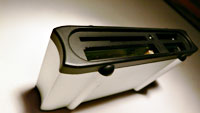 We were sadly guilty of leaving the charger for our Nikon N70 back in Blighty during out recent jaunt to NYC, and after seeing the battery levels accelerating downwards as we transferred zillions of images to our laptop, we shelled out for a cheap’n’cheerful Targus card reader, the TG-CRD14 ($25 street price).
 Google have thrown the switch on the latest addition to their search results – music.
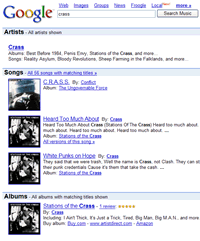 Initial music search results are split down to three sections Artists; Album; Songs. The information available is comprehensive.
 This book covers the Mac OS X 10.4 (aka Tiger) for geeks who have come from a Unix/Linux environment and are happiest using the command line, not sexy GUIs (graphical user environments).
 Be aware, it’s not a book for the casual Mac user, but if you get excited about the insides of an OS (which some of us at Digital-Lifestyles do admit to), you’ll find plenty of material.
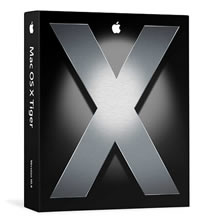 Bits like the section of PearPC might be a bit over the top for even a normal Unix user, but it does work. If you just want to develop Mac OS programs, this could be a way to do it – although it will be slowly as the emulator isn’t very fastest.
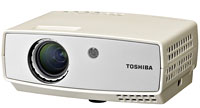 It wasn’t that long ago that lugging around a projector was the first step on the painful route to a guaranteed hernia, but thanks to the wizardry of boffins and the onward march of technology, projectors are no longer the size of small houses.
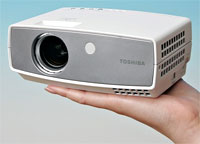 The TDP-FF1A (try saying that with a mouthful of tea) also comes with a handy USB port to let photographers directly display their photos straight off the camera.
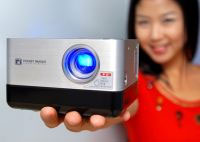 Also shown off at the September IFA 2005 in Berlin was Samsung’s neat Pocket Imager SP-P300M projector.
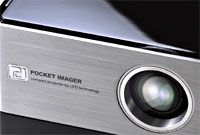 The attractive LED projector sports a contrast ratio is 1000:1 with an impressively high claimed bulb life of 10,000 hours.
 Intel has been bigging up its next-generation laptop technology, claiming they will use 25 percent less power while retaining class-leading performance.
 According to Intel’s marketing chief for mobile platforms, Keith Kressin, this process means that the Napa system (which includes the Yonah processor, its attendant chipset and a new wireless chip) will soak up 28 percent less power than its predecessor while managing to perform 68 percent better
 The tough challenge for Intel’s engineers is shoehorning ever more powerful processors into ever-slimmer laptops while improving battery life and managing to dissipate the processor’s heat.
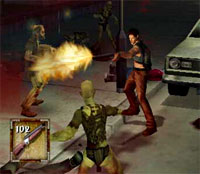 The New Scientist is reporting that US researchers have discovered a brain mechanism that may link violent computer games with aggression.
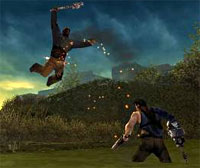 Bartholow argues that this reduction in response is correlated with aggressive behaviour.
 The team shipped in a crew of 39 gamers, and quizzed them on the amount of violent games they played, before being shown a series of neutral images interspersed with occasional violent or negative (but non-violent) scenes, while sensors recorded their EEGs.
 Throughout the tests, the violent games experience and P300 response were still strongly correlated with aggressiveness.
 Freeman also added that stopping people playing violent video games would be like banning them from playing sports such as football or hockey.
 Sad to report that UK News organisation ITN has decided to end its ITV News Channel. Despite much favourable comment, they feel that there’s no room in ITV’s multi-channel world for a dedicated News Channel and the channel will close in January.
 With a fearful eye on Skype’s runaway success, Microsoft has joined the stampede to offer Internet-based telephony services by announcing a cut price, pre-paid PC-to-phone service, the result of a deal with the US telecommunications group, MCI.
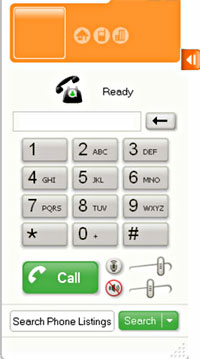 In recent months, Google, Yahoo! and eBay’s Skype unit have all chipped in with their own cheapo PC-to-phone VoIP (Voice over Internet Protocol) services.
 Similarly, Skype, the current big boys of the PC-to-PC VoIP market, are offering calls for about 2 cents a minute from a PC to a phone in the US other countries.