 BT’s dominance of the UK home telephone is coming under fresh pressure as the phone call market becomes the most liberal in Europe. Previously, their pricing levels have had to be agreed in advance with the UK regulator Ofcom, but with it understood that this is going to be lifted soon, price cuts are expected.
In a sign that the gloves are well and truly off, Tesco has unleashed a price-busting Voice over IP (VoIP) package designed to lure customers from the incumbent operator.
It’s further proof (if any were needed) that VoIP continues to shake things up in the voice phone market.
The Tesco package will be marketed at just under £20 and will include a ‘normal’ phone handset that plugs in to a broadband-enabled PC’s USB port, and the software need to drive it. Calls will be made at a fraction of the current cost.
Many other companies continue to pressure BT. Talk-Talk, the landline phone service by The Carphone Warehouse, has already consolidated two of the traditional landline competitors and it’s likely that Sky would also welcome call revenue via its recent Easynet acquisition.
Pressure is also coming from outside the UK. US giant AOL has BT in its sights with a programme to exploit the Local Loop Unbundling (LLU) agreement BT made with Ofcom, which permits AOL and others to house high tech Voice over IP equipment at exchanges throughout the country.
 Technical-savvy Skype callers have for a long time taken advantage of VoIP calling to obtain free or cheap calls.
The danger for BT is that the trickle of the public away from its traditional services over recent years could become a torrent, as more content, including broadband TV starts to be delivered by IP, BT could lose their in-built advantage as the default delivery gateway to UK homes.
Is all of this price cutting good news for British consumers? Well, certainly lower call prices will benefit the majority of UK call makers, but there is a question mark in the long run. It could bring mixed blessings for the UK’s telecoms infrastructure as BT tries to cut costs and investment to ensure that its institutional shareholders remain happy as they operate on slimmer margins.
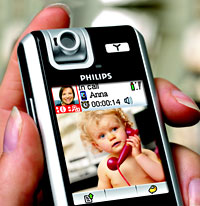 It’s been a long time coming, but Dutch enormo-corp Philips are looking set to finally roll out their innovative Wi-Fi-enabled VoIP telephone, the VP-5500.
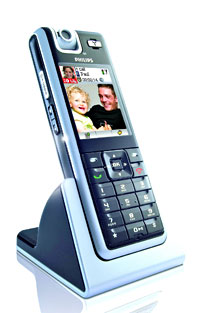 Announced way back in Sept 2005, the VoIP phone comes with a VGA camera that rotates up to 240 degrees, letting users check out their look on the built-in, high-resolution LCD display before committing a potential videocall fashion catastrophe.
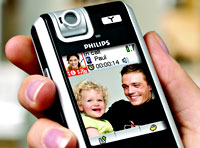 Built around established standards-based technologies like Wi-Fi and Linux, the VP5500 can be upgraded wirelessly, opening the door to future upgrades – giving operators the chance to add value-added services as the becmoe available.
 To be honest, we’re still a little unsure about video calling.
 A few years ago, you’d be greeted with a blank face or a call to the local psychiatry service if you started going on about ‘listening to your downloaded podcasts’, but figures released from the BBC show how the format is continuing to grow in popularity.
 The chart also revealed that nearly two million downloads took place during the BBC podcasting trials over December.
 Simon Nelson, controller of BBC Radio & Music Interactive was enthusiastic: “It’s fantastic to see how the demand for radio downloads has grown since we first offered them in 2004. These figures underline the enduring relevance of radio in the digital world.”
 Over the last couple of weeks there’s been a lot of speculation that Disney are going to be bidding to buy Pixar, the digital animation studio that’s supplied the majority of Disney’s successful computer-generated animation successes.
 According to an online survey conducted by brand-meisters Brandchannel.com, Google has held on to its title as the world’s most influential brand in 2005, pushing Apple out of the numero uno spot for the second time this decade.
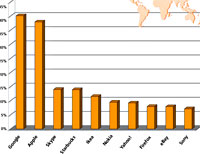 Globally, top honours went to Google, who outflanked brand rivals Apple with an avalanche of punter-pleasing freebies like Google Mini, Desktop and Google Earth, described by Brandreport as, “arguably the greatest thing to hit the Internet since porn” (steady on, chaps!).
 Although Google whipped Apple globally, the company still rules the roost on their home turf, with Steve Jobs’ outfit being declared the leading brand in North America in front of their rivals.
 It’s a story of booze and beer in the central & Latin America segment, with Corona and Bacardi sitting proud in first and second places respectively.
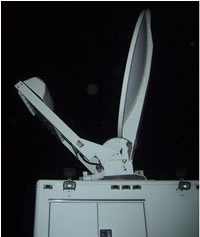 Digital-Lifestyles has been informed, and can exclusively reveal, that BT is looking to shed its OU operations from its Media and Broadcast (BT M&B) division.
 Despite BT as a whole being determined to move into new revenue opportunities like TV, there’s new breed of technology solutions for linking signals which are outside BT’s control. This bothersome issue is further squeezing their previously healthy profits, and the current cost base for BT’s OU services makes it difficult to justify continued operations, indeed we’ve been told that the OU is currently unprofitable. It’s hoped that a buyer will be able to make the operations pay, by reducing costs and realising synergies.
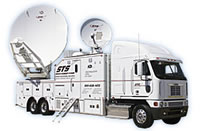 Further deals for incumbent European telecoms operators are on the cards as they retreat into their core businesses. See France Telecom, who recently off-loaded one of its Paris Earth Stations to the satellite operator
  A heady mix of ever plummeting digicam prices, larger memory card capacities and more capacious hard drives means that it’s easy to end up with photos and videos scattered to the four corners of your PC, making it nigh on impossible to find your pictures.
 A start-up screen gives new users an overview of features to help them get started while upgraders will be glad to see the program sticking to the tried and trusted three-paned interface, coupled with a useful ‘image basket’ function.
 Unlike many other image management programs, you don’t have to ‘import’ images into the program before they can be viewed, so the program also doubles up as an excellent image file browser.
 At times, the sheer weight of features can prove a little overwhelming to new users, but for keen photographers keen to keep a vice-like grip on their growing photo collections and looking for a strong, all-round image management solution, we strongly recommend ACDSee.
 So where do we start?
 Naturally, there will always be those who say regulatory decisions made by organisations such as Ofcom are ‘independent’ and ‘evidence-based’ and therefore would be valid whoever happened to be in government. However, most people know Ofcom is ultimately a product of the government who created its remit – New Labour – and who on occasion have allowed the notion of ‘evidence-based’ regulation to underpin a culture of third party ‘experts’ who decide policy matters with a minimum of public participation or scrutiny.
 If you were to consider UK telecoms, media, and technology (TMT) policy since Parliament passed the Communications Act 2003 and brought about the formation of Ofcom much has happened. The regulatory machinery of the state has swung into action with relative efficiency, taking on such issues as BT’s marketplace position, digital switchover, and public subsidy and control of broadcasting and new media. And we are starting – just starting – to see the results of some those efforts.
 This is not a good thing. These industries are massively influential from a social and economic perspective. According to Ofcom, for example, the U.K. communications marketplace has an annual turnover of £55.9 billion. That’s tens of thousands of jobs and billions of pounds at stake. Policies applicable to the TMT sector also affect how the U.K.
 Certainly the party is already developing new ideas (or in some cases adopting the opposition’s cast-offs) in other policy areas. And by all accounts, David Cameron is doing an effective job of moving the Tories back toward the centre of British politics. The new leader appears flexible and open to new policy approaches. But nothing definite is happening in the TMT space. We think it should.