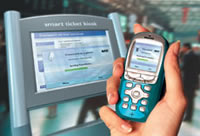
 According to industry insiders, trials of mobile phones doubling as payment tools will be taking place in Taiwan shortly, marking a big step for the nation’s contactless technology development.
They’re using Near Field Communication (NFC), a close-range wireless technology that operates over a few centimeters, enabling the simple transfer of information. Created by Nokia Corporation, Royal Philips Electronics and Sony Corporation, it uses a restricted version of RFID and we’ve been last 18 months, or so.
Taiwanese cardholders can already make payments at contracted petrol stations, coffee shops, video rental stores, train stations etc by simply waving their NFC-enabled device in front of sensor devices.
BenQ, one of the 12 partners in the NFC consortium, is expected to deliver 100 new mobile phones embedded with smart chips for the trial program next month.
Stage one of the trials will be conducted by Taipei Smart Card Corp, who will start testing the BenQ phones as a means of payment for services on bus lines, the MRT and public parking lots in the capital.
If that all goes tickety-boo, developers will look to strike deals with mobile service providers to integrate chips with Subscriber Identity Module (SIM) cards in handsets, giving access to mobile banking functions and even debit or credit card functionality.
The merging of cell phones and IC-chips is part of the government’s M-Taiwan (mobile-Taiwan) scheme, which put together a (NFC) consortium in November last year.
Taiwan’s alliance pooled the resources of BenQ, Taipei Smart Card, the Institute for Information Industry, five cellphone service providers, MasterCard International and Visa International.
 NFC handset payment services are already tickling the public’s imagination in Japan and South Korea.
In Japan, Sony has been conducting contactless payment services with a mobile phone operator and train company, and in South Korea, SK Telecom has launched the Moneta card program with a circulation of 100,000 Visa-enabled mobile handsets.
According to Peter Manners, regional head of Visa International Asia-Pacific, the next phase is to promote the use of Universal Subscriber Identity Module (USIM) cards in 3G handsets.
Addressing besuited execs at the Smart Card Expo at the Taipei International Convention Center, Manners said Taiwan is second only to Malaysia in the Asia-Pacific in terms of chip-embedded card penetration.
Nokia 3220 Brings Contactless Payment and Ticketing
BenQ
NFC Forum
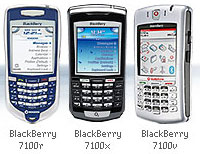 Research In Motion (RIM) have announced that that the BlackBerry wireless communicator now boasts 3 million worldwide subscribers, with one million subscribers added in less than six months.
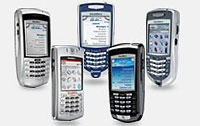 BlackBerry Enterprise Server’s ability to integrate with Microsoft Exchange, IBM Lotus Domino and Novell GroupWise (and other existing enterprise systems) has proved a hit with corporate customers keen to take advantage of push-based wireless access to e-mail and other corporate data.
 With the NTP lawsuit now resolved, RIM is free to follow its European initiative and license its Blackberry Connect software to US mobile phone vendors, so we can expect to see more third-party phones and handsets connecting to the service.
 Cell phone penetration in Western Europe will hit 100% by 2007 as mobile-loving customers continue to scoop up multiple phones and phone cards.
 Although some people might think that the rise is fuelled by drug dealers toting multiple phones for ‘business’, the increase is actually explained by customers buying multiple phones and/or SIM cards.
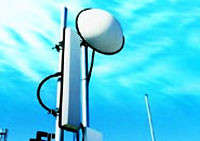 With a manly backslap, Intel and Sprint have announced that they will work together to advance development of the 802.16e WiMAX standard.
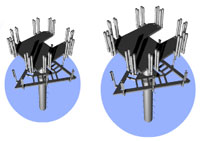 In case that sounded too simple, here’s Oliver Valente, CTO and VP of technology development for Sprint, to baffle you with a buzzword remix: “Our relationship with Intel will help validate requirements, drive key ecosystem development needs, formulate network strategies and define the potential for advanced wireless services adoption”.
 Sean Maloney, another executive with an impossibly long job description (“executive vice president and general manager of the Intel Mobility Group”) added: “WiMAX technology has the promise to deliver new broadband services to consumers globally.”
 UK third-generation mobile phone network 3, have teamed up with TV production and distribution company Granada to bring the popular ITV show, Celebrity Wrestling, to video mobiles for the first time.
 Gareth Jones, COO of 3 thinks the idea is a whoop-de-do winner: “TV shows like this are ideal for our ‘Today on 3’ service, we’re tapping into programmes that we know our customers really enjoy and we’re providing it to them in bite-size chunks on 3.”
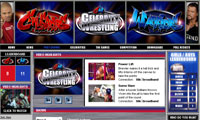 Lord knows who would want to fork out for this dreadful tack, but Granada will be supplying around sixty video clips to 3 customers over the course of the eight week series, with the clips charged at 50p each (or included within add-on packages).
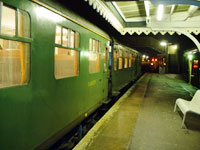
 T-Mobile is offering a free WiFi pilot service on Southern Rail’s busy London-to-Brighton train service in readiness for a full launch in June.
 T-Mobile manager for WiFi Jay Saw was in full corporate PR spin mode as he enthused: “We are the only operator that has placed GPRS, 3G and WiFi at the centre of its strategy. That differentiates us from the competition. We’re the world’s largest network – by our own definition.”
 Nokia continues to be the Big Cheese of the worldwide mobile handset market, shipping nearly twice as many phones as its nearest competitor, Motorola.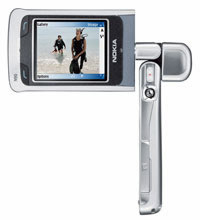
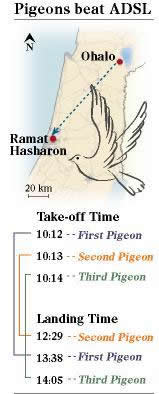 This has Friday Story written all over it. A few Israeli geeks set up a test to compare the speed of delivering data via pigeon (PEI – Pigeon Enabled Internet, as they’ve labelled it) compared with ADSL.
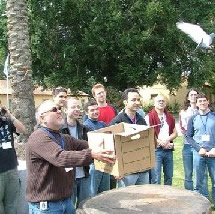 As you know, the A in ADSL stands for Asynchronous, so the transferred rates listed equate to the speed that information is received. Upload rates are significantly lower. By their calculations, uploading 4Gb of data on ADSL would take around 96 hours – making the pigeon transfer significantly more efficient, equivalent to a T1 connection at 1.5Mbps.
 Chat around the office lead us to wonder what the next in the endless list of variation on creatures being used to transfer information would be. Nicolas Nova has provided the answer –
 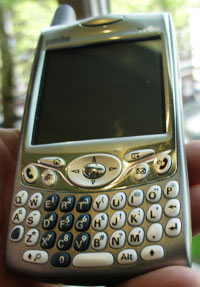 PalmOne has formally launched its Treo 650 in the UK – more than six months after jammy Americans got their mitts on the keenly anticipated smartphone.
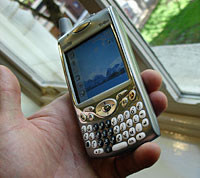 The handset includes useful quad-band GSM/GPRS connectivity for voice and data, with the bundled VersaMail email application supporting a single Microsoft Exchange Server 2003 ActiveSync account and multiple IMAP and POP accounts.
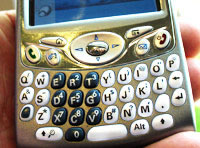 Even with WiFi, Treo users will still be missing out on the killer VoIP application, Skype, so I asked if there were any plans to introduce a version for the Palm platform.
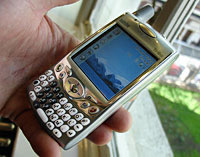 Despite attending an official product launch, I left none the wiser as to when the Treo will actually be available or what other network carriers (apart from Orange) will be offering the phone. Naturally, there wasn’t a peep about pricing plans either.
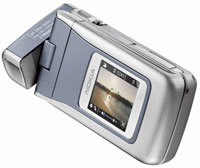
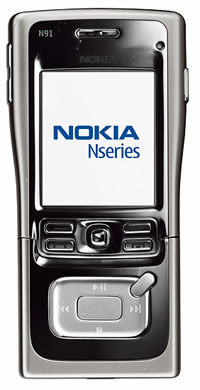 Nokia has launched three new Nseries mobile multimedia handsets, capable of taking print-quality pictures, playing MP3s, reading e-mail, browsing the Web sites and viewing mobile TV.
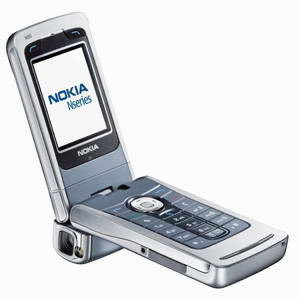 Nokia N90
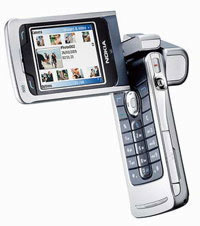 Images, videos and sound can be stored on the phone’s internal 31 MB memory or on the supplied 64 MB RS-MMC
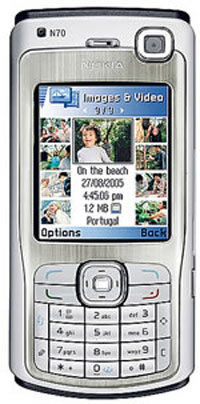 Joe Coles, Director of imaging product marketing at Nokia, stressed the consumer demand for camera-enabled mobiles: “The number one reason why people today purchase new handsets is the camera. Indeed, we foresee that by the end of 2005, over half a billion people worldwide will own a camera phone.”