 Britain’s biggest cable operator, NTL, has agreed to shell out an eye-watering $6 billion (~£3.42bn, ~€5bn) for Telewest Global.
This new uber cable company should provide more effective competition with BT and create a powerful rival for pay-TV leader Rupert Murdoch’s BSkyB, which currently has more television customers in the U.K. than the two cable providers combined.
At the end of March this year, BSkyB had 7.70 million television subscribers compared with NTL’s 3.19 million and Telewest’s 1.82 million.
 According to a statement – which ends three years of speculation about the merger – Simon Duffy, NTL’s chief executive, will lead the combined company.
“While the combined entity could potentially pose a longer-term competitive threat to BSkyB, the merger of the two companies could give BSkyB a short-term competitive boost in that it may distract the cable companies from external growth as they merge their networks,” said UBS AG analyst Aryeh Bourkoff.
Both sides are currently keeping Mum about the mixture of cash or shares involved, although a large cash component is believed to be involved.
The Daily Telegraph is reporting that executives at Telewest are set to rake in obscene amounts of filthy lucre for their stock options and other options if the NTL deal goes ahead.
 Chairman Cob Stenham can expect his bank balance to increase to the tune of $20m (~£11.4m, ~€16.77m) while chief executive Barry Ellison will no doubt cackle wildly with joy as $17m (~£9.7m, ~€14.25m) rolls into his coffers.
And there’s more, with finance director Neil Smith scooping $3.5m, CEO Eric Tveter getting $9m (~£5.13m, ~€7.54m) and seven non-executive Telewest directors holding 230,000 shares receiving a total of $36.4m (~£20.75m, ~€30.5m) in total from selling their stakes as part of the takeover.
Good work if you can get it, eh?
 BT will roll out IPTV in ‘late summer 2006’, according to Andrew Burke, CEO, BT Entertainment, (pictured right) speaking at the Enhanced TV Show in London today.
 Elena Branet, Senior Marketing Manager at Microsoft TV, (pictured left) said IPTV would allow viewers to use picture in picture channel surfing, see caller ID on their TV sets, or watch TV while messaging a virtual community of friends and family. She said that basic IPTV would be possible with a minimum connection speed of just 1.5 MB.
 Also at the show, David Bainbridge, MD of Yes, Yoo Media, (pictured right) said trials of a new product, ‘Broadband TV’ would start on ntl in October. Not to be confused with IPTV, this is a solution to help content creators repurpose content across platforms – working with cable TV, IPTV and 3.
 The Times have covered Richard Freudenstein, COO of BSkyB, speech at the RTS Cambridge Convention
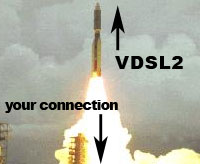 After demonstrating that high-definition television over copper was achievable through networks with increased bandwidth capabilities and compression techniques, France Telecom is looking to develop the technology and is currently testing VDSL2 transmission systems in its R&D Laboratories.
 All clear on that, now?
 UK Online have officially joined the 24Mbps broadband party by announcing the October launch of their own broadband ADSL2+ based product.
 UK Online has been conducting technical trials of its ADSL2+ service since March of this year and their 24Mb broadband service should be available in October for under £30 (~$55 ~€43) a month.
 Be Unlimited
 Temptingly, there’s no connection fee for new users with a free Wi-Fi-enabled modem lobbed in for no charge (the company will be using DSLAMs from Alcatel, and a Thompson 716g V5 wireless modem, optimised for VoIP and video-streaming applications.)
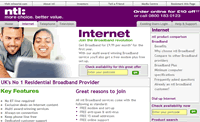 After a period of speculation, a press release on UK cable company NTL’s Web site makes it official that they intend to move their customers to broadband connection “up to 10Mb as standard.”
 We think it may be some time before this actually gets to the customers, as NTL are also talking of introducing an interim service, ‘The Turbo Button,’ which will burst a connection to higher speeds, when customers are downloading bandwidth heavy content like video.
 Like Popeye with a mouthful of spinach, broadband providers Easynet have barged BT out of the way to claim a lucrative three-year deal to supply wholesale broadband services to Onetel, Centrica’s telecommunications division.
 Ian El-Mokadem, Managing Director, Onetel sounded chuffed with the deal: “The partnership with Easynet will allow us to deploy next generation broadband services and benefit from Local Loop Unbundling economics. The market is set to evolve rapidly and we wanted a partner that could demonstrate experience in the local loop, and a willingness to work in a true partnership.
 The long-awaited results from the Welsh Digital TV trial were published today.
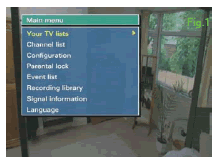 The digital signal was switched on in November 2004, running simultaneously with current analogue for three month.
 Transmission and Coverage – No one lost their TV service during the trial. Only three homes, which were previously in poor reception areas, could not receive the digital service and these were given a digital satellite service. Broadband was introduced during the trial and is seen as an alternative form of delivery to satellite.
 Content – Having an EPG went down well with the residents, particular when they used it to record programs on their PVR. The trialists also enthused about the ability to receive extra TV channels – after all the major benefit to consumer if the expanded choice they will be given.
 TV cables could provide broadband Internet access speeds up to a trouser-flapping 100 megabits per second as early as next year according to Finnish broadband equipment maker Teleste.
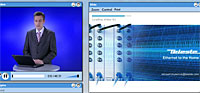 “This is a cost-efficient technology, as we use the cable TV networks which are already in place,” Teleste’s CEO Jukka Rinnevaara told Reuters.
 The foxy Finns are currently running field trials with cable TV service provider Essent in the Netherlands, but are yet to reach the top speeds they predicts will be available to most homes in a few years time.
 Rissanen calculated the cost of connecting a home to the high speed ethernet-to-the-home technology could range from US$60.30 (~£35, ~€50) and US$241 (~£140, ~€200).
 Armchair football fans around Europe will soon be able to enjoy live Champion’s League matches over the Internet and mobile phones.
 Champions League coverage in the UK is provided by BSkyB and ITV (both of whom look likely to retain their current rights), and the Internet simulcasts could provide a honey pot for new revenue streams with advertising and betting partners.
 BSkyB has already announced its commitment to