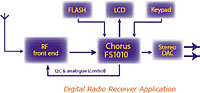
 Frontier Silicon have announced the “world’s first multi-standard, multi-band mobile digital TV chip set”.
The new device, called Kino 3, is a new multi-standard and multi-band MDTV chip set which supports both the Korean and European digital multimedia broadcast (DMB) as well as the DVB-H standard for mobile TV reception.
Kino3 will be world’s first thingamabob to combine a silicon tuner with broad tuning range and a baseband processor utilising software defined radio techniques to address multiple MDTV reception standards.
Frontier claims that the Kino 3 will be able to compete in terms of cost, size and power consumption with devices that just support a single standard.
 In a fug of industry-speak, Anthony Sethill, CEO of Frontier Silicon, told the Broadcast Asia Conference in Singapore, “We strongly believe that regulatory, spectrum allocation and installed infrastructure issues could considerably slow down the deployment of MDTV worldwide. With our experience in developing pioneering semiconductor solutions for digital broadcasting, we recognised this as a company early on and deployed resources to develop multi-standard ICs. Our aim is therefore to remove this barrier by quickly introducing a solution, and we are on course to introduce our Kino 3 solution in 2006”.
And here – as they say on shampoo adverts – is the science bit:
DMB is an extension of the Eureka 147 specification commonly referred to as DAB and used for digital radio broadcasts in much of Europe. DVB-H has been developed as an extension to the existing DVB-T standard which is widely used across Europe for digital TV broadcasts. Both DMB and DVB-H have been developed to provide the robust and high bandwidth data channels required to enable the reliable reception of digital video on handheld devices.
 Korea is expected to see commercial MDTV services based on DMB rolling out during 2005, with the UK and Germany following in 2006.
Commercial services based on DVB-H will begin broadcasting in America during 2006 with parts of Europe adopting this standard during 2006 and 2007.
Fans of obscure spec sheets will have to wait until 2006 to discover the thrilling details of Frontier Silicon’s Kino 3 chip set, but we can inform you that it comprises of a state-of-the-art multi-standard baseband demodulator/decoder and multi-band (Band II, III, IV, V and L-band) RF tuner IC, and incorporates integrated microcontroller and memory. And possibly an onboard rear view dipstick.
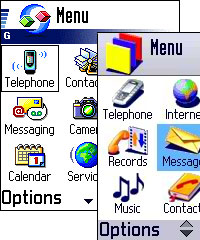 Finnish mobile phone giants Nokia have launched a new Web browser for their Series 60 smartphones.
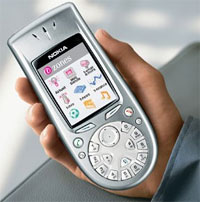 “Nokia is excited to enrich Series 60 with optimised mobile Web browsing. Open source software is an ideal basis for development since it enables Nokia to leverage and contribute to speedy software innovation and development. As a result, the entire Series 60 value chain, from manufacturers and operators to end-users, will benefit from the flexible architecture, full Web compliance and a truly enjoyable user experience,” enthused Pertti Korhonen, Chief Technology Officer, Nokia.
 Philip Schiller, Apple’s senior vice president of Worldwide Product Marketing reckons the new browser is the dog’s nadgers: “The Safari Web Kit’s blazing performance, efficient code base and support for open standards make it an ideal open source technology for projects like Nokia’s new Series 60 browser.”
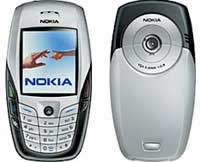
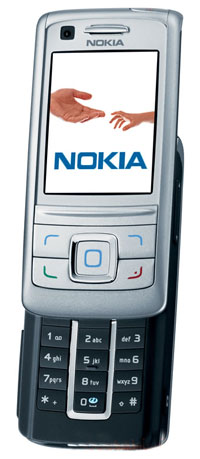 In a veritable orgy of mobile manufacturing, Nokia has launched a grand total of seven new handsets, including a dual camera 3G device and their most feature-rich CDMA phone yet.
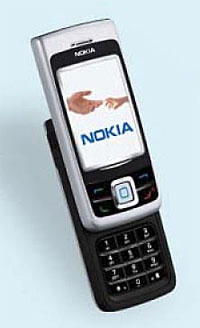 The 3G multimedia-tastic 6280 is a compact WCDMA/EDGE sliding handset sporting a 320 x 240 pixel screen, a 2 megapixel camera (with a VGA front camera for video calls), a removable mini-SD card and a built-in FM radio. It’s expected to appear on the shelves in the fourth quarter 2005 for EUR375.
 “The growth prospects on the CDMA front are extremely encouraging. The CDMA market is expected to grow at pace with the overall handset market and the global CDMA handset volume is expected to increase by 10 to 15 percent year-on-year in 2005,” he said.
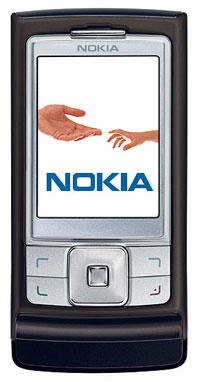 The last of the slider phones is the 6111, which has more than a passing resemblance to the hugely successful i-mate JAM phone, although the screen is much smaller at 128×160 pixels. The camera contains a 1-megapixel camera and 6x digital zoom and retails for around EUR270.
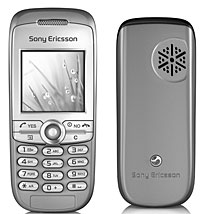
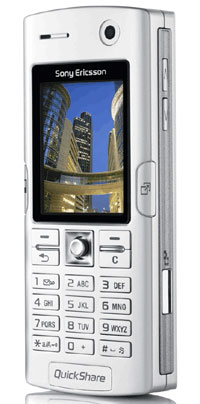 On the same day that Nokia went forth and multiplied with seven new phones, rivals Sony Ericsson announced four new handsets, aimed at increasing its presence in the low end and mid-market sectors.
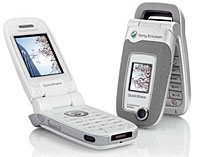 There’s 32MB of memory space on the phone for shunting on ringtones, wallpapers, still shots and video footage, with a built in music player and FM radio taking care of multimedia.
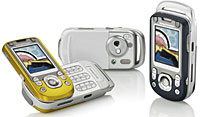 The S600 comes with 64MB of onboard memory, but sadly, there’s no memory card on offer – presumably it’s been left off so as to not compete with the higher spec’ed K750 model.
 Flipped open, the twin-display phone offers a 1.8″ 128 x 160 pixel, 65k colour, TFT main screen, supported by a 101 x 80 pixel, colour secondary display on the outside.
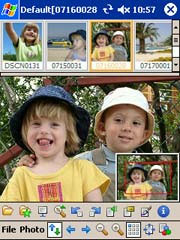 These days, a smartphone/PDA isn’t worth sniffing at unless it comes with a built in camera and a shedload of internal/external memory for storing mobile snaps on.
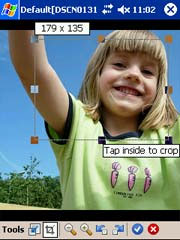 When you install the Pocket PC program, there’s also an option to install the Resco Album Generator on your desktop PC – this program lets you create photo albums ON your desktop and then have the pictures and the album information transferred to your handheld device on the next sync.
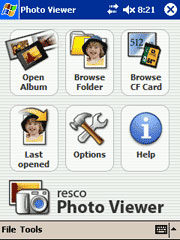 In full screen mode, the keypad can be used to scroll through picture collections manually, or users with tired fingers can set up a slide show and choose from a selection of transition fades and effects.

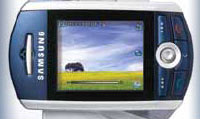 Scheduled for release at the beginning of July is Samsung’s “Web friendly” SGH-Z130 3G handset.
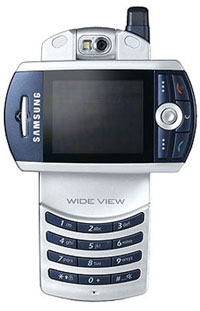 There’s a fair bit of memory on board to handle all the multimedia fluff, with a total of 88.5 MB storage offering 80 MB for Image/Sound/Video, 4 MB for Java, 3 MB for Email and 1.5 MB for MMS with just enough room left over for 200 SMS messages.
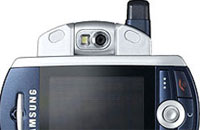 As with earlier versions of Netfront, there is a handy option to render Web pages to fit smaller screen widths, saving a ton of pesky horizontal scrolling.
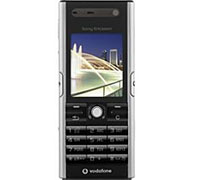
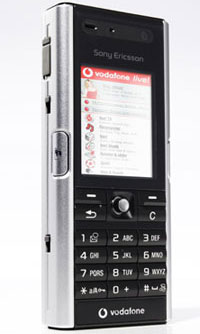 Rather immodestly self-declared as ‘beautifully designed’, Sony Ericsson and Vodafone have announced their new V600i 3G phone.
 Subscribers can also take advantage of the content streamed from the Vodafone live! site, including live sports and music videos.
 Cutting edge office hipsters keen to perfect that
  After an eternity of “will they? won’t they?” rumours Siemens has announced that it is to flog its loss-making mobile-phones unit to the Taiwan-based BenQ Group.
 Through the haze of a soft focus lens, Klaus Kleinfeld, the CEO of Siemens AG whispered sweet nothings about his new bedfellow:
 Perhaps a little tipsy from wielding his fearsome buying power, BenQ Chairman & CEO K.Y. Lee roared “With the acquisition of Siemens’s mobile phones business, we are rapidly approaching our goal to become one of the world’s leading players in the mobile phone industry. Our expansion strategy will be strongly supported by this deal, as we can rely on a global organization with excellent employees, a well-established blue-chip customer base in the mobile business and a strong brand with high impact.”
 “Siemens will continue to offer its customers in the telecommunications industry one-stop shopping for all their needs. With BenQ, we have found a partner who will supply us with the corresponding products. In addition, we will be collaborating closely in research and development. Moreover, we also intend to utilize synergies in jointly addressing customers and in our selling operations,” commented Lothar Pauly, the CEO of the Siemens Communications Group.
 United and Verizon Airfone have become the first companies to receive Federal Aviation Administration (FAA) approval to install Wi-Fi for use on US domestic commercial aircraft.
 Although the FAA approval currently only applies to the cabin of United’s B757-200 aircraft, it’s an important landmark on the way to enabling full high-speed wireless Internet access on board all United aircraft.
 “Our wireless broadband system will require only the addition of an avionics box, a wireless access point and a directional antenna, making it the faster and more affordable choice for United and its passengers,” said Bill Pallone, president, Verizon Airfone.
 Once a service provider is selected by the FCC, United should be able to meet their passengers’ Wi-Fi needs in double quick time with, no doubt, zillions of other airlines following their lead.
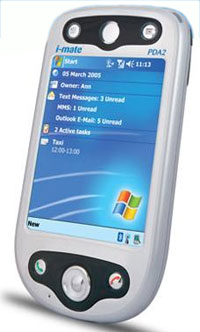 Dubai-based Microsoft Windows mobile specialists i-mate have added the HTC-manufactured i-mate PDA2 to their popular range of Pocket PC phones.
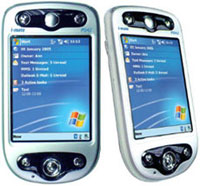 Memory can be expanded through a SD/MMC slot, also compatible with SDIO peripherals.