 After a period of speculation, a press release on UK cable company NTL’s Web site makes it official that they intend to move their customers to broadband connection “up to 10Mb as standard.”
Don’t get too excited yet. Clearly that could mean anything, even 2,400 baud fits into that category.
NTL tell us that they will be first upgrading their current 3Mb customers to the 10Mb service, while expanding these customer download restirctions form 30Gb/month to 75Gb.
We at Digital-Lifestyles hate a limit on traffic – we see it as another way to extract cash from punters when they start to have their TV/video content delivered via their broadband – an extra reason for a cable TV company to restrict you.
Well, when this all going to happen? It’s pretty unclear, but according to NTL, ‘by the end of 2006, the roll out of this new product portfolio will be complete,’ which gives them a lot of leeway doesn’t it?
 We think it may be some time before this actually gets to the customers, as NTL are also talking of introducing an interim service, ‘The Turbo Button,’ which will burst a connection to higher speeds, when customers are downloading bandwidth heavy content like video.
NTL and their broadband service have for a very long time been damned by many of their subscribers, past and present. They were recently voted the very worst broadband provider in the UK in a poll of member by the consumers organisation, Which?
Such dreadful service lead one particular subscriber, Bryan Stevens, to take action online four years ago, forming ntl:hell, a news and discussion board that was solely focused on how bad NTL’s service was. Its membership expanded at a frightening rate … up to the point were NTL offered Mr Stevens a job running the board for ‘the good of NTL subscribers’. A look at the discussion board today give a clear indication of how effective embarassing your harshest critics works.
Many of you will already know that the person who was managing director and chief operation officer at NTL during the time ntl:hell was born – Stephen Carter. He now runs the UK super regulator OfCom.
 The BBC’s online coverage of Live 8 in July notched up a record volume of Web traffic on their radio and music Websites.
 The latest figures for the BBC’s online traffic also show a healthy boost in figures for their sports coverage on the Radio Five Live Website, with 910,841 unique users being recorded during June, compared with 840,019 the same period in 2004.
 It was mainly good news elsewhere, with Radio 1, Radio 2, Radio 3, Radio 4, 1Xtra, Asian Network and BBC 7 all increasing their unique users compared to the same period last year, with only 6 Music – one of our favourites – letting the side down with a disappointing slump from 418,729 to 356,564.
 Hellomagazine.com, the online version of the ghastly celebrity magazine Hello!, is expanding its existing SMS and JAVA mobile offer with a new WAP portal.
 A bookmark directly linking to the portal will be sent by return, with users able to browse the latest headlines for free.
 Celeb-thirsty fans can check the headlines then go in deeper if they want the full story with photos. We’re really happy to be adding HELLO! WAP to our mobile offer and we’ll soon be beefing it up even more with wallpapers, ringtones and other entertaining stuff.”
 Illegal music downloaders shell out more for legitimate music downloads than goody two-shoes music fans.
 How much both groups spend on CDs wasn’t specified.
 Respondents cited built-in cameras, organiser functions and video cameras above music players in their preferences for mobile phone features.
 London’s Ravensbourne College is launching a new program called the School of Computing for the Creative Industries.
 We would have thought that most of the passion manifests itself in the student bar, but the School insists that the new creative “understands that s/he is defined by the impact and credibility of their online presence.”
 All the technical facilities in the School will be built on open source platforms, with support offered to students wishing to release projects under free and open source licenses.
 Punters are being invited to get all interactive with the BBC’s TV and radio schedules as part of their Backstage experiment. The call to action was trumpted at the London hosted Open Tech grass roots conference that ran at the weekend.
 The BBC has already received more than 50 prototype ideas for using BBC feeds and content for non-commercial purposes since the project’s launch in May.
 A British court has fined a man £500 ($870, €720) for using a residential wireless broadband connection without permission.
 We have to say this seems a little harsh as there appears to be no evidence that there was any hostile motive behind his actions.
 The long-awaited results from the Welsh Digital TV trial were published today.
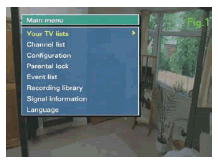 The digital signal was switched on in November 2004, running simultaneously with current analogue for three month.
 Transmission and Coverage – No one lost their TV service during the trial. Only three homes, which were previously in poor reception areas, could not receive the digital service and these were given a digital satellite service. Broadband was introduced during the trial and is seen as an alternative form of delivery to satellite.
 Content – Having an EPG went down well with the residents, particular when they used it to record programs on their PVR. The trialists also enthused about the ability to receive extra TV channels – after all the major benefit to consumer if the expanded choice they will be given.
 Armchair football fans around Europe will soon be able to enjoy live Champion’s League matches over the Internet and mobile phones.
 Champions League coverage in the UK is provided by BSkyB and ITV (both of whom look likely to retain their current rights), and the Internet simulcasts could provide a honey pot for new revenue streams with advertising and betting partners.
 BSkyB has already announced its commitment to
  BT has announced that it will be doubling the speed of its entry-level broadband service.
 BT’s generosity knows some bounds though, with its no frills package retaining its monthly usage limit at 1 gig.
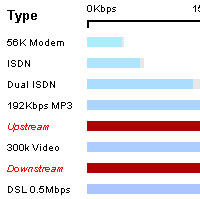 This is the second free upgrade that BT has introduced, with the telecoms giant upping the speed for all of its retail broadband customers back in February.
 I quickly learnt that not only was I paying more than most, but my BT connection was as swift as a sleepy sloth on a hot day compared to the rocket-like speeds quoted by others.