 As you probably know, we’re big fans of the Internet-based telephony application Skype, and when we got our grubby hands on an imate JAM PocketPC phone (with SanDisk Wi-Fi card), we couldn’t wait to start reaping those free VoIP calls with Skype for Pocket PC, v1.1.0.6.
A quick visit to Skype’s website bagged the free 2.5 meg download, and told us that our machine was up to the job.
Skype recommends a rather beefy 400 MHz processor or above, so our JAM phone (also known as the T-Mobile MDA Compact) should be fine for the job with its sprightly 416 Mhz CPU.
Seeing as most PDA/smartphone users typically operate their devices in power saving modes running the processor significantly slower than top speed, there is a danger that Skype’s demanding CPU footprint may turn into something of a battery hog, so be warned
Making Calls
The interface will be very familiar to Skype PC users, offering a near-identical feature list, including chat messaging. Once logged in, your phone contacts appear as usual although we found the online notification a bit flaky, often failing to correctly indicate that friends were online.
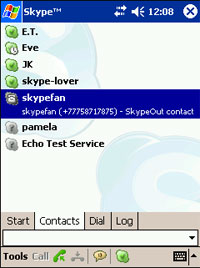 Using Skype to place voice calls to Skype users or via SkypeOut was simplicity itself, with almost all attempts to connect calls successful first time. Sadly, once connected, things weren’t quite so rosy.
My first call was encouraging; with the other person’s voice coming over reasonably clear with no problems their end either.
The second call, however, was a catastrophe, with a distorted, intermittent signal making me sound like Norman Collier doing an impression of the Daleks. It was unusable.
Other calls have resulted in recipients being subjected to buzzes, clicks, pops, complete silences or weird dub remixes of my voice, while I’ve been treated to random snippets of audio, whirring clicks and, in once case, words spoken some time previously coming back in a spooky loop.
At times, it was a bit like trying to communicate over a children’s walkie-talkie at the limits of its range or hearing disconnected voices through the fug of mind bending drugs.
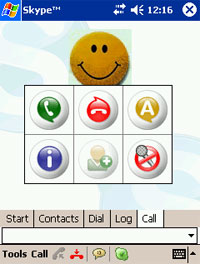 But I battled on, and found subsequent Skype calls to be a veritable potpourri of good, bad and indifferent, with more terrible calls than good ones.
In didn’t help that Skype defaulted to using the JAM’s speakerphone, making a headset essential for any kind of clarity (and privacy).
Although you can buy natty headsets with boom microphones that make you look like an Air Traffic Controller, I’ve yet to see a Pocket PC with a dedicated mic input, so you’ll still have to bark your words into the device’s integrated microphone.
For the greater part, the IM element of Skype worked fine, and if you’ve got a wide circle of chums using Skype, is worth the download alone.
Conclusion
With the fast growth of VoiP and Wi-Fi access, there’s no denying that the software has huge potential.
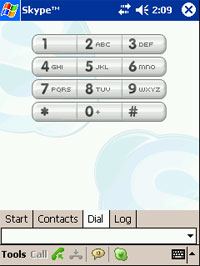 As we reported in March 2005, there’s free Skype access provided at hundreds of airports, railways stations etc through The Cloud’s network, which – in theory – means you could be ringing up associates worldwide for nowt.
But no business client is going to be impressed with a phone call full of buzzing noises, weird clicks with the caller sounding like Sparky the Magic Piano on a bad day.
Seeing as almost all of the problems encountered were specific to the PocketPC version, it’s hard to work out whether it’s the limitations of the platform holding back Skype, or that the software hasn’t matured yet.
The good news is that Skype for Pocket PC is a free download, so it’s definitely checking it out to see how it works on your device.
The company are aggressively developing the product, and with luck many of the issues we encountered may be resolved in the near future.
For now, we can only give it a mixed review. We love the technology and we – naturally – love the idea of free VoiP calls on a smartphone, but until calls become more reliable – and usable – we’ll be sticking to conventional networks for important calls.
Rating: 3/5 

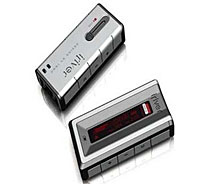 In a deluge of announcements, iRiver has paraded four new flash-memory based music players before the SEK exhibition in Seoul this week.
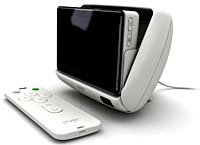 The second player is the H10 Junior, a flash-based Mini Me version of the popular H10 player, which some patronising marketing genius has declared as “One For The Ladies”.
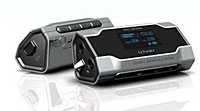 Wrapping up iRiver’s latest product shifting marathon is the T20 and T30 flash music players.
 A survey by technology researchers IDC revealed that passengers aren’t too keen on the prospect of spending long flights listening to fellow passengers bellowing into their mobile phones.
 The growth of clever-clogs smartphones phones like the i-mate JAM and PalmOne Treo would allow connected passengers to check their email and surf the web during flights.
 In a bold, nay brave, nay reckless move, the LA Times offered readers the chance to edit its editorials on their website via a “Wikitorial”.
 At midnight, the site managers left the doors to the candy store wide open and headed home for the night, presenting an irresistible temptation to online wagsters to do their worst, free from moderation.
 Apple is elbowing its corporate presence onto Glastonbury Festival with a launch at world famous music event later this week, according to a report in MacWorld.
 This will feature winners of a competition run between iTunes and Hit40UK which asked budding musos to create a five-song iMix of tracks they felt appropriate for kick-starting the Dance stage this year.
 These take the form of fan-tempting collectible iTunes cards stuffed full of band-specific artwork and special codes that let mustard-keen fans download tracks from a specific artist or album.
 eGov Monitor is reporting that pressure is building for a national campaign to spur demand for eGovernment, with the government likely to be asked to fund a large-scale marketing campaign to promote online public services.
 Although growth in the take-up of some e-services has been promising, the eGov article states that the need to drive up public usage across the board remains a major concern for the UK’s eGovernment programme.
 It’s not yet confirmed, but it appears that Google is preparing to challenge PayPal with its own online electronic payment system, rumoured to be called ‘Google Wallet’.
 Sellers who run auctions on eBay are major buyers of Google’s ads, which appear alongside search results, so it’s not surprising to see the company angling in for a slice of the payment action.
 According to a survey by Entertainment Media Research, UK legal digital music downloads have grown by a thumping great 75% in a year.
 These findings are supported by the news that legal digital downloads have accounted for 8% of Coldplay’s recent album sales in the US – the biggest share for any new release to date.
 Two fifths of those surveyed preferred digital downloads because they were only interested in one or two tracks, while 29% downloaded music to sample an album before purchase.
 Sony BMG Music Entertainment has announced that it intends to add copy-restricting software to its latest CDs.
 This doesn’t affect Apple computer users – they can freely copy and transfer music from the restricted CDs to their iPods – but consumers using Microsoft’s Windows software won’t hear a note, although they will be able to transfer music to Windows Media-supporting devices.
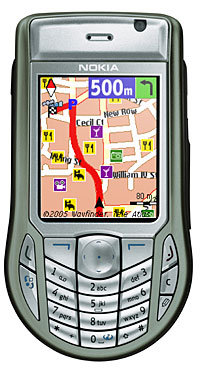 Nokia and Wayfinder Systems have proudly proclaimed the availability of the Nokia 6630 Navigation Pack, a compact smartphone-based navigation package for folks on the move.
 Never one to knowingly undersell his product, Jonas Sellergren, VP Product Management, Wayfinder Systems proclaimed “the Wayfinder Navigator application on the Nokia 6630 brings the ultimate navigation solution to the consumer.”