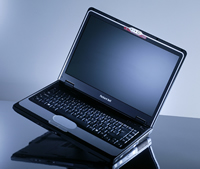
 We played with the Packard Bell EasyNote ‘Skype Edition’ Laptop, at its first European showing yesterday. The machine we used was the only one in Europe and had been jetted in from development labs in Estonia.
They claim it to be the worlds first ‘Skype Edition’ laptop, and we’ve no reason to doubt them. While many machines have been selling with Skype pre-loaded on it, this is the first to have a dedicated button built-in to the machine.
If your reaction is, ‘so what? It’s a laptop with a soft-button on it,’ that wouldn’t have been too dissimilar to our initial reaction – before we used it. After having seen it action, our view is more favorable.
Where’s the button?
Our first surprise was to find the Skype button at the top of the screen, where you normally find the catch. We’d expected it to be on or around the keyboard.
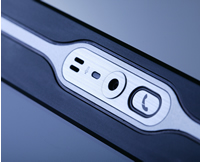 As you can see from the close-up photo, the Skype button sits on the right, the microphone on the left and in the centre is a video camera, a la new Mac laptops. There’s an LED between the mic and video camera and another surrounding the Skype button.
How does it work?
The button performs various functions depending on what you’re doing with Skype at the time.
If you’re working on another app and feel the urge to Skype someone, pressing the Skype button, brings the software to the foreground. No big shock there.
When a Skype call comes in to you, pressing the button answers the call, bringing you live.
There’s a LED surrounding the button that shows various states of call as follows
- Orange colored when Skype application is connected to Internet and in idle mode
- Orange/Green alternate blinking when there is an incoming Skype call
- Green when there is an active Skype call in progress
- OFF when Skype application is not connected to Internet or not launched
The green LED between the mic and camera shows solid green to indicated you have a call in progress, perhaps to save you from the embarrassment of slagging off the person you’ve just completed a call with, while thinking the call had finished.
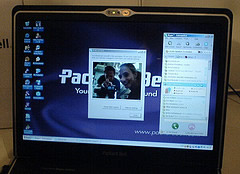 Calling quality
One of the concerns we’d had was the placement of the mic and the call quality that might bring.
We know that the mic on the Apple iBook lid is less than great to be using with Skype. We often find ourselves craning our necks forward, and half closing the lid to get close enough to the mic to make ourselves heard by the other party.
Packard-Bell appear to have got over this. In the call that we placed, the other end reported they could hear us perfectly well, despite us being around two feet away from the laptop and the room that we were calling from being pretty noisy.
On reflection we realised that the palaver we go through with the Mac wouldn’t work on this machine as, if you were on a video call, they’d be getting a view of your space bar.
Video built-in
As I’m sure you know, video conferencing has been included in Skype for a while now (it was one of the most requested features). By including the camera at the lid, Packard-Bell have made it easy to video call while on the move – without having to lash video cameras to the lid of your machine.
Having seen the preview window, we can report that the results were pretty impressive. The quality appeared to be more that sufficient for video conferencing.
General spec and availability
The general spec of this machine is described by Packard-Bell as having a “high-performance Intel Dual-core.”
We’ve absolutely no idea what the general computing function of this machine is – that’s not what we were looking at. Given that PC designs has been perfecting since the release of the IBM XT, we’d suspect that it’s pretty much as you’d expect.
The Packard-Bell EasyNote ‘Skype Edition’ is expected to be getting to retail in August this year at a cost of E899.
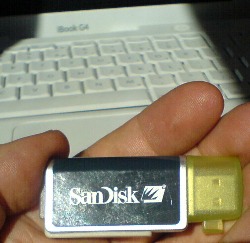 SanDisk makes tons of memory related products but how many of you knew that they made memory adaptors and converts? Makes sense doesn’t it?
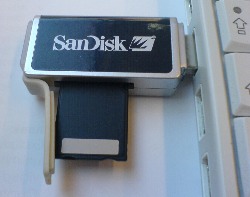 Setting about to download them to my iBook via my then current MS/USB adaptor was most perturbing experience. It refused to acknowledge that my beauties were there at all. Argh, panic! Logic prevailed and I reached for a PC laptop. While the PC saw the images, when I tried to copy them off the machine would get slower and slower to the point where it finally fell over.
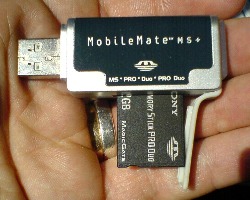 It works with the many, varied versions of MemoryStick format, including plain old MemoryStick; MemoryStick Duo; MemoryStick PRO and MemoryStick PRO Duo.
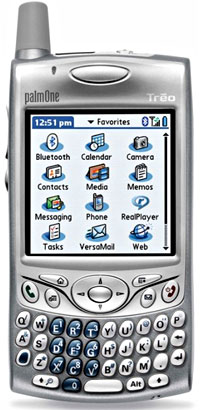 As you know, we *heart* nice, new shiny gadgets and we love to sit on the (sometimes uncomfortable) cutting edge of technology.
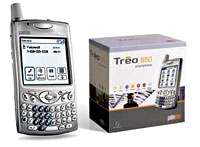 With the Treo just about everything works.
 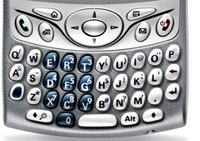 Moreover, the interface is fast and responsive and although Palm’s idea of multi-tasking is simply to close down whatever you’re doing and start up the next program (while remembering all the settings) it doesn’t suffer from the gradual slowdown to a crawl that constantly blighted our Windows experience.
 Palm Treo 650
 One of the challenges facing Stephen Carter’s replacement as head of the UK communications regulator Ofcom, is how the frequency spectrum released by the move to digital terrestrial TV will be allocated. Not only is the decision crucial for Ofcom, who must reconcile both the requirement to allow the market to operate while taking into account the British citizen, but it also figures in the BBC’s strategy around the impending licence settlement and the organisations’ worldwide ambitions.
 How will displays receive the content to create the impetus for a large scale take up? The likely options are; Cable under what is expected to be a Virgin branded offering; Sky who are pushing HD to protect and grow their revenue; the BBC who are committed to both an alternative to Sky on Satellite and providing their content on all viable platforms and broadband, which looks increasingly viable by virtue of higher transfer rates to the home, along with improved digital compression technologies.
 France, slower off the blocks in moving to a Digital Terrestrial TV service, with its’ amusingly acronym-ed TNT, has a solution that builds in HD capabilities, and for sure the UK will not wish to be seen falling behind mainland Europe.
 Some of the most compelling games are often the simplest, and games don’t get much more basic than the age-old game of Battleships.
 If you miss, you get a splashy sound (and quite possibly the derision of your chum across the room) and if you hit the target you get a gratifying kaboom (with the option to shout and jeer at your opponent’s misery).
 Our opinion
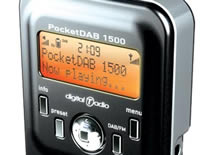 We’re big fans of Pure Digital and their seemingly endless mission to push the features and functions of DAB radios. Their latest move is to launch a new portable DAB radio.
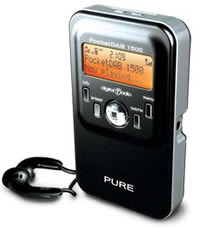 Recognising that what they’re selling is audio quality, Pure have done a deal with Sennheiser to have Sennheiser’s MX300 headphones included in the package.
 Yo! Boom Boom! AOL’s produced a book* new ‘Action Sports On Demand’ website designed for skateboarders, snowboarders and other action sports athletes.
 Taking a sniff around the suitably “yoot” style website, we clicked on the ‘About Us’ section, only to be greeted with one of those really annoying, pretentious dictionary-style definitions:
 Spots! Yeah! Rad!
 Imagine a world where Internet performance is controlled by the company who owns the cables and where speed is sold to the highest bidder. Imagine a world where some Web sites load faster than others, where some sites aren’t even visible and where search engines pay a tax to make sure their services perform at an acceptable speed. That’s the world US Telecommunications companies (telcos) such as AT&T, Verizon, Comcast and Time Warner are trying to create.
 As Doctorow and other commentators have observed, Internet users and businesses already pay proportionally for their use of the net, allowing the owners of the infrastructure to take a further cut distorts the market in favour of those with the deepest pockets and threatens innovation and the development of new services.
 When it comes to World Cup football Web coverage in the UK, the BBC isn’t just dribbling past its rivals – it’s positively crushing past them, according to figures released by Nielsen NetRatings.
 Interestingly, the Sporting Life site proved the ‘stickiest’ with punters spending the longest time on the site (an average of 36 mins each).
 Channel 4 has today launched a new broadband Simulcast service, making their live TV schedule available online for viewing, for free.
 Channel 4 has, however, said that it is negotiating with US studios to add their content at a later date.
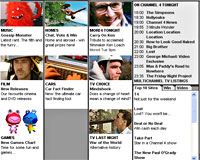 Appearing in a thundercloud of enthusiasm, Channel 4 CEO Andy Duncan was on-beam and on-message and rapidly hit evangelical overdrive, describing the Web transmission as an opportunity “to build on what Channel 4 has always done – stimulate, infuriate, debate, create,” adding that he didn’t see the digital revolution as an attack on Channel 4’s power as a public broadcaster, but as a “fantastic opportunity,”