Location-based mobile services, such as tracking your child at the playground, finding a friend at a sporting event or managing a fleet of delivery drivers, may be a step closer to reality with TomTom’s recent acquisition of Applied Generics. The Scottish company has developed a system deployed over mobile networks that provides real-time data on the location of mobile users. While TomTom will use the system to improve the traffic information on its personal navigation devices, sharing the data with mobile network operators and third-party service providers could also open up a promising new revenue stream for the company.
TomTom relies mainly on the location coordinates from satellite systems to pinpoint its customers. Through its acquisition of Applied Generics in January 2006, TomTom gains access to technology that uses low-level signalling data from mobile networks to determine the location of mobile devices and their users. If TomTom successfully deploys this Geographical Information System (GIS) with mobile network operators, TomTom can offer real-time information on the location coordinates of a population that reaches far beyond the size of its current customer base.
TomTom’s main motive for the acquisition was to gain access to Applied Generic’s flagship software RoDIN24. The system analyses mobile network data anonymously for high-quality and real-time traffic information. Through the acquisition, TomTom hopes to increase the quality of TomTom Plus, its road information service. The company is interested in collecting the traffic data for its own use as well as selling on the information to third parties.
In addition to traffic information, Applied Generics markets systems for tying the location of mobile phones with the mobile user identity. Demand for subscriber location data like this is expected to grow significantly over the next few years and will quickly become a key building block for offering digital connectivity services. Revenue projections by Telecompaper suggest true potential for mobile location-based services, with uptake by a small, but high-usage group of customers able to already generate significant revenues. While TomTom acquired Applied Generics primarily for the traffic information, the company offers a good starting point if TomTom decides to develop location-based mobile services and broaden its revenue sources. The company is in a good position to steal the limelight in this emerging market, helped by good momentum in its core market for navigational devices, the fruits of its successful IPO and its international market focus.
Barriers still need overcoming: this market will not be taken quickly. Mobile network operators may be hesitant to share their data on subscriber locations, while privacy issues may form a concern among end-users. The technology may address quality concerns of existing road information services, but may not be the key to offering relief from road congestion. The revenue possibilities however make it a promising bet for both TomTom and mobile network operators.
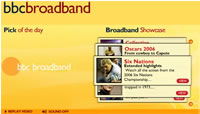
 ‘The Apprentice’ TV show has been a smash hit in the UK, much the same as it was in the US. The BBC now plan to use it as the ‘first extensive broadband experience,’ as part of the BBC TV Plus project.
 Initially looking at these advances it’s easy to get excited, but when looked in context of how long it’s taken, a frustrations come to the surface.
 (Funnily enough, after reading that article the person responsible for the project contacted us and it turned out to be someone whose previous work outside the BBC we’d been very impressed with.)
 The easy way of getting “content” into a mobile phone, would be just to print 2D barcodes. However, Viacom Outdoor has started a rather more challenging experiment, fitting London Underground posters with Bluetooth transmitters.
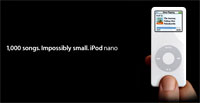
 Keen to further expand their vice-like grip on the portable digital music market, Apple have unveiled a cut-down 1GB version of their turbo box-shifting iPod Nano player.
 The new 1GB Nano can hold up to 240 songs or 15,000 photographs and comes with all the usual Nano features, including the colour display and docking connector.
 As Shaw Wu, an analyst with American Technology Research, put it: “Apple is selling a $69 MP3 player with the best software. How do you compete with that? It’s tough.”
 The iPod range continues to be an outrageously successful money spinner for Apple, with around 32 million iPods shifted last year, including 14 million during the holiday season.
 Sony has announced the new VAIO VA1 Series, a wireless home entertainment desktop computer.
 High definition audio is provided by Sony’s Direct Stream Digital (DSD), a technology developed by Sony in conjunction with Philips.
 Sky has announced three of its top Exec will be altering roles, we suspect, as they prepare to become more than just a satellite TV company.
 We think Mike Darcey sounds like he’s going to have the most fun, and certainly the most toys to play with.
 T-Mobile was told to see the headmaster and returned with a derrier rouge after making exaggerated claims about its “web’n’walk” mobile Internet service.In a wave of PR-driven hyperbole
 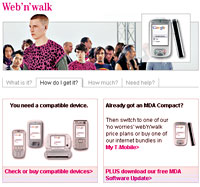 T-Mobile had a valiant stab at a defence, arguing that their advert was all about making the distinction between Ye Olde Crappe WAP and their new, full Internet-access, web’n’walk service, adding that they had included the line, “subject to coverage”.
 To the sound of a salvo of slapped wrists, the statement concluded that the ad, “was misleading because readers were likely to interpret the claim to refer to geographical network coverage. We told T-Mobile to avoid making such unconditional claims in future advertising.”
 Apple have announced a competition to become the downloader of the 1 Billion th music track on iTMS.
 At the time of writing, we see on the live track count that they’ve sold just short of 950,981,000 tracks.
 You know we like to save you money when we can and for those with sharp eyes, you’ll see near at the bottom of the page in light grey (thanks Apple), “*No purchase necessary to win. Click here to submit a free entry form.” Following the link takes you to the form telling that you can indeed make up to 25 free entries a day. We’re not sure on the US rules for competitions, but we know in the UK that free entry is essential when there’s no skill involved with entering the competition.
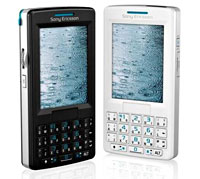 Sony Ericsson have announced their new M600 handset, a tri-band (900/1800/1900 plus UMTS 2100 for 3G data outside the US) jobbie, with Symbian OS 9.1 and UIQ 3.0 operating systems.
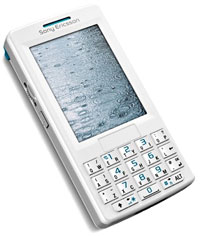 Touted as a “fully-specified email tool and mobile phone”, the handset offers true multitasking, so a user can, for example, browse the Internet while chatting away on the phone.
 For road warriors and shuffling suits, there’s the facility to read and edit PowerPoint, Word and Excel documents and Adobe PDF files on the move, with the popular Opera 8 browser provided for surfing the Internet.
 In line with its business focus, there’s no built in camera, and Wi-Fi is an unfortunate omission too.