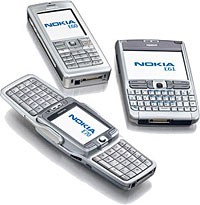
 Nokia has announced the Eseries phones, a new range of devices designed for swivel action execs and be-suited business bods.
With the range initially comprising of three new phones aimed at money-rich, time-poor office types, all the Eseries will run on the Symbian Series 60 platform 3rd Edition, sport QVGA or better displays and incorporate push email including BlackBerry and attachment editing.
The Nokia E60, Nokia E61 and Nokia E70 claim superior voice functionality and quality, with the devices supporting advanced voice services like Internet (Voice over IP) phone calls, Push to talk and SIP-based services, backed by a range of local connectivity options including WLAN, Bluetooth and Infrared and USB.
 The devices are the first in the industry to support remote device management based on OMA DM*, letting IT managers remotely control and protect corporate data on the device and fiddle about with phone configurations. Or just have a good nose about.
“When we carefully considered the requirements of our customers when developing these devices, two clear new trends emerged: the need for IT departments’ to have a secure and manageable platform, and the need for devices to support a variety of employee preferences and different working styles,” said Niklas Savander, senior vice president of Nokia’s business device unit.
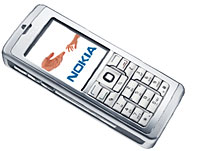
Nokia E60 (above)
Starting off the new range is the E60, an attractive, traditionally styled 3G phone with VoIP, speakerphone, a 24-bit 352 x 416-pixel display, and a low-voltage RS-MMC slot.
Offering useful business features like integrated speakerphone, conference calling and voice-aided applications like Push to talk, and IP-based telephony, the phone supports GSM/EDGE 900/1800/1900 and WCDMA 2100.
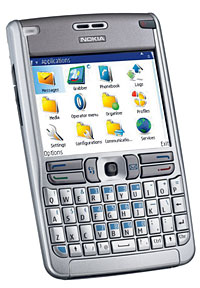 Nokia E61 (right)
Next up is the E61, which looks to be shoving its slimline oar (0.55 inches) into Treo/Motorola Q/Blackberry territory, with the device supporting multiple mobile email clients like BlackBerry Connect, GoodLink, Nokia Business Center, Seven Mobile Mail, Seven Always-On Mail, and Visto Mobile.
Looking like an E60 after an encounter with an elephant, the wide and flat E61 sports a full QWERTY keyboard, landscape 24-bit QVGA display (352 x 416-pixel display), miniSD slot and quad-band GSM/EDGE and WCDMA 2100 connectivity.
Full attachment handling (documents, spreadsheets, presentations, PDF viewer and ZIP manager) is built in with an editing function for documents, spreadsheets and presentations included.
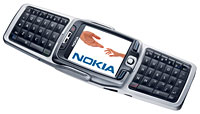 Nokia E70 (left)
Finally, the E70 features the same, slightly strange, flip-open QWERTY keyboard phone seen on Nokia’s 6800 series.
The phone comes with a full party box of gizmos and gadgets, including a 352×416-pixel display, 2 megapixel camera with CIF-resolution video capture, USB 2.0, miniSD slot, and Wi-Fi 802.11g/e/i.
The phone will be available in a GSM/EDGE 850/1800/1900 version for the Americas, plus a 3G version for Europe and Asia.
All three Eseries phones are expected to be available in the first quarter of 2006 worldwide.
 Just like the Smash aliens falling over laughing at the sight of humans mashing potatoes, one day people may look back in amazement that people used to walk around the streets with bits of wire hanging from their lug’oles.
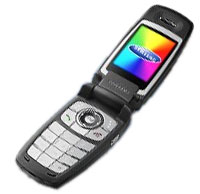 Using CSR’s BlueCore3-ROM (BC3-ROM) and proprietary BlueCore Host Software (BCHS) – whatever they are – Samsung’s phones can wirelessly stream MP3 music via Bluetooth to the latest Bluetooth stereo headsets, like their very own SBH100.
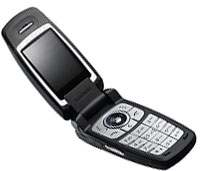 The integrated BlueCore Host Software helps reduce the power consumption of the Bluetooth device by implementing all of the Bluetooth lower power modes such as deep sleep, letting uses take full advantage of all handset features without draining battery life.
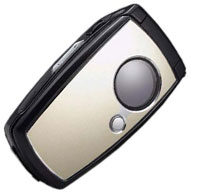 The SGH-E750 and SGH-E760 handsets are expected to be available on GSM networks worldwide in Q4 2005.
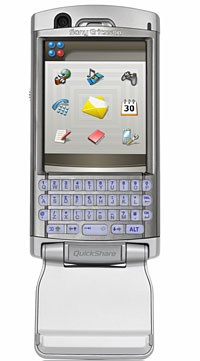 Sony Ericsson has beefed up its flagship P-series smartphone range with the new 3G P990 phone.
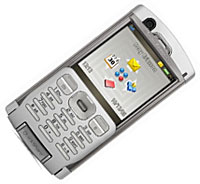 Naturally, Sony are keen to shove their oar into Blackberry’s waters, with the P990 prepared for all major push e-mail clients enabling full e-mail access with attachments.
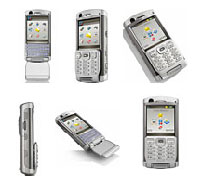 The P990 will be the first commercially available smartphone to use the enhanced Symbian OS version 9.1 and the UIQ 3.0 user interface, which has been optimised for one handed use.
 Anybody who really thinks that T-Mobile is behind the new “Web’n’Walk” offering it trotted out last week, has really not being paying attention. It’s Google Talk, a VoIP service normally available for PC users, now sneakily able to go out over 3G data services.
 Officially, the new service gives you the Web in your pocket. This is not new; the Opera press release went out announcing Web’n’Walk back in June! it would only have been in any sense new last month, if we were discussing the “3” Internet service was being leaked, since Hutchison had previously been resolutely adamant that its users would have access only to the “3” web in a walled garden. That news was known to NewsWireless readers back in broke in early September: Hutchison will be opening up its 3G phones to full Internet browsing shortly.
 Can UMTS really compete?
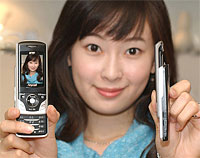 Samsung Electronics have announced a new slim-line phone with an automatic “flying mode” function.
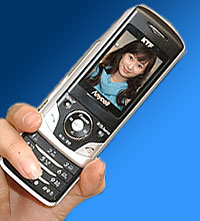 It’s quite an attractive looking phone, with the pocket-untroubling 15.9 mm case coming in a natty black and silver finish with a large-ish LCD and a small sliding keyboard.
 3G network operators 3 have announced a partnership with EMI Music UK to supply full-length music videos directly to the company’s 3 million customers.
 The tie-up with EMI means that 3 subscribers can access a veritable cornucopia of audio/visual delights on their phones, with the new video material adding to the wireless operator’s bulging music catalogue, which includes full-length video and audio titles from Sony BMG and indie music videos supplied by VidZone.
 Next up on the back-slap promenade was Dave Gould, Commercial Manager, Digital Media for EMI Music UK: “We’re delighted to bring videos from EMI Music UK’s labels to 3. 3 is a leading network in bringing mobile music to its customers and we’re really excited about working with them to allow fans to catch up with their favourite artists anywhere and at anytime.”
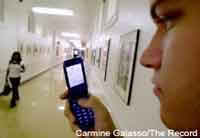 Handy… Literally!
 Sounds nasty!
 That lot again
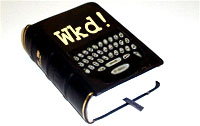 Aussie God squadders looking to get down with Da Yoot have translated all 31,173 verses of the Bible into SMS text-speak.
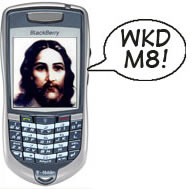 The translations were based on the Contemporary English Version and remained faithful to the grammar, with just the spellings being altered.
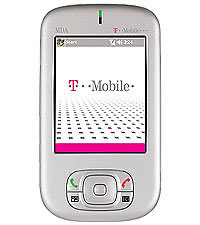 T-Mobile have launched ‘Web’n’walk’, their mass-market mobile Internet service, and are confidently predicting that it expects to lure hundreds of thousands of customers onto the service over the next couple of years.
 Conceding that Internet services on mobile devices to date had so far been, well, rubbish, McBride bigged up T-Mobile’s approach for fast, simple and affordable services and products, saying that mobile networks will eventually carry more Internet traffic than fixed-line computers or phones.
 Japan’s largest annual IT show, Ceatec (Combined Exhibition of Advanced Technologies), opens today and will feature around 700 companies, according to the organisers.
 Toshiba has promised to display a super-slim 12.7 millimetre high drive designed for laptops which can read HD-DVD discs and read and write DVDs and CDs.