 Market analyst Gartner reports that mobile phone sales have soared 22 percent compared to the same period last year.
In the third quarter, manufacturers shifted a mighty 205.4 million mobile phones, with Gartner predicting that mobile phone sales could total 810 million units this year.
The report observed that consumers are still slow to warm to 3G, but growth is expected in the fourth quarter.
Finnish mobile giants Nokia increased their market share during the third quarter to 32.6 percent, up from 31 percent a year earlier.
Motorola’s hip’n’happening RAZR phone helped increase their market share to 18.7 percent, letting the company leapfrog their rivals Samsung Electronics into second place.
Now sat glumly in third place with 12.5 percent of the market, Samsung’s fading performance was put down to the company failing to address emerging markets as effectively as their rivals – in particular Motorola, who introduced a winning range of basic, very-low-cost phones.
In the US, new customers were thin on the ground but there were mobile phone sales aplenty (36.3 million units) with customers switching operators (“churn”) to get a better deal.
 In the Latin American segment, sales were up 46 per cent compared to last year, totalling 26.1 million phones units, while in Western Europe, big sales of 40 million phones were driven by customers upgrading their handsets.
Gartner’s report curiously lumped Eastern Europe, the Middle East and Africa sales together, arriving at a total of 39.7 million, up 40 percent compared to a year earlier.
The main movers in this area were Nigeria, Poland, Russia, South Africa, Turkey and Ukraine.
Across Asia, sales zipped up to 52.2 million units, up 27 percent compared to the last year’s quarter with China and India contributing strongly to the growth.
Meanwhile, figures were far less rosy in the Japanese market, registering a minuscule growth of 0.6 percent, to 11.3 million phones.
The Gartner report predicts full-year sales of up to 810 million phones, which may even reach 820 million if suppliers and distributors are able to fully meet consumer demand.
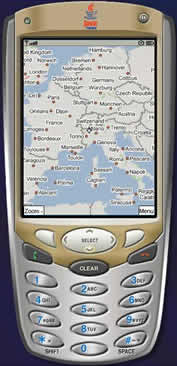 For those who have better thing to do with their lives than fanatically watch every twist and turn of online technology, or if you’re living outside the US of A, you may well not have been using Google’s recently launched Google Local For Mobile (GLM)- or even have heard of it.
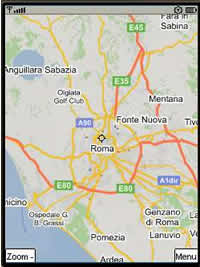 Yesterday we revealed how GLM has
 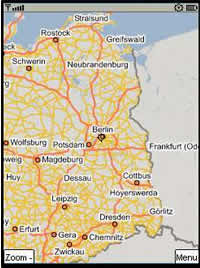 More detail than the browser version
 Intertrust must have though that all of the xmases came at once on the day Vodafone confirmed their licensing deal. It’s not every day that the World’s largest mobile operator signs a deal like that with you.
 The Vodafone deal goes well beyond these basics and licenses all of the technologies and patent that Intertrust have available.
 Both Vodafone and Intertrust declined to reveal the value of the transaction, but given the need for separate deals with the handset companies, it may be here that Intertrust make most of their money. This will not be optional if the handset manufacturers want to be on the Vodafone service and offer content.
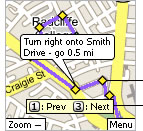 Despite their emphatic denial, Google appear to be planning to bring GPS to the recently announced Google Local For Mobile.
 Currently the users of the service have to key in or select the desired starting and destination points, and press a key to mimic their progress in the real world. Using GPS eradicates the need to tell the system where you are, or update the system to your progress.
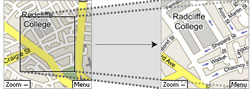 The GPS feature could well be waiting for a second release of the service, or waiting for next-gen handsets with aGPS built into them, to become more widely used.
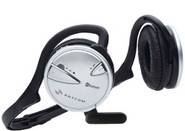 It has taken the Bluetooth headset industry a remarkably long time to twig that we don’t want to use one headset for listening to music, and then frantically rip it off to use another Bluetooth headset for answering the phone. Anycom has the one… at a price.
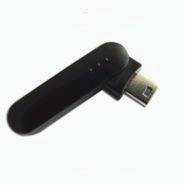 And the icing on the cake: a Bluetooth audio gateway. Without further details (actual hands-on reviews!) this is probably going to seem more wonderful than it can in reality be: but what we’re hoping it will do, is allow you to plug several audio inputs into it, and switch between them – from landline phone to Skype, from Skype to iPod, from iPod to mobile phone.
 I like this … Guba
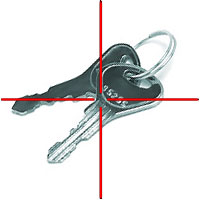 Guidepoint, a company that make navigation and location soft- and hardware, have released a new product, that allows car owners to
 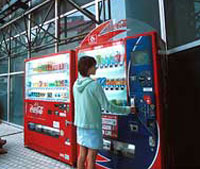 Hope it gives change!
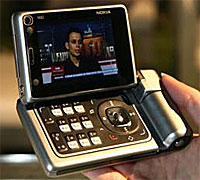 Nokia has announced three more Nokia N series multimedia devices, the Nokia N92 (the world’s first mobile device with a built-in DVB-H receiver), the Nokia N71 and the Nokia N80.
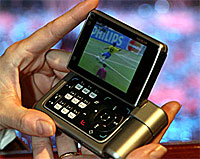 Using the built in software, users can also create personal channel lists, subscribe to TV-channel packages, set program reminders and interact through services such as voting, program feedback and additional web discovery.
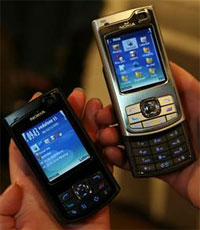 Sporting WLAN and 3G, the Nokia N80 is being touted as the world’s first handset to feature UPnP technology, and has the ability to be used as a remote control for wirelessly swapping content between PCs, audio equipment and TVs.
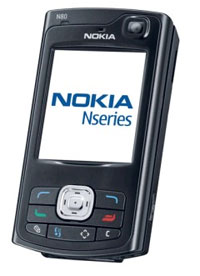 Photos snapped on the Nokia N80 can also be printed wirelessly to any UPnP-enabled printer or photo kiosk.
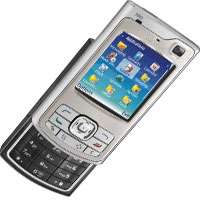 Storage comes in the form of 40 MB of internal memory, with support for miniSD cards of up to 2 GB.
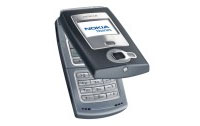 We could only find a teensy-weensy picture of the 3G clam phone as we went to print, but we can tell you that is has two displays and two cameras, one of which is a 2-megapixel camera.
 Vodafone UK and British Sky Broadcasting (Sky) have announced an agreement to launch Sky Mobile TV, the UK’s first commercially available mobile TV service available on a wide range of handsets, as we
 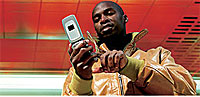 The deal looks set to turbo-boost adoption of entertainment and information services to mobile phones, with users able to enjoy TV programmes on the move with access to live breaking news and sports reports from Sky News and Sky Sports News.
 The Sky Mobile TV pack will be provided free of charge (subject to Vodafone customer fair usage policy) until the end of January 2006, with customers being charged £5.00 (~$8.90, €7.38) per month for each of the Sky Mobile TV packs subscribed to thereafter,
 Additional mobile channels are likely to sign up to the Sky Mobile TV service over the coming months.
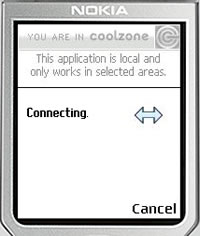 Today Nokia announced CoolZone, a Bluetooth-based distribution system that lets mobile phone users locally browse, pay for and download content on their mobiles while they are in shops supporting it.
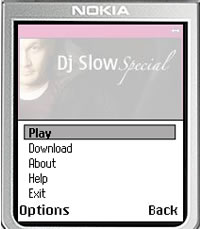 As the user of the service needs the user to download an application to use the service, we can imagine little hacking groups are already forming plans to hang around near these shops offering their own ‘applications’ with similar names to unsuspecting, or inexperience users.
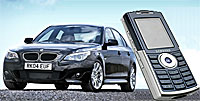 There’s been an orgy of synergistic back-scratching and brand backslapping going on in Samsung’s schmoozing department as the company announces an alliance with German luxury car brand, BMW.
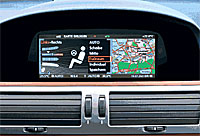 BMW drivers will be able to link the phone to the iDrive control interface, which features a control knob at the centre of the vehicle’s console, allowing access to various functions displayed on the in-dash monitor.
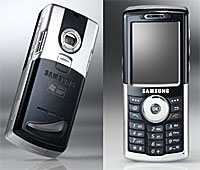 Samsung have already been poking their dipstick into the field of mobile-to-car technology, announcing a partnership with Audi back in July.