 The clever-clogs at Toshiba Research Europe have announced that they have been successful in applying quantum cryptography to the transmission of video and voice over IP.
This means that it will be next to impossible for hackers to “tap” into voice and video files streamed over the net.
White coated boffins at Toshiba’s Cambridge UK labs demonstrated their Quantum Key Server system, which involves encoding bits of encryption data onto particles of light (photons).
This ultra secure technology looks set to revolutionise digital security by replacing the current distribution methods for keys, which are needed to decrypt secure messages.
 Toshiba’s quantum video link increases the security of communication systems by encrypting every single video frame with a unique digital key – so cracking one frame of a video would be useless unless all the other frames were cracked too.
The secrecy of each of these keys is ensured by quantum cryptography, an ultra-secure key distribution method.
Dr Andrew Shields, head honcho of the Toshiba group developing the system, said, “Corporate networks are increasingly vulnerable to the theft of keys from the desktop, either by hacking, Trojans or fraudulent employees. The Toshiba Quantum Key Server mitigates this risk by allowing frequent key refresh.”
“The Toshiba Quantum Key Server can be used to enhance the security of not just video and speech, but also a wide range of other high bandwidth data communications, ranging from sensitive legal documents to medical and tax records.” he added.
Quantum cryptography also allows the key distribution link to be monitored for tapping and other skulduggery, and although we can’t pretend to understand half of what the good Doctor is on about, we liked this bit:
 “Imagine if you received a letter, you opened that letter and read it, there is no way of telling if someone has read that letter en route. When you encode the information on single particles, the letter self destructs whenever someone else reads it.”
“I sometimes say it is like the messages in Mission Impossible,” he added, “If anyone tries to read the messages, they self destruct.”
Toshiba has so far received “good feedback” from government and financial institutions shown the demonstrations, although commercial implementation looks to be some years away.
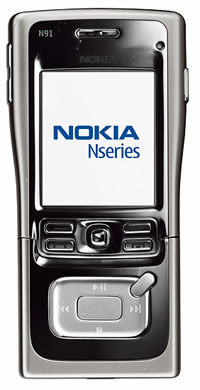 Nokia has launched three new Nseries mobile multimedia handsets, capable of taking print-quality pictures, playing MP3s, reading e-mail, browsing the Web sites and viewing mobile TV.
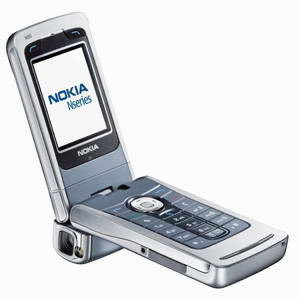 Nokia N90
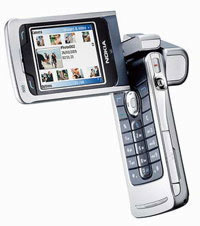 Images, videos and sound can be stored on the phone’s internal 31 MB memory or on the supplied 64 MB RS-MMC
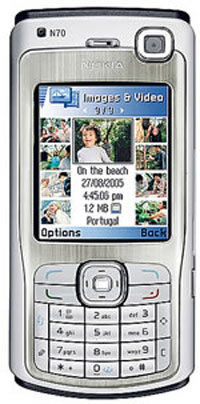 Joe Coles, Director of imaging product marketing at Nokia, stressed the consumer demand for camera-enabled mobiles: “The number one reason why people today purchase new handsets is the camera. Indeed, we foresee that by the end of 2005, over half a billion people worldwide will own a camera phone.”
 Digital-Lifestyles were on hand to witness a new world record being created, as former World Text Champion Arttu Harkki used a Treo 650 smartphone to type the fastest-ever email on the move using a QWERTY keyboard – using a single thumb.
 Before the record attempt could start, Hein Le Roux, official adjudicator from Guinness World Records explained the rules, “There are a lot of phones that incorporate QWERTY keyboards, and we need to make sure that the record is standard across all models. For this reason, we asked Arttu Harkki to type using just the thumb of one hand.”
 As the stopwatch-toting Le Roux looked keenly on, Harkki’s mighty uni-thumb went supernova as he bashed out the following message:
 Once I’d recovered from the high octane excitement of watching someone write a text message repeatedly, I asked Le Roux what the previous record had been, and was surprised to find that there hadn’t been one, because this was a new category.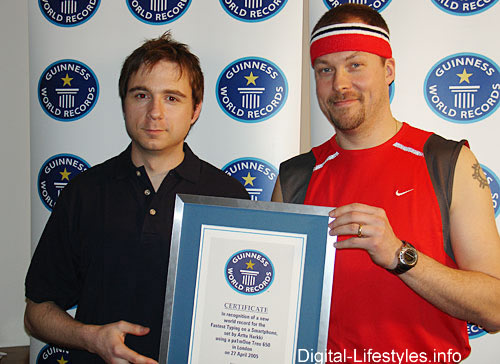
 AbbiTalk, a West Sussex-based provider of Voice Over IP (VoIP) telephony services, is talking tough about its cut-rate broadband call packages, that offer customers extra telephone lines with discount local and UK call charges and no line rental.
 Prices start at £149 for “AbbiTalkBasicOne”, which provides one extra phone line, a unique number with Pre Pay phone account, an adaptor and a DECT digital cordless phone with digital answering machine.
 No line rental is charged and there’s no need to use a computer to make the calls as these are accomplished through the standard cordless handsets.
 BBCi has launched a programming service for digital satellite viewers showcasing short films made by ordinary folk across the UK.
 Video Nation broke new ground when it first hit UK TV screens – running in short slots dropped in to the programming schedule.
 Content on the ‘Your Stories’ service is divided into daily themes, each with its own title. “My Music”, for example, featured an eight-year-old trumpet player and a blind pianist.
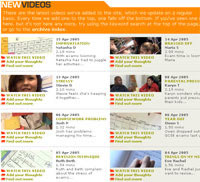 BBCi controller, Rahul Chakkara, explained the reasoning behind Your Stories service: “The BBCi audience is maturing, and is looking for content that is social and highly involving, available to them whenever they want.”
 Unlike several telecoms companies in the US who are hell bent on blocking free Wi-Fi hotspots, BT has stated that it has “no problems” with the concept.
 The network covers the length of Upper Street – one of the busiest streets in Islington – with the Council donating PCs to some local businesses as part of its push to boost economic activity in the area and to encourage local residents onto the Internet.
 Clark does not envisage US-style legal wrangling in the future for the UK and expressed confidence that if more people use Wi-Fi it will drive demand for BT’s services.
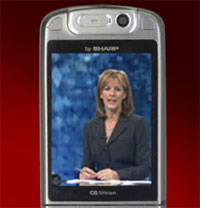 ITN is set to steal a march on its rivals by delivering up-to-the minute election analysis and comment through a partnership with Vodafone Live!
 Nicholas Wheeler, managing director of multimedia content at ITN, commented: “This is a new facility using mobile technology that was not available at the time of the last election.”
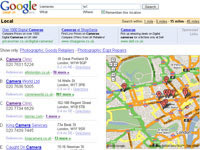
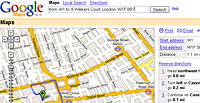 Web search goliaths Google have delivered a large size nine up the rear end of their fierce rivals Yahoo by being the first to launch a local search service in Britain.
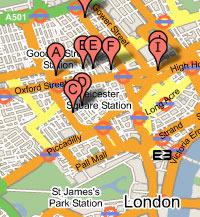 “It’s the first time we’re bringing local search to a country outside North America,” said Kate Burns, ad sales and operations manager for Google in Britain, declining to give details about launches elsewhere in Europe.
 Global search advertising revenue is already sending cash tills into overdrive, with US investment bank Piper Jaffray estimating spending to rise to US$7.9 billion (£4.1BN/€6bn) in 2005 from US$5.5 billion (£4.1bn/€4.2bn) in 2004 – with most of the growth coming from international expansion and higher volume.
 The latest National Statistics monthly update to the survey of Internet Service Providers (ISPs) shows that there was a 1.9 per cent increase in the number of active subscriptions to the Internet in the past year (Feb 2004 – Feb 2005)
 Permanent Internet connections rose to 43 per cent of all subscriptions in February 2005 (up 2 per cent from Jan 2005) with a year on year increase of 85.9 per cent for subscriptions for permanent connections.
 A government-backed study has revealed that more than one in 10 UK teenagers frequently use the Internet to look at “adult-only” Web sites.
 When it came to trusting the media, television was seen as the most trustworthy form of mass communication, with 48% trusting it completely or a lot.