 AOL is giving away hundreds of thousands of dollars of gold, cash and goods seized from a spammer as a warning to anyone thinking of “making a living sending spam to AOL members”.
In a story sure to win the hearts of anyone who faces a daily deluge of spam, AOL will be dishing out nearly US$100,000 (£56,000, €80,550) worth of gold bars and cash along with a fully loaded Hummer H2 – all the former property of an email marketer.
The US internet giants scooped the bounty as part of a settlement against a New Hampshire resident in a lawsuit filed under the Can-Spam Act.
AOL sued the (then) 20 year old spammer in March 2004 after several months of investigation, accusing the spammer of making a career of mass mailing millions of messages offering “ephedra, male enhancement pills and other dubious products”.
 The company said it managed to close down the dastardly spammer’s 40-computer enterprise thanks to help from its members, who enthusiastically clicked a “report spam button” to register their complaints.
The controversial Can-Spam Act provides Internet service providers with enough legal resources to get medieval on the outboxes of unsolicited e-mailers.
Under the Act, courts have the power to seize any property that a convicted spammer has obtained using money made through the offence, as well as grabbing computer equipment, software and technology used for illicit purposes.
AOL members and non-members living in the mainland US can sign up online for a chance at winning the goods until the 19 August, with the lucky winner announced shortly after.
“But this isn’t just a ‘thank you’ to members,” the company said in a statement. “It also serves as a message to anyone thinking of making a living sending spam to AOL members: AOL will find you and sue you.”
 Thanks to its aggressive mo’fo’ antispam filters, AOL has claimed that spam on their servers has fallen by more than 85 percent since its peak in late 2003.
AOL hasn’t finished with the New Hampshire mob yet though, with one of the spammer’s co-conspirators – believed to have a cool US$500,000 (£277,450, €404,750) stashed away – declared the “next stop on our spammer treasure map,” according to company spokesman, Nicholas Graham.
The US District Court for the Eastern District of Virginia in Alexandria has also issued a US$13m (£7.21m, €10.46m) judgment against other members of the New Hampshire resident’s gang.
AOL plans to donate the “high-end” computer equipment seized from the New Hampshire spammer to public schools near its headquarters in Northern Virginia.
It’s been a bad time for spammers recently, with Microsoft reaching a US$7m (£3.88m, €5.64m) settlement with former “spam king” Scott Richter, with the US$1m (£0.55m, €0.80m) of the payout being earmarked for community centres in New York and US$5m (£2.77m, €4.03m) being invested in efforts to fight Internet crime.
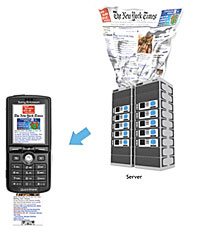 Norwegian browser brewers, Opera Software, have announced Opera Mini, a J2ME (Java 2 Mobile Edition) Web browser for “virtually all mobile phones”.
 The browser makes up for the feeble firepower of low end phones by using a remote server to pre-process Web pages before sending them to the phone, rather than trying to get the phone to process the pages.
 “With Opera Mini, the phone only has to run a small Java-client and the rest is taken care of by the remotely located Opera Mini server. With Opera Mini you don’t have to have an advanced phone to surf the Web, which means that most people can use it with their existing phones.”
 Patriotically, Norway’s leading commercial television station, TV2, have already bundled Opera Mini with its mobile services in Norway to offer its viewers a complete mobile content package with a branded Web browser.
 It used to be that artists rebelled against the system, the government, the breadheads and The Man, but artists signed to Sony in Japan are fighting their label’s decision not to make their songs available through the iTunes Music Store.
 Talks between the two electronic giants Sony and Apple are believed to be continuing to resolve the problem.
 Sony BMG’s global digital business president Thomas Hesse was full of optimism about the emerging opportunities brought about by digital distribution channels such as iTunes and ringtones.
 The Sony bigwig suggested that the record industry could learn from the movie studios where carefully-timed “release windows” have helped maximise commercial opportunities for new films.
 It’s farewell to film at Dixons, as the company announced that it would no longer stock 35mm film-based cameras.
 After reaching a peak in the UK of 2.9 million cameras sold in 1989, 35mm camera sales have been steadily falling, with the public being wooed by the convenience, improving quality and falling costs of consumer digital cameras.
 “Time and technology move on … digital cameras are now the rule, rather than the exception. We have decided that the time is now right to take 35mm cameras out of the frame,” Magrath added.
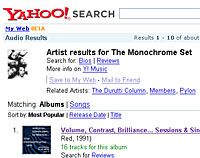 Yahoo is testing a new Audio search facility to let users find audio files on the Web.
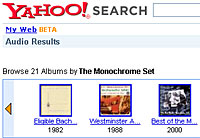 Although the service is still in beta we were impressed with its speedy and simple interface: typing in the name of one of my (sadly) obscure old punk songs immediately brought up the album details, a list of download locations and links to reviews and other released albums.
 Mobile operator 3 has announced a partnership with EMI Music UK to supply full-length music tracks directly to the three million customers on their network.
 The agreement will also enable customers to access music from EMI’s other UK labels which include Parlophone, Relentless and Virgin with the “hottest and freshest” 100 EMI Music UK’s tracks made available for downloading in either WMA or AAC format (depending on the handset).
 In a flurry of synergetic deals, Robbie Williams launched his single “Misunderstood” on the 3 network before it had been heard on TV or radio and Natasha Bedingfield and Rooster have also streamed concerts live to 3’s customers.
 Sony Ericsson’s boffins have come up with the cunning idea of creating phones which automatically change the way they behave, depending on the time, date and place.
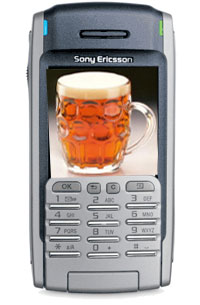 Travellers touching down in Glasgow airport may be ‘treated’ to a bagpipes ringtone courtesy of a GPS country location signal, or perhaps the phone might blast out some demonic black metal on arrival in the Norwegian hinterland.
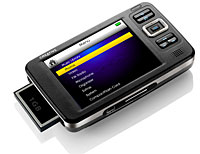 With the slap of a leather gauntlet against iPod’s shiny white face, Creative has unveiled its new Zen Vision a portable media player.
 The Zen Vision supports a slew of video codecs, including AVI, DivX, XviD, MPEG-1, MPEG-2, MPEG4-SP and Microsoft’s WMV9.
 Resplendent in its white or black finishes, the Zen is quite a looker, and is only slightly larger than the rival iPod.
 The pocket sized powerhouse comes with a rechargeable Li-ion battery offering up to 4.5 hours of video playback and 13 hours of audio, depending on the file’s format and energy settings.
 New US research claims that Americans are becoming increasingly “digital,” with over three quarters owning computers and many households verily humming with multiple digital electronics products, including cell phones to entertainment devices to cameras.
 The research was commissioned by hard drive manufacturer, Seagate, who were keen to remind users of their role in the digital revolution: