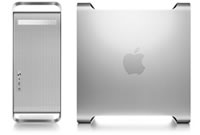
 “Now that Macs have PC chips in them, they can run PC software.” Obvious, isn’t it. Except that someone recently managed to make the new Intel-based Mac run PC software, and it’s a big, big surprise, and it’s something many said would never happen.
The difference between a PC and a Mac used to be the processor. PCs had Intel chips, Macs had Power PC chips; nothing like each other. The new Macs have Intel chips in them, which is why most people assumed that they are, really, “just PCs.”
They aren’t. What they are, are Extensible Firmware Interface Extensible Firmware Interface (EFI) machines. PCs, by contrast, are BIOS machines. They have a completely different way of starting up, and as recently as January, many well informed experts were quite sure the two systems couldn’t both exist on the same machine.
Others thought it must be possible.
 So Colin Nederkoorn announced a competition, back in January, to see if you could run both forms of software on the same machine. Techweb, quoting Nederkoorn: “When the Intel Macs were announced, I expected Apple would have the foresight to make it easy to dual boot,” said Nederkoorn. “But then I found out that Apple was using EFI rather than a BIOS. One group said it should still be possible, while a whole other camp said it was impossible.”
To make it interesting, he put up cash; he put $100 into the kitty,and called for volunteers to put up more. With over $5,000 as a prize, the trick was tackled, and it’s been done.
According to Associated Press reporter May Wong, the prize was given to two San Francisco Bay Area software developers last week. Jesus Lopez, 33, of Alameda, was one; and Eric Wasserman, 41, of Berkeley was the other; apparently Lopez “did most of the technical work — spending late nights and weekends on the challenge — while Wasserman, a devoted Mac user, introduced him to the contest in February and supported him in the process.”
The software to do it is downloadable from the Windows XP on an Intel Mac Project. Don’t rush over there to download it, even if you actually have an Intel Mac, because (as you can see from the How To) it’s not for beginners.
Why do it? Mainly, because it’s a more elegant way of running both families of software – Windows and Mac – without having to buy two machines, and without having to load a huge “virtualisation” engine plus emulators, to manage it.
No doubt, Linux users will write in to explain politely that if we all used Linux we’d be able to use EFI anyway…
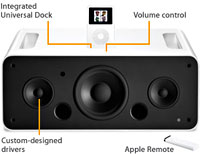 With a multitude of third party manufacturers making a mint from a multiplicity of iPod accessories, Apple has decided to cut itself a slice of the action with their own high-end Apple iPod Hi-Fi speaker system.
 With portability in mind, the iPod Hi-Fi features big handles on either side (but no central grip which is a bit odd).
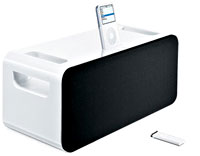 That shiny finish looks a bit scratchable to us too and we can’t imagine many death metal loving teenagers wanting a great big white box in their satanic bedrooms either.
 Mind you, Steve Jobs was suitably enthusiastic, declaring it as the, “home stereo reinvented for the iPod age”.
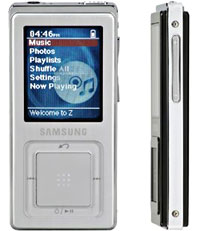 Due to hit the shelves in March, Samsung Electronics’ new YP-Z5 MP3 player is causing a stir because it was designed by Paul Mercer – the very same programming genius who created the interface for Apple’s runaway success, the iPod.
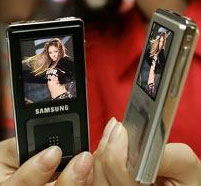 At $199 (~e167, ~£113) to $249 the pricing is similar Apple’s product, and – crucially – Samsung is promising a seamless connection between player and download service via Microsoft’s PlaysForSure digital music standard.”
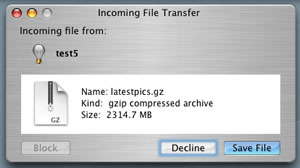 The days of smugness of Apple Macintosh users are coming to an end. Symantec is reporting that they’ve recently identified a virus for Macs. It’s a pretty rare occurrence, given there’s only been about 10 Apple viruses in the last 10 years.
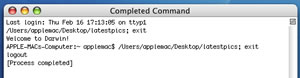 By identifying the four most recently executed apps using Spotlight, it uses this information to attempt to infect these files.
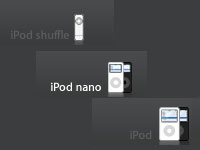
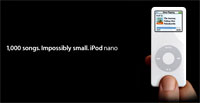
 Keen to further expand their vice-like grip on the portable digital music market, Apple have unveiled a cut-down 1GB version of their turbo box-shifting iPod Nano player.
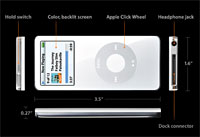 The new 1GB Nano can hold up to 240 songs or 15,000 photographs and comes with all the usual Nano features, including the colour display and docking connector.
 As Shaw Wu, an analyst with American Technology Research, put it: “Apple is selling a $69 MP3 player with the best software. How do you compete with that? It’s tough.”
 The iPod range continues to be an outrageously successful money spinner for Apple, with around 32 million iPods shifted last year, including 14 million during the holiday season.
 Apple have announced a competition to become the downloader of the 1 Billion th music track on iTMS.
 At the time of writing, we see on the live track count that they’ve sold just short of 950,981,000 tracks.
 You know we like to save you money when we can and for those with sharp eyes, you’ll see near at the bottom of the page in light grey (thanks Apple), “*No purchase necessary to win. Click here to submit a free entry form.” Following the link takes you to the form telling that you can indeed make up to 25 free entries a day. We’re not sure on the US rules for competitions, but we know in the UK that free entry is essential when there’s no skill involved with entering the competition.
 You may have heard about yesterdays launching of the latest UK warship – HMS Darling (its ninth incarnation), a Type 45 Destroyer.
 As well as all of the killing parts, it’s also got a cuddly side, which frankly is the side that interests us more. The 230 crew will be treated quite unlike any other Navy.
 If you’re interested in buying one, do let
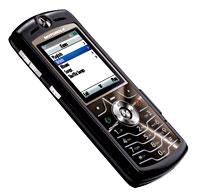
 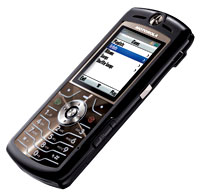 Four months after releasing their first iTunes-enabled mobile phone, the disappointing Motorola ROKR E1, Motorola have had another stab at creating the perfect music phone.
 The biggest complaint was the laughably feeble memory on the ROKR that could only hold a maximum of 100 iTunes songs – regardless of memory capacity – and a treacle-slow song transfer rate.
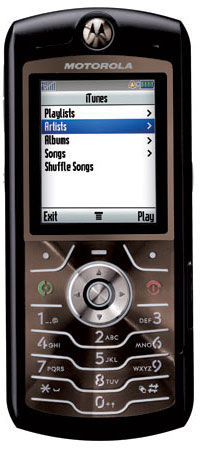 In a flurry of arty waffle, Steve Lalla, vice president and general manager for mass-market products at Motorola, explained that the, “L7 is really in what we call our ‘self-expression portfolio,’ where design and style is the key premise behind the product”.
 Over the last couple of weeks there’s been a lot of speculation that Disney are going to be bidding to buy Pixar, the digital animation studio that’s supplied the majority of Disney’s successful computer-generated animation successes.