 Speculators with a wad of cash might like to consider convert said cash into an ITV plc share holding in the next few days some feel.
Rumors in the city on Friday that BT was seriously considering making a bid for the UK’s top-rated commercial broadcaster have already driven the ITV share-price up. While this particular risk adverse suitor might not make the deal, ITV is looking an increasingly attractive proposition to a variety of companies.
Even without a takeover, ITV has been tipped by financial commentators to outperform the sector having come out the other side of a restructuring process as a more focused media company.
 BT, despite having previously stated that it has no desire to enter the content market, needs to consider the competition from both BSkyB and a revitalised NTL. This could force BT’s into making an early move before other predatory companies come out of the shadows but will need to balance this against the cost of such an acquisition.
Google has already done a deal with ITN, part owned by ITV (and its contracted news provider), to access the company’s extensive archives and is busy beefing up an alliance to take on Microsoft and Yahoo.
Away from the ‘Search goliaths’, mobile companies also see an opportunity in DVB-H TV services. This would provide revenues but the mobile operators would be in a position where they’d need to split revenues with broadcasters or content owners. Perhaps they would like to get a hold of a strong broadcaster to pay for those expensive licenses?
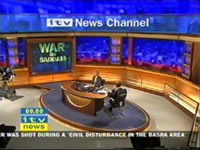 Unlike Sky, which is principally a broadcast platform owner and call centre operator, ITV actually has what companies with desires to be fully-grown media giants badly need; content and a fifty year plus heritage of making TV programmes.
Until a financially-pressed Chancellor of the Exchequer looks at the anomaly that is the Channel 4 company (effectively a state owned UK TV company), there’s not a lot else available in Europe that sustains close scrutiny. The UK’s Channel 5 is embedded with RTL and it is unlikely that the BBC will be considered for privatisation until after the next Royal Charter is granted.
In the current frenzy of consolidation, ITV a relative minnow in global terms is sure-fire shark bait to Telcos, mobile operators and Internet giants.
 Factory sales of consumer electronics are set to soar to a record high of $135.4 billion (~£77bn ~Ä112) in 2006, according to the Consumer Electronics Association’s annual industry forecast.
 Projections for 2006 and year-end figures for 2005 are included in CEA’s bi-annual US Consumer Electronics Sales and Forecasts report, released every year at the International CES and updated mid-year.
 In 2005, DTV sales grew 60 percent to $17 billion, with the market fuelled by the growing popularity and competitive price declines of flat panel LCD and plasma displays, which accounted for 40 percent of all DTV sales.
 “MP3 technology helped boost the audio and accessories markets in 2005. With the introduction of video playback capability, MP3 player sales surged 200 percent in 2005 to $3 billion. Trends in 2006 should be no different,” he added.
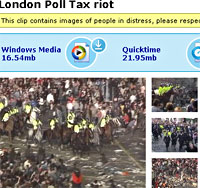
 The BBC has announced its Open News Archive, making archive news reports freely available to the UK public to download and use for free in their own creative works.
 Made available under the terms of the recently-launched Creative Archive Licence, the footage can be viewed, downloaded, edited and mixed by UK residents – so long as it’s for non-commercial programming (there’s also several other caveats that budding film makers should read first
  Helen Boaden, Director, BBC News, said: “This trial is an important step in allowing us to share with our audiences the extraordinary news archive which the BBC has recorded over the years. We look forward to getting their reaction.”
 The BBC already offer nearly a hundred clips in their
  Internet auctioneer eBay have cancelled their plans to allow live pets to be sold on its Web site after receiving a barrage of complaints from users.
 As company spokesman Hani Durzy explained, users were concerned that the listings would encourage unsanitary ‘puppy mills’, where animals are sometimes bred in less-than ideal conditions, and that it might prove difficult working out legitimate animal shelters and the get-rich-quick scamsters.
 After a flurry of rumours and speculation, AOL and Google have announced that they have sealed the deal on an extended partnership deal, which sees Google shelling out $1bn for a 5% stake in AOL.
 Naturally, the synergistic shufflings don’t stop there, with plans being unveiled to make the two companies’ instant messaging tools work with each other and for Google to include AOL video in its video search database.
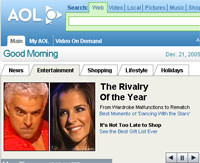 Sitting red faced in the corner and looking like a chump through all of this is Microsoft.
 BT has been hit by two further blows, bringing into stark relief the height of the mountain it must climb to achieve its TV ambitions. Secondarily, drawing into sharp focus the changing landscape for domestic phone calling, as the competition begins to consolidate.
 Separately, a consolidating Carphone Warehouse has been on the acquisition trail and agreed the purchase of Tele2’s UK and Ireland operations, and separately, Onetel.
 The purchase of Onetel from Centrica for £132 million includes £37.1 million, while will be delivered if Centrica deliver a targeted number of customers in the next three years via its British Gas operations. The Carphone Warehouse will also pay Centrica an additional £22.2 million if higher sign-up targets are met.
 Here at Digital Lifestyles, we expect competition to be even fiercer in 2006 as both BSkyb and the Telcos battle to capture high spending subscribers.
 In the week that BT and Sky both saw their triple play offerings potentially trumped by a possible NTL/Virgin ‘quadruple play’, BT chose to release details of its upcoming content deals with BBC Worldwide, Paramount and Warner Music Group.
 Against a backdrop of whispered rumours of delays with Microsoft’s IPTV Edition, the BT service is slated for launch next year.
 Problems won’t be confined to BBC programmes if ITV programming is carried, advertisers are bound to be unhappy that time-shifting viewers will skip the paid for messages.
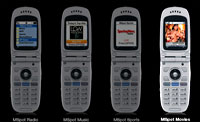 Sprint and MSpot, have announced the launch of MSpot Movies, a new service which streams mobile-optimised feature films to mobile phones.
 The streaming content will be cut up into ‘chapters’ (short segments optimised for a mobile audience) and will also include music concerts and stand-up comedy specials.
 Although there’s no denying that mobile video is set to grow – Strategy Analytics reckon they’ll be 150 million viewers by 2008 – we really can’t raise much enthusiasm at the prospect of burning up our bandwidth by watching a selection of crap movies on a tiny screen in 5 minute chunks.
 A US federal appeals court has upheld the mammoth $22,500 (£12,760, €18,930) fine slapped on a 29 year old Chicago mother caught illegally distributing songs over the Internet.
 After Ms Gonzalez rejected an earlier proposed settlement from music companies of about $3,500 (£1,950 €2,950), a federal judge later filed a summary judgement ordering her to shell out $750 (£425) for each of 30 songs she was accused of illegally distributing over the Internet.
 Ms Gonzalez’s case was part of first wave of civil lawsuits filed by record companies and their trade organisation, the Recording Industry Association of America (RIAA), back in September 2003.
 Takeover mania isn’t confined to one side of the Atlantic; Liberty, the media group that includes QVC and holds a majority stake in IAC/Interactive Corp, is buying Provide Commerce whose mission is “To become the leading e-commerce marketplace for the delivery of perishable products direct from the supplier to the consumer,” whatever that means.
 The Liberty purchase, is subject to approvals from US regulatory bodies as well as Provide Commerce shareholders, if all obstacles are cleared then the acquisition should complete in the second quarter of 2006.
 Bill Strauss Provide Commerce’s CEO was equally direct,