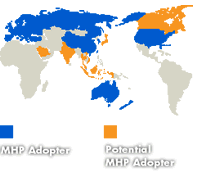
 Natalie Mouyal of DigiTAG follows up on her previous piece on Wednesday that reviewed the current position of MHP services in Europe.
As MHP-based interactive services are launched throughout Europe, will they encourage the uptake of digital television services? Country case-studies demonstrate that the strategy adopted for the launch of interactive services does impact the roll-out in the market. Two different types of launch strategies can be used for the free-to-air DTT platform.
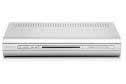
In a first strategy, national governments focus on the roll-out of digital terrestrial services using simple (zapper) set-top boxes that converts the digital signal for reception on an analogue television set. This strategy encourages the uptake of DTT services by promoting the purchase of a relatively inexpensive zapper set-top box in order for viewers to access an increase in the number of television programme services. Once the DTT services are accepted by the general population, broadcasters can launch interactive services in a second step. However, this strategy results in a large quantity of zapper boxes in viewer households that will need to be converted in order to access interactive services.
In a second strategy, interactive services are an integral part of the initial launch of DTT services and viewers are educated to understand that television can provide a wide range of new services. DTT is no longer a simple translation of a previously existing television services but rather a new television experience. However, this strategy requires a greater financial investment given the higher cost of an MHP-enabled set-top box when compared with zapper set-top box.
 Generally, countries have tended mix the two strategies. Viewers have benefited from both an increase in the number of television service programmes available, as well as interactive television services. Yet, this combination has not always allowed for an impressive take-off of MHP based interactive services. In the case of Finland, consumers could choose between a zapper set-top box that allows them to access more television service programmes or an MHP-enabled set-top box that allows them to access both the increased number of television services programmes as well as the interactive services. However, MHP-enabled set-top boxes make up only 5% of all set-top boxes currently purchased.
So as to encourage viewers to buy MHP-enabled set-top boxes, the Italian government has provided households with a subsidy towards the purchase of their interactive set-top boxes. While this subsidy can be used for any open platform interactive boxes, such as those used to receive TV via fibre optic broadband services, it has encouraged the purchase of MHP-enabled set-top boxes. It is estimated that 1.5 million MHP-enabled set-top boxes have already been purchased since February 2004. In addition, the decrease in subsidy from €150 (~US$190 ~£102) in 2004 to €70 (~US$95 ~£51) in 2005 reflects the drop in price for MHP-enabled set-top boxes following their massive uptake.
The consumption of MHP-enabled set-top boxes has kick started the economies of scale for their manufacture. The marginal cost difference for an MHP-enabled set-top box and a zapper set-top box is now much reduced. By adopting this strategy, the Italian government has successfully prevented its market from being flooded with simple zapper set-top boxes.
 It has been assumed that many consumers will invariably prefer the cheaper zapper set-top box to a more expensive MHP-enabled set-top box. However, this reasoning disregards the type of interactive services offered. For example, should viewers find interactive services compelling and easy to use, they may be willing to spend the extra money necessary for an interactive set-top box. Thus, it would seem that consumer education is key to the successful roll-out of interactive services.
Much will depend on the role and importance attributed to interactive services. Should governments wish to promote t-government services, it is necessary to encourage households to purchase an interactive set-top box. Broadcasters may use interactive services as a means to increase their revenue and as a result invest funds in the development of appealing content. The priorities of content developers, broadcasters and governments will impact the successful roll-out of interactive services and likely lead to variations between markets.
Natalie Mouyal, works for Digitag
 The BBC has let rip with a new beta service that invites Web developers and designers outside of the organisation to start fiddling about with their content and “create cool new things”.
 The UK broadcasting goliath made a commitment to support social innovation in response to last year’s Graf Report, and this is echoed in their plans to develop an open community where people can share expertise, ideas, and collaborative efforts.
 It’s not all about profit though, with the BBC hoping that contributors will create prototypes on their Web sites to be freely shared with others for non-commercial use.
 Microsoft ubermensch Bill Gates foresees mobile phones overtaking MP3s as the top choice among portable music players, while dismissing the popularity of Apple’s iPod player as unsustainable.
 “If you were to ask me which mobile device will take top place for listening to music, I’d bet on the mobile phone for sure,” Gates told the newspaper.
 Xbox 360, Microsoft’s successor to their popular Xbox gaming console, will be “unleashed” tonight at a celebrity-packed launch broadcast on MTV, which shows at 8pm in the UK. It was launched on US MTV last night.
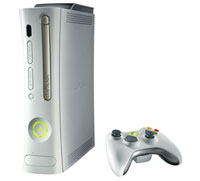 The Xbox will ship with a 12X dual-layer DVD-ROM drive – supporting progressive-scan DVD movies and a host of DVD and CD formats – three USB 2.0 ports, two memory unit slots and support for four wireless game controllers.
 “Xbox 360 marks the beginning of a renaissance in video games,” whooped Don Mattrick, president of Worldwide Studios for Electronic Arts. “The unbelievable Xbox 360 games in development at Electronic Arts will accelerate the industry’s mission to make video games the pre-eminent form of all entertainment.”
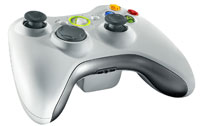 Naturally, gamers love to customise their experience, so there’s a camera option to let vain players add their mugshots into games or even see their friends onscreen as they frag them to an inch of their worthless lives.
 Xbox 360 players can also access recorded TV and digital movies, music, video and photos stored on Windows XP Media Center Edition 2005-based PCs through any Xbox 360 system in the house.
 Telewest Broadband today announced plans to transform its TV service, giving consumers greater access and control over additional digital programmes.
 There will also be a mix of free and subscription services including popular TV series, music videos and niche content.
 Eric Tveter, president and chief operating officer at Telewest sunk deeper into his deluxe executive chair and glossed: “We are transforming TV as we know it by giving consumers both a superb choice of programmes and the flexibility to watch them whenever they want. We don’t ever want to hear our customers say there’s nothing on the box or that they have missed their favourite programme.”
 Microsoft has unveiled Windows Mobile 5.0, a new version of its Windows operating system for mobile devices.
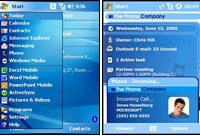 Although the underlying software code remains 90 percent the same as its predecessors, the new Windows Mobile removes some technological distinctions that gave the phone and PDA platforms different capabilities.
 Swivel action business folks will appreciate updates to the mobile versions of Microsoft Word and Excel, with the software providing more consistent formatting of documents created on a computer and allowing charts to be created from a spreadsheet.
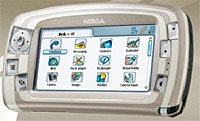 NTL Broadcast and O2 have revealed the first batch of channels to be part of their forthcoming mobile TV trial in the Oxford area, announcing an initial 16 channels including Cartoon Network, CNN, Discovery Channel, Sky Sports News and Sky Travel.
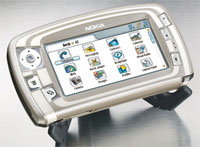 To support the trial, NTL Broadcast is building a new broadcast network of eight DVB-H transmitters to cover 120 square km around Oxford that will enable the lucky participants to receive digital television on the move. To enable a commercial service to be launched in the UK, Ofcom will need to license spectrum and O2 is already lobbying the UK regulator to bring forward plans to distribute radio frequencies for mobile TV services.
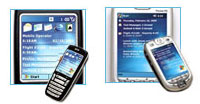 If you’ve ever accessed the Web through a mobile phone or PDA, you may be familiar with the annoyance of finding some sites inaccessible, hard to read or just a right royal pain in the Bluetooth.
 “Mobile access to the Web has been a second-class experience for far too long,” Web founding father and W3C director Tim Berners-Lee said in a statement. “MWI recognizes the mobile device as a first-class participant, and will produce materials to help developers make the mobile Web experience worthwhile.”
 “Web access today is so fundamental, that it shouldn’t be hampered by wires,” table-thumped Philipp Hoschka, W3C’s deputy director for Europe.
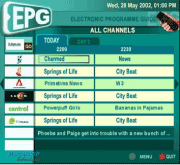 In Austria, a DTT trial with MHP-based interactive services provided 150 households in Graz with access to an interactive television service called !TV4 using the telephone connection for the return channel. Using their television remote control, viewers could retrieve information services and vote. Given the success of the trial, it is likely that MHP-based interactive services will be launched alongside DTT services.
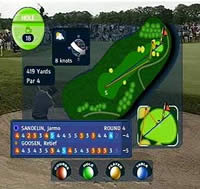 Of course MHP is not the only interactive television service system in the market. Proprietary systems such as MediaHighway and OpenTV have been installed in a large number of set-top boxes, often for cable and satellite platforms. In the United Kingdom, the MHEG standard is widely used on the terrestrial platform. As a result of the various products and services in the market, the DVB Project has been working on the development of the Portable Content Format (PCF) to deliver a wide range of interactive television services to multiple platforms with a minimum of re-authoring. It has significant interest for operators who wish to migrate towards MHP by allowing them to manage simultaneously a mixed population of devices.
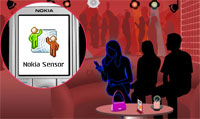 Going up to people and actually introducing yourself has become, like, so uncool with the introduction of the Nokia Sensor Bluetooth widget.
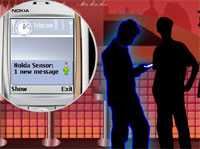 The Sensor app comes with the usual yoof-tastic features, like Buddy Alerts, which tells you if someone you know is nearby (isn’t that what eyes are for?) and ‘Group Codes’ which bleep when someone with similar interests is lurking in the area.