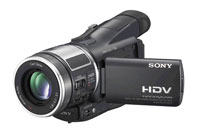
 Pausing briefly for breath after announcing the new PlayStation today, the busy bees in the Sony hive have announced the world’s smallest and lightest high definition consumer camcorder with full HD resolution based on HDV 1080i.
The HDR-HC1 is the second consumer HD camcorder from Sony with the company hoping its lower price and size will help popularise the HD video recording format.
With some skilful spatial jiggery-pokery, Sony have managed to squeeze the camcorder’s size down to less than half that of their current model, the HDR-FX1, with the price falling substantially too.
The price and size economies were brought about by replacing the 3 CCD sensors with a single CMOS image sensor – a cheaper, simpler optical system that doesn’t require a bulky prism to split the image to each of the sensors.
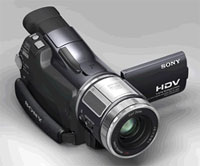 The new camera also uses a smaller and more compact Carl Zeiss lens, with a diameter of 60mm compared to 92 mm on the previous model.
The lens offers a 10X optical and 120X digital zoom, zoom ring, zebra pattern and spot focus with manually adjustable white balance, shutter speed and focus.
Depending on the recording mode, the camcorder can provide around 90 minutes of continuous recording.
A 2.7in wide hybrid, touch-panel LCD screen allows access to menu options, with an option to switch between 16:9 and 4:3 aspect ratios (in DV mode) to see exactly how the content might look on television.
There’s also a built-in microphone, pop-up flash, Super SteadyShot image stabilisation and Sony’s Super NightShot Plus Infrared System for filming in low/no light conditions.
 A Memory Stick PRO Duo media slot is provided for transferring images captured on the camcorder’s 2.8-megapixel still camera.
Even with all these features, Sony’s engineers have managed to reduce the size of the camera’s electronics, cutting the 5 circuit boards down to 2 and reducing the total component count from 3,000 to 2,000.
This has been achieved with some nifty integration of components into chips, said Sony.
All of this has made the HDR-HC1 into a tiny little puppy, measuring just 71 x 94 x 188mm, and weighing a mere 680g without the battery – compare that with the previous bruiser of a camcorder that measured 151 x 181 x365 mm and weighed a muscle building 2kg.
Like its predecessor, the HDR-HC1 is based on the HDV format, which uses current-generation DV tapes to store high-definition video.
DV tapes are completely compatible and can hold the same amount of video under HDV as they can under standard definition, offering advantages to current DV camcorder users looking to preserve their investment in recording media.
HD video connectivity comes in the shape of Y/Pb/Pr component video signal, Japanese D3/D4 format signal and a 4-pin iLink interface.
This output can be streamed to high-definition compatible monitors and televisions with an HDV iLink interface.
The HDR-HC1 will be launched in Japan in early July and in North America, Europe and Asia around the same time. Although costing is not confirmed, it’s expected to roll out for 180,000 Yen in Japan. (~£915 ~US$1,680 ~€1,328).
 The Nokia 6680 imaging smartphone has been declared the new ‘Best in Class’ 3G device according to a report by Strategy Analytics.
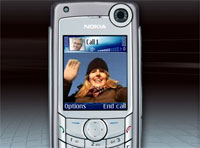 The report noted strong deviations (oo-er!) in the results of these evaluations by gender with the lay-deees preferring the Sony Ericsson and NEC devices, whereas the geezers exhibited a strong preference for the Nokia and Motorola handsets.
 Microsoft has released the final version of MSN Desktop Search, offering new features based on extensive user feedback and boasting extended support for file types.
 These advanced indexing options also let users specify file types to be indexed as text, create a list of file types that should not be indexed, decide the location of the index file and boost the priority of the indexing process (although this may cause some PCs to run as slow as a tired sloth on Mogadons, but at least it can be turned off).
 As is the norm with search toolbars, there’s a pop up blocker and form-filler installed, although there’s still no Firefox-style tabbed browsing on offer, although MSN says it will be added soon.
 Sony has unveiled prototypes of their new Playstation 3 console at the Electronic Entertainment Expo (E3) in Los Angeles.
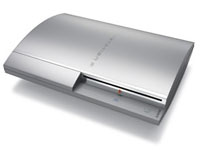 Sony are currently collaborating with the world’s leading tools and middleware companies, to provide developers with extensive tools and libraries to make the best of the Cell processor and enable efficient software development.
 More and more people are using computers or portable players for music, even though traditional radio still leads the competition, according to a recent market study.
 Last week, Yahoo revealed their determination to become big noise in the music industry, unveiling a
 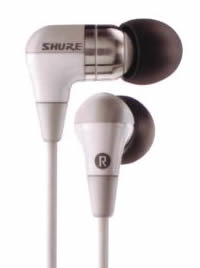 Shure have just released their E4c earphones. These are the in-ear type with various mouldings (sleeves) that fit on to the actual phones so you can get a comfortable fit.
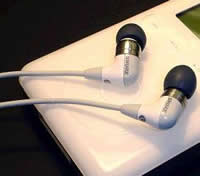 While sitting on the underground you could just hear the station announcements on the public address system, but not much else. The music playing was ambient dance music and you could really make out the nuances etc. Unfortunately the only downside of blotting out everything made you realise even more how miserable everyone looked.

 BBC New Media is to extend trials of its interactive Media Player (iMP), allowing viewers to download material from 500 hours of its television and radio programming.
 The 5,000 trialists will be able to search for programmes they want to watch, filter programmes by channel, select subtitles and, in the case of some series, to collect and watch episodes that they may otherwise have missed.
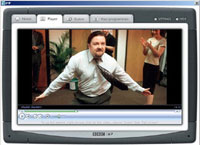 The pilot will use DRM software to delete programmes seven days after the programme has aired on TV, ensuring that users can no longer watch the content after that time. The digital rights system will also prevent users emailing the files to their chums or sharing it via disc.
 AOL today trumpeted its intention to muscle into the UK phone business with the launch of a home service offering unlimited calls for an introductory flat rate of £7.99 (~US$14, ~€11) per month.
 Johnny-come-lately subscribers signing up after 30 June 2005 will pay this standard monthly subscription fee.
 Microsoft has announced that it would begin testing OneCare Live – a PC-health care fix-it all application – with a general release sometime next year.
 OneCare is a separately sold subscription-based service designed to work as a mainly “hands-off” application, quietly doing its good deeds in the background while sending security updates to users’ computer systems without them having to download or install the fixes.