 Their glorious football team many not be first at anything much these days, but BT have announced that Cardiff and the surrounding area will lead the UK with the implementation of their 21st Century Network (21CN).
The £10bn investment will roll out the next generation of converged communications, including telephone calls, broadband and Ethernet services delivered through an Internet-based platform.
The investment will end BT’s dependence on telephony through on Ye Olde public switched telephone network (PSTN) and should – in theory – result in cheaper telephone bills for its customers.
What is this 21CN thing, do I hear you ask?
Here’s how BT describe the technology:
“BT’s 21st Century Network (21CN) is a global IP infrastructure, based upon multi-protocol label switching (MPLS), that carries voice, data and Internet services on a single network. The 21CN offers multiple services across a single network, rather than today’s multitude of networks offering specific services.”
“For BT, this will mean fewer network elements overall and require simpler network management. For BT’s customers, the 21CN will deliver more choice, control and accessibility, as well as increased flexibility, reliability and security.”
 BT is expected to begin migrating around 350,000 customer lines in the area during the second half of 2006, with the 21CN programme requiring the replacement of equipment in more than 50 local exchanges along with the implementation of new IT systems to make the technology do its stuff.
Ask BT competitors what 21CN is and you’ll get quite a different answer. Their view is that it is effectively the death of meaningful competition in the UK and that once BT has it in place there will be no incentive to try and unbundle exchanges.
Three cool-sounding “metro nodes” (super telephone exchanges) are to be developed in Cardiff, Swansea and Newport, with 10 new transmission sites also being developed across the region. These will be assessed for power supply, space and logistics planning before the ‘on’ switch is pressed.
First Minister Rhodri Morgan purred, “It’s incredibly exciting for us that Wales has been selected to provide the test bed for BT’s new 21st Century Network This investment by BT clearly signifies that Cardiff and central South Wales is one of Europe’s most dynamic and progressive regions. The end result will transform our personal and business lives, and help attract high-tech industry and services to Wales.”
Matt Bross, BT group’s chief technology officer, said, “This roll-out will be the first time anywhere in the world that customers will have communications services provided over such a radical next generation network.”
“The operational experience that we gain in Cardiff and the surrounding area will enable us to move full steam ahead and deliver 21CN to everyone in the UK – migrating a total of 30 million lines – in just four years.”
“It’s an enormous technical and operational challenge, but will enable customers to benefit from compelling new services.”
How the installation and implementation of the service – and the customer feedback – works out will help BT finalise plans to roll out 21CN to customers across the UK by the end of the decade.
 In a pretty gung-ho move that shows a lot of seriousness, the US Department of Justice (DoJ) have announced the results of Operation Site Down. More than 20 raids occurred in Australia, Belgium, Canada, Denmark, France, Germany, Israel, the Netherlands, Portugal and the UK, as well as 70 in the USA.


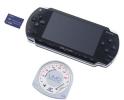 Sony’s PlayStation Portable is a media hub, but unfortunately, apart from games there isn’t really any content available for it (not forgetting unlucky UK citizens who can’t even officially buy one until September).
 Using an Apple Mac has many advantages and ripping DVDs is one of them. Look for an application MacTheRipper, it does exactly what is says on the tin, and takes the MPEG2 information from a DVD while removing region coding, macrovision and other DVD annoyances and stores the resulting files on the hard disk.
 Windows users don’t despair
 It’s not surprising that when an entrepreneur sees something as successful as Skype has been, (you can’t see over 127m downloads in any other way), that the word opportunity is writ large in their eyes. This is especially when that person likes disrupting legacy business models, such as the phone system.
 The big differentiator between Gizmo Project (a temporary name – they’re asking for suggestions) and Skype is Gizmo uses the open standard of SIP (Session Initiation Protocol, for those who really want to know), as opposed to the proprietary method Skype uses. This goes after Skype in the only way it can.
 Skype has done well in encouraging other companies to build extra software and importantly, hardware including phone handsets (
 AOL launches video search service
 Podcast subscriptions have rocketed over the one million mark, with figures from Pew Internet and American Life suggesting that over 6 million Americans – nearly a third of the estimated 22 million owners of MP3 players – have listened to podcasts.
 Life on the Web going to get considerably faster for some denizens of London, thanks to an ultrafast 24Mb broadband connection offered by Be* Unlimited.
 Cable company Telewest Broadband is making Teleport, its TV-on-demand service, available to over 26,000 customers in Cheltenham and Gloucester today.
 Teleport Movies offers around 200 current and library films from FilmFlex, with rental charges costing between £2.00 (~$3.59, ~€3) and £3.50 (~$6.28, ~€5.20) for a 24-hour rental period.
 Eric Tveter, president and CEO of Telewest, mused: “Teleport has arrived and it’s genuinely going to change the way people watch TV. The schedule normally dictates viewing, but our customers will have the choice and convenience of a service they can tailor – it’s TV on their terms.”
 Quake to be ported to 3D-enabled mobile phones
 Bluetooth group offers security tips to avoid attacks
 Etch A Sketch makes a comeback on mobile phones
 A study from mobile media firm Enpocket, asked which medium consumers would give up last if they had to choose between TV, newspapers, mobile phone, the Internet, radio and magazines.
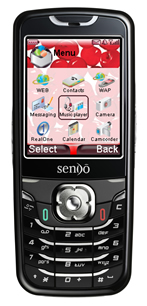 It’s not everyday a new mobile handset company comes along, so it was sad news to hear that Sendo, a relatively new entrant, had gone into administration. Motorola weren’t slow to see a good buy, and purchased it by the afternoon. Guy Kewney takes us through the reasons.
 Partisan thinking is also behind
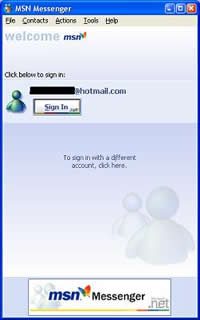
  The ability to disconnect from the world has taken a further blow as Vodafone and Microsoft announce a global tied up to offer MSN Messenger IM to Vodafone’s mobile phone customers. People sitting at their MSN Instant Messaging (IM) client on their computers will be able to carry out chats with their Vodafone carrying chums.
 Putting on his best tech-savvy face, Peter Bamford, Chief Marketing Officer for Vodafone glowed, “IM is a growing part of the increasingly important mobile messaging market. By bringing our collective customers together, we’ll deliver more options for staying in touch when messaging. Our agreement will grow IM and SMS, meaning additional revenue for Vodafone.”
 While we didn’t get to any exact figures, we were able to find out the service will be charged on the basis of each message sent. This will cause current IM users to radically change the way they use IM. No more will they be quickly replying with short witticisms, but will need to become more Bard-like in their compositions – if they don’t want to end up with huge bills at the end of the month.